In the last ten years, there has been a dramatic shift towards digital banking, with neobanks being one of the most rapidly expanding financial technology. Customers of neobanks, in contrast to those of traditional banks, have access to a wide range of online services through the use of mobile apps and web-based platforms, which greatly enhances the efficiency and convenience of these services.
With neobanks, you can open an account in a flash and get budgeting, international money transfer, and financial guidance powered by artificial intelligence. In addition, neobanking apps are encouraging smart banking and changing the game when it comes to managing customer finances. Forecasts indicate that the worldwide neobanking industry would expand from its 2025 valuation of USD 210.16 billion to a whopping USD 7.66 trillion by 2034, a compound annual growth rate (CAGR) of 49.3 percent. In 2025, Europe will have the biggest portion of the market at 37.2%, but by 2032, the neobanking industry in the US is predicted to have grown substantially and be worth about USD 302.0 billion.
About Neobank
A neobank is a cutting-edge bank that provides banking services via digital channels such as mobile apps. Neobanks aim to provide quick and inexpensive financial services and products to everyone who needs them, rather than relying on a network of physical locations like traditional banks do.
Most neobanks either:
- Operate with a banking license
- Partner with licensed banks using Banking-as-a-Service (BaaS)
Common services include:
- Digital savings accounts
- Current accounts
- Virtual debit cards
- International transfers
- Bill payments
- Personal finance management
- Budget tracking
- Loans
- Investment options
Popular examples include Chime, Revolut, Monzo, N26, Nubank, and Starling Bank.
Why Are Businesses Investing in Neobank Apps?
Neobank is becoming more popular by the day as more and more people want digital solutions for all of their financial demands. Businesses that offer neobanking services can provide their consumers many benefits by utilising digital banking and other similar services. Some of these advantages are:
- Lower operational costs than traditional banks
- Faster customer onboarding
- Reduced paperwork
- Better customer engagement
- Data-driven financial insights
- Global market reach
- Subscription and interchange revenue opportunities
- API-driven integrations
Digital banking has shifted from being a convenience to becoming a standard expectation among modern consumers.
Key Factors Affecting Neobank App Development Cost
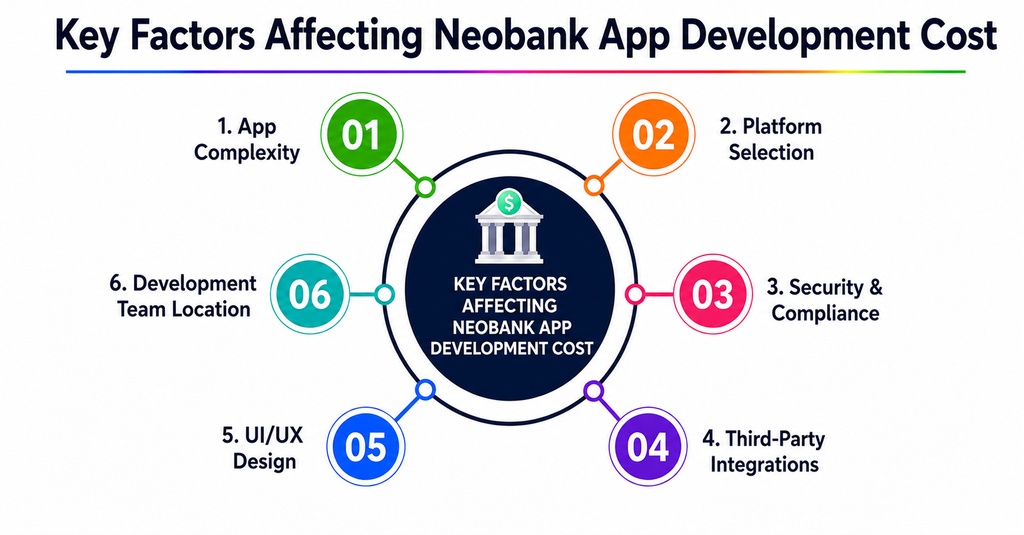
No two fintech applications are identical. The total development cost depends on several technical and business factors.
The complexity of your application significantly impacts development costs.
Basic Neobank
Includes:
- User registration
- KYC verification
- Account dashboard
- Transaction history
- Money transfers
- Notifications
1. App Complexity
Estimated Cost: $40,000–$80,000
Mid-Level Neobank
Additional features include:
- Debit card management
- Budget tracking
- QR payments
- Bill payments
- Analytics
- Customer support
Estimated Cost: $80,000–$150,000
Advanced Neobank
Includes:
- AI financial assistant
- Cryptocurrency support
- Investment portfolio
- Lending platform
- Open Banking APIs
- Wealth management
- Fraud detection
- Multi-currency wallets
Estimated Cost: $150,000–$350,000+
2. Platform Selection
Development costs vary depending on the platforms you choose.
| Platform | Cost Impact |
| Android | Medium |
| iOS | Medium |
| Web Portal | Additional Cost |
| Cross Platform | Lower than native |
| Native development | Higher |
Launching on multiple platforms increases development effort but expands your potential user base.
3. Security & Compliance
Financial applications require robust security measures to protect user data and comply with industry regulations.
Essential security features include:
- End-to-end encryption
- Multi-factor authentication (MFA)
- Biometric login
- PCI DSS compliance
- GDPR compliance (where applicable)
- AML (Anti-Money Laundering) checks
- KYC verification
- Secure APIs
- Role-based access control
- Fraud monitoring
Security implementation can account for a significant portion of the overall development budget because it requires specialized expertise and ongoing compliance efforts.
4. Third-Party Integrations
Most neobank apps integrate with external services for identity verification, payments, notifications, analytics, and customer support.
Common integrations include:
- Payment gateways
- Banking APIs
- KYC providers
- SMS and email services
- Push notifications
- Analytics platforms
- Customer support tools
- Card issuing services
- Accounting software
- Currency exchange APIs
Each integration may involve additional development time, testing, and ongoing service fees.
5. UI/UX Design
An intuitive and visually appealing interface is essential for user trust and engagement in a financial application.
A comprehensive design process typically includes:
- User research
- Wireframing
- Interactive prototypes
- Design systems
- Accessibility improvements
- Responsive layouts
- User testing
High-quality UI/UX design can improve customer retention and reduce on boarding friction, making it a worthwhile investment.
6. Development Team Location
The location of your development team also influences project costs due to varying hourly rates across regions.
| Region | Average Hourly Rate |
| North America | $ 100 – $ 200 |
| Western Europe | $ 80 – $ 150 |
| Eastern Europe | $ 40 – $ 80 |
| India | $ 25 – $ 60 |
| Southeast Asia | $ 20 – $ 50 |
Partnering with an experienced offshore development company can help optimize costs while maintaining quality, provided the team has expertise in fintech and regulatory compliance.
Essential features of a Neobank App
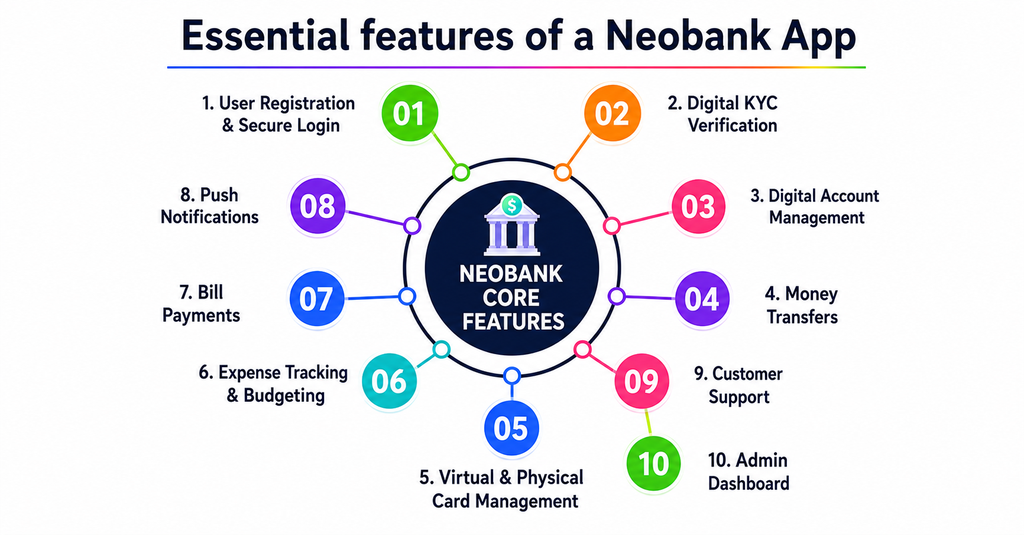
Providing customers with a safe, easy, and feature-rich digital banking experience should be the primary goal of any neobank app. The neobank app must have certain qualities in order to cater to the target demographic and the banks’ business strategies. A competitive neobank app needs the characteristics listed below.
1.User Registration & Secure Login
Streamlined and user-friendly onboarding that abides by all applicable financial requirements is essential. A minimal set of documents should be required for verification in the process without sacrificing security or know-your-customer (KYC) checks.
Key Features:
- Email and mobile number registration
- Social login (optional)
- OTP verification
- Biometric authentication (Face ID/Fingerprint)
- Multi-Factor Authentication (MFA)
- Password recovery
- Device management
2. Digital KYC Verification
In order to streamline the onboarding process and cut down on human interaction, it is recommended that, wherever feasible, identification verification be automated.
Features Include:
- Government ID verification
- Selfie verification
- OCR-based document scanning
- Face matching
- Address verification
- AML screening
- Risk profiling
Benefits:
- Regulatory compliance
- Reduced fraud
- Faster account activation
- Better customer trust
3. Digital Account Management
The goal of the user-friendly dashboard is to provide consumers with complete command over their financial situation. It is important for a mobile dashboard to be responsive and user-friendly.
Capabilities
- Account balance
- Mini statement
- Transaction history
- Download account statement
- Beneficiary management
- Multiple account support
- Multi-currency wallets
4. Money Transfers
Any neobank app worth its salt will have features that allow users to send and receive money.
Supported Transfers
- Bank-to-bank transfer
- Peer-to-peer (P2P)
- QR payments
- Scheduled payments
- International remittances
- Instant payments
- Recurring transfers
Additional features include:
- Transaction confirmation
- Real-time status tracking
- Transfer history
- Payment receipts
5. Virtual & Physical Card Management
Adding card control to the neobank app was necessary since modern clients want more control over their spending.
Features
- Virtual card issuance
- Physical card requests
- Card activation
- Freeze/unfreeze card
- Set spending limits
- PIN generation
- International payment control
- Contactless payment settings
6. Expense Tracking & Budgeting
One major advantage of neobanks is intelligent financial management.
Budgeting Features
- Monthly spending reports
- Category-wise expense tracking
- Goal-based savings
- Income vs expenses
- Spending alerts
- Budget recommendations
- Personalized financial insights
These tools encourage better financial habits and improve user engagement.
7. Bill Payments
Allow customers to pay recurring bills directly from the app.
Supported payments include:
- Electricity
- Water
- Gas
- Mobile recharge
- Internet
- Insurance
- Credit card bills
- Education fees
- Utility payments
Automation through recurring payments adds further convenience.
8. Push Notifications
Real-time notifications keep users informed about every account activity.
Examples include:
- Successful transactions
- Failed payments
- Salary credits
- Security alerts
- OTP verification
- Promotional offers
- Budget reminders
- Card usage notifications
9. Customer Support
Providing quick and effective customer support is essential for building trust.
Support Options
- Live chat
- AI chatbot
- Ticket management
- Email support
- Voice calling
- FAQs
- Knowledge base
10. Admin Dashboard
An admin panel helps financial institutions manage operations efficiently.
Admin Features
- User management
- Transaction monitoring
- Fraud detection
- Compliance reports
- Customer verification
- Revenue analytics
- Support ticket management
- Role management
Advanced Features That Differentiate Your Neobank
To better serve their customers and cut expenses, most neobanks are embracing new technology like AI and ML.
AI Financial Assistant
By analysing a user’s actions and purchases, AI may tailor a banking experience to their unique needs.
Examples include:
- Smart budgeting suggestions
- Spending insights
- Savings recommendations
- Investment advice
- Personalized offers
AI Fraud Detection
Using data from users’ app activity, such as unexpected spending, locations that aren’t recognised, and several unsuccessful login attempts, machine learning can help detect and flag fraudulent actions.
Benefits include:
- Reduced financial fraud
- Improved security
- Faster threat detection
- Better regulatory compliance
Cryptocurrency Wallet Integration
As digital assets become more mainstream, many neobanks offer crypto-related services such as:
- Buy and sell cryptocurrencies
- Digital asset storage
- Portfolio tracking
- Crypto payments
- Real-time exchange rates
Open Banking APIs
Through the use of open application programming interfaces (APIs), open banking technology enables consumers to securely access and control all of their financial data in a central location.
Benefits include:
- Unified financial dashboard
- Enhanced customer experience
- Access to fintech innovations
- Faster service integration
Investment & Wealth Management
Offering investment options within the app can increase customer engagement and create additional revenue streams.
Features may include:
- Mutual funds
- Stocks
- ETFs
- SIP management
- Robo-advisory
- Portfolio analytics
Recommended Technology Stack for Neobank App Development
The safety, scalability, and efficiency of the neobank app are all affected by the technological stack that is chosen. The following is a rundown of what every good financial application must have.
| Layer | Technologies |
| Mobile App | Flutter, React Native, Swift, Kotlin |
| Frontend | React.js, Angular, Vue.js |
| Backend | Node.js, Java Spring Boot, .NET Core, Python (Django/FastAPI) |
| Database | PostgreSQL, MySQL, MongoDB |
| Cloud | AWS, Microsoft Azure, Google Cloud Platform |
| APIs | REST, GraphQL, Open Banking APIs |
| Authentication | OAuth 2.0, JWT, Firebase Authentication |
| Security | SSL/TLS, AES-256 Encryption, Tokenization |
| Payments | Stripe, Razorpay, PayPal, Banking APIs |
| Notifications | Firebase Cloud Messaging, OneSignal |
| Analytics | Google Analytics, Mixpanel, Firebase Analytics |
| DevOps | Docker, Kubernetes, Jenkins, GitHub Actions |
A modern tech stack ensures scalability, faster development, and easier maintenance as your user base grows.
Neobank App Development Cost Breakdown
How much it will cost to build a neobank app is relative to the size of the development team, the project’s scope, and the amount of features that will be included.
| Development Stage | Estimated Cost (USD) |
| Business Analysis & Planning | $5,000 – $12,000 |
| UI/UX Design | $8,000 – $20,000 |
| Frontend Development | $20,000 – $50,000 |
| Backend Development | $30,000 – $70,000 |
| API Integrations | $10,000 – $30,000 |
| Security & Compliance | $15,000 – $40,000 |
| Quality Assurance & Testing | $10,000 – $25,000 |
| Deployment & Launch | $5,000 – $10,000 |
| Maintenance (Annual) | 15–20% of initial development cost |
Estimated Total Cost:
- Basic Neobank App: $40,000 – $80,000
- Mid-Level Neobank App: $80,000 – $150,000
- Enterprise Neobank Platform: $150,000 – $350,000+
An estimate of the costs associated with each step of development is provided in the table. The development company’s level of expertise and the intricacy of the project are two factors that could affect the final price tag.
Neobank App Development Timeline
Time required to complete the project ranges from four (4) to twelve (12) months, with the exact duration dependent on the app’s complexity and the amount of features that need to be built.
| Phase | Estimated Duration |
| Discovery & Planning | 2–4 weeks |
| UI/UX Design | 3–5 weeks |
| MVP Development | 8–12 weeks |
| Backend & API Integration | 6–10 weeks |
| Security & Compliance | 4–8 weeks |
| Testing & QA | 3–5 weeks |
| Deployment & Launch | 1–2 weeks |
In order to gauge interest in a concept before investing in its development and subsequent scaling, many companies create a Minimum Viable Product (MVP). Investors can make educated selections before committing to a large-scale project using this cost-effective strategy.
Hidden Costs of Neobank App Development
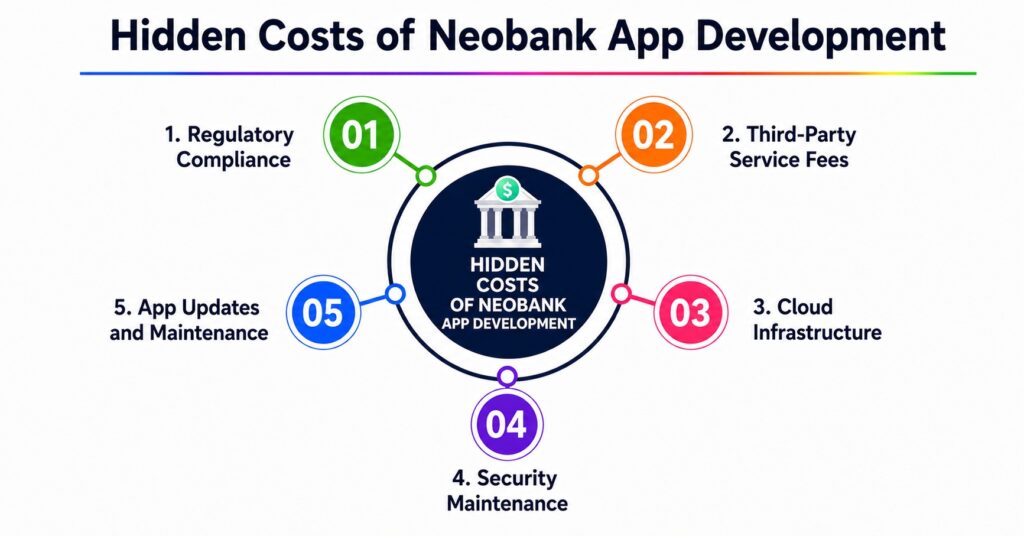
When running a company, it’s easy to lose track of costs beyond the initial investment in staff, neobank app design, and development. If investors want to get a good idea of how much their neobank application will cost, they should think about things like:
1. Regulatory Compliance
Financial applications must comply with local and international regulations depending on the regions they operate in.
Common compliance requirements include:
- KYC (Know Your Customer)
- AML (Anti-Money Laundering)
- PCI DSS
- GDPR
- PSD2 (Europe)
- SOC 2 (for security and operational controls)
Meeting these standards often requires additional development, legal consultation, audits, and continuous monitoring.
2. Third-Party Service Fees
Neobank apps typically rely on external providers for various services, such as:
- Identity verification
- Payment gateways
- Card issuing
- SMS and email notifications
- Currency exchange APIs
- Fraud detection
- Cloud storage
- Customer support platforms
Most providers charge monthly subscriptions or usage-based fees, which should be factored into your operating budget.
3. Cloud Infrastructure
As your customer base grows, you’ll need scalable cloud infrastructure to maintain performance and availability.
Typical cloud-related expenses include:
- Application hosting
- Database management
- File storage
- Load balancing
- Backup and disaster recovery
- Monitoring and logging
- CDN (Content Delivery Network)
Cloud costs generally increase with user activity, storage needs, and transaction volumes.
4. Security Maintenance
Security is an ongoing responsibility rather than a one-time implementation.
Regular activities include:
- Security patches
- Vulnerability assessments
- Penetration testing
- SSL certificate renewals
- Access control updates
- Fraud detection improvements
- Incident response planning
Continuous investment in cyber security helps protect customer data and maintain regulatory compliance.
5. App Updates and Maintenance
User expectations and operating systems evolve continuously, making regular updates essential.
Maintenance typically covers:
- Bug fixes
- Performance optimization
- Feature enhancements
- Compatibility with new Android and iOS versions
- API updates
- Database optimization
Many businesses allocate 15–20% of the initial development cost annually for maintenance and support.
How to Reduce Neobank App Development Costs
Building a secure and scalable neobank app doesn’t have to exceed your budget. The following strategies can help optimize development costs without compromising quality.
1. Start with a Minimum Viable Product (MVP)
Rather than building every feature from the start, launch with the core banking functionalities and expand based on user feedback.
An MVP typically includes:
- User registration
- KYC verification
- Account dashboard
- Money transfers
- Transaction history
- Push notifications
This approach reduces initial investment, speeds up time-to-market, and helps validate your business model before scaling.
2. Prioritize Essential Features
Focus on solving your users’ primary needs first. Advanced capabilities such as AI-powered financial advice, investment management, or cryptocurrency support can be introduced in later releases once the platform gains traction.
3. Use Cross-Platform Development
Frameworks like Flutter and React Native enable developers to build Android and iOS applications from a single code base.
Benefits include:
- Lower development costs
- Faster deployment
- Easier maintenance
- Consistent user experience across platforms
4. Leverage Cloud Services
Using cloud platforms such as AWS, Microsoft Azure, or Google Cloud eliminates the need for expensive on-premise infrastructure while offering scalability, reliability, and managed services.
Choose an Experienced FinTech Development Partner
A team with expertise in digital banking and fintech can help:
- Avoid costly technical mistakes
- Accelerate development
- Ensure regulatory compliance
- Build scalable architecture
- Deliver secure, high-performance applications
Selecting the right technology partner often results in lower long-term costs and a smoother development process.
Conclusion
Neobanks are reshaping the financial services landscape by delivering faster, more accessible, and user-friendly banking experiences. As customer expectations continue to evolve, investing in a well-designed neobank application presents a significant opportunity for startups and established financial institutions alike.
The cost of developing a neobank app depends on several factors, including feature complexity, security requirements, regulatory compliance, technology stack, integrations, and the expertise of your development team. While a basic solution may cost between $40,000 and $80,000, enterprise-grade platforms with advanced capabilities such as AI, multi-currency support, and wealth management can exceed $350,000.
Starting with a Minimum Viable Product (MVP), choosing a scalable technology stack, and partnering with an experienced fintech development company can help you reduce risks, optimize costs, and accelerate your time-to-market.
Frequently Asked Questions (FAQs)
1. How much does it cost to develop a neobank app?
The cost typically ranges from $40,000 to $350,000+, depending on the app’s complexity, features, compliance requirements, technology stack, and development team location.
2. How long does it take to build a neobank application?
A basic MVP generally takes 4–6 months, while a feature-rich enterprise neobank platform can require 8–12 months or more, depending on integration and regulatory approvals.
3. What are the essential features of a neobank app?
Core features include user registration, digital KYC, account management, money transfers, virtual card management, transaction history, bill payments, budgeting tools, push notifications, and customer support. Advanced platforms may also include AI-powered financial insights, fraud detection, and investment management.
4. Which technology stack is best for neobank app development?
A modern tech stack may include Flutter or React Native for mobile development, React.js for web interfaces, Node.js or Java Spring Boot for back end services, PostgreSQL for databases, and cloud platforms like AWS, Microsoft Azure, or Google Cloud Platform. Security technologies such as OAuth 2.0, JWT, and AES-256 encryption are also essential.
5. Is regulatory compliance mandatory for a neobank app?
Yes. Depending on the target market, neobank applications typically need to comply with regulations such as KYC, AML, PCI DSS, GDPR, and other regional financial standards to ensure secure and lawful operations.