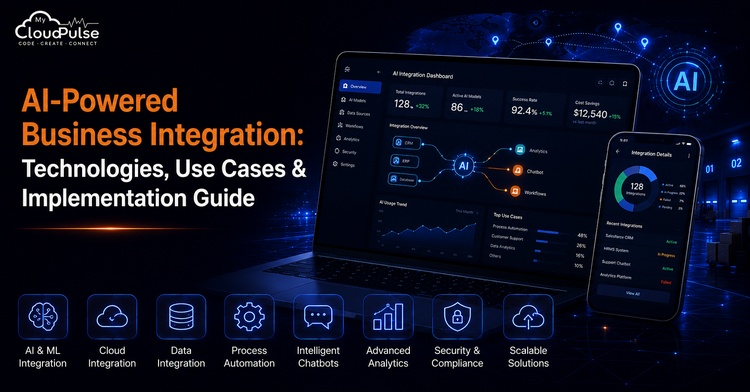
Artificial intelligence is transforming the way companies operate, compete, and innovate in the marketplace. From automating routine processes to personalizing the customer experience and providing powerful insights, AI can provide a much-needed boost to any business’s productivity and performance. But implementing isolated AI-driven applications is no longer enough. To maximize ROI, businesses should integrate AI into their existing software and processes to create a lasting impact.
That is where AI integration comes in. By combining the power of AI technologies like machine learning, generative AI, natural language processing, computer vision, and predictive analytics with the organization’s existing digital infrastructure, businesses can achieve exponential gains. AI integration enables enterprises to optimize operations, automate tedious processes, deliver better products and services, and drive hyper-personalized experiences for their customers while being mindful of existing workflows, databases, and applications. And it does that all without disrupting the status quo.
As businesses across industries embrace AI’s potential to disrupt markets and redefine customer expectations, they must invest in AI integration to design intelligent solutions that offer maximum value. But getting into the AI space is no simple task. Businesses must consider key factors like identifying the best applications for AI, preparing data sets, securing sensitive information, and choosing the right technologies and approaches for implementation.
Market Statement of AI-Powered Business Integration
AI adoption is rapidly becoming a standard part of business operations. According to Stanford HAI’s 2026 AI Index Report, 88% of surveyed organizations reported using AI in at least one business function in 2025, compared with 78% in 2024. Generative AI adoption also increased, with 79% of organizations reporting regular use in at least one business function. However, adoption does not necessarily mean successful enterprise-wide implementation. McKinsey’s 2025 State of AI survey found that nearly two-thirds of organizations had not yet begun scaling AI across the enterprise, while only 39% of respondents reported an enterprise-level EBIT impact from AI. These findings highlight the growing importance of effective AI integration strategies that connect AI technologies with existing business systems, data, and workflows.
AI Integration vs. AI Development: Understanding the Key Difference
AI Integration
These have some similarities but also pose significant differences, which are crucial to understand to address business objectives. AI introduction generally refers to introducing an already existing artificial intelligence technology, model, application programming interface (API), or tool. For instance, installing an AI chatbot on a company’s website, adding an AI recommendation system to an e-commerce platform, or utilizing an AI-powered document processor within the organization’s human resource information system are some examples of AI integration. This process is usually quicker than the development of new technologies from scratch.
AI Development
On the contrary, AI development refers to the process of designing and building a target-specific AI model or API that can meet certain business requirements. Typically, it involves data preparation, machine learning model development, algorithm design, coding, and infrastructure building. Overall, AI development is necessary when existing technologies are insufficient to address specific business needs.
AI Integration vs. Traditional Automation: How Businesses Are Evolving
Traditional automation typically follows rigid predefined rules while AI-driven automation uses artificial intelligence to improve processes powered by traditional automation. While traditional methods excel at executing standardized, repeatable operations (such as sending out emails, transferring data between different systems, generating reports, and conducting financial transactions), they can be ineffective in more dynamic, fluid environments that require human intuition and judgment.
The use of AI introduces intelligence into the operations of traditional automation software and systems. The combination of AI technologies like machine learning, natural language processing, computer vision, generative artificial intelligence, AI agents, and various other AI-driven technologies with traditional methods creates systems that can comprehend information, learn associations, recognize patterns, create responses, and perform other functions that were previously beyond the reach of ordinary automation. An email customer support system that can read and understand user requests, analyze past communications, produce appropriate responses, and escalate difficult or unique cases to human representatives is an example of an AI-driven automated process.
Implementing AI-driven automation is not a replacement for traditional automation and rigid rule-based programming. Instead, companies can use a mix of both to continue streamlining their operations while benefiting from the flexibility, power, and potential for growth that AI technologies offer. Traditional automation can be used for standardized, easily defined, repeatable tasks while AI can assist with processes that require analysis, synthesis, prediction, learning, generating new information, and more.
Key AI Integration Solutions for Modern Businesses
AI integration services can be customized according to the company’s specific needs, technology, goals, data, and operations. Apart from standalone software, artificial intelligence can also be embedded into other programs and systems. Below are the most common AI integration services.
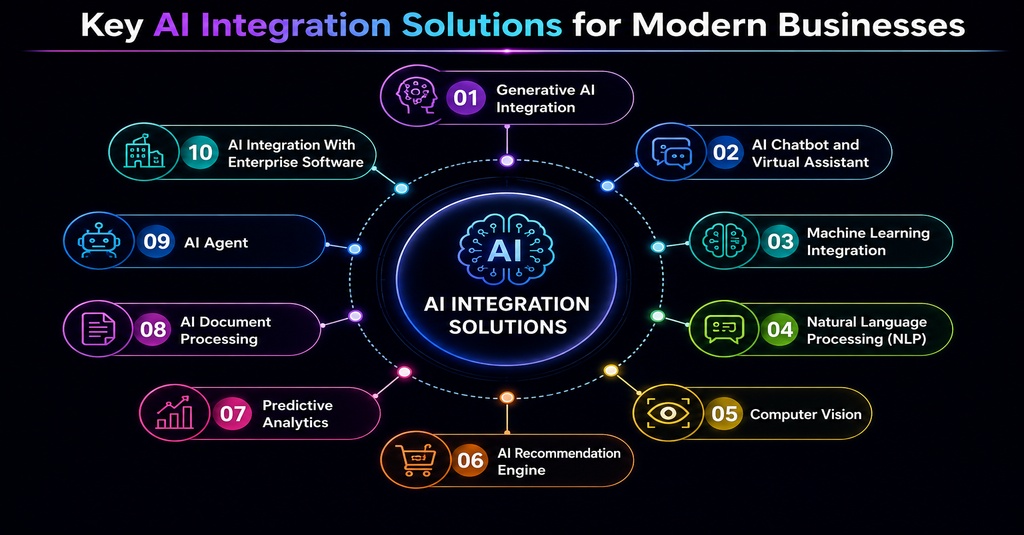
1. Generative AI Integration
Artificial intelligence integration can be applied to large language models that are used for content creation, summaries, answering requests, and employee assistance on websites, apps, tools, or platforms.
2. AI Chatbot and Virtual Assistant
Chatbots and virtual assistants can be integrated into web applications, web pages, CRM, software, and other platforms for assistance and recommendations.
3. Machine Learning Integration
Machine learning can be applied to analyze data, identify patterns, predict future behaviors or trends, and assist in decision-making.
4. Natural Language Processing (NLP)
Natural language processing technology can be used to execute chatbots and virtual assistants, perform sentiment analysis, document classification, search engines, and email or messaging processors.
5. Computer Vision
Computer vision is an AI technology that allows the identification and analysis of images or videos. This technology can be used for quality checks, biometric scans, object detection, medical scans, and video surveillance.
6. AI Recommendation Engine
The recommendation engine can be integrated into web apps or software to recommend products, services, or other offerings to customers.
7. Predictive Analytics
This technology can be used to predict results such as sales, customer behaviors, financial trends, or equipment malfunction. AI integration for predictive analytics can be applied to databases or software to achieve data-driven decisions and predictions.
8. AI Document Processing
AI document processing is performed using OCR, NLP, or machine learning algorithms to extract information from documents, invoices, and images for data validation, identification, categorization, and more.
9. AI Agent
An AI agent can be integrated into systems or other computer programs to perform tasks such as searching data, executing other programs, and doing processes with little human intervention.
10. AI Integration With Enterprise Software
AI can be combined with other enterprise applications such as CRM, ERP, HRMS, e-commerce, accounting software, customer support platforms, business intelligence, and more. Artificial intelligence integration with enterprise software replaces conventional functions with better performance rather than eliminating the integrated applications.
Building the Right Data and Cloud Foundation for AI Integration
The success of an integration of AI is defined by the supporting cloud infrastructure, data architecture, security, and scalability. Even the most sophisticated model is only as good as the data it has access to – which is why organizations must take a close look at their existing technology ecosystem and assess it from these perspectives before adopting AI for their applications or processes.
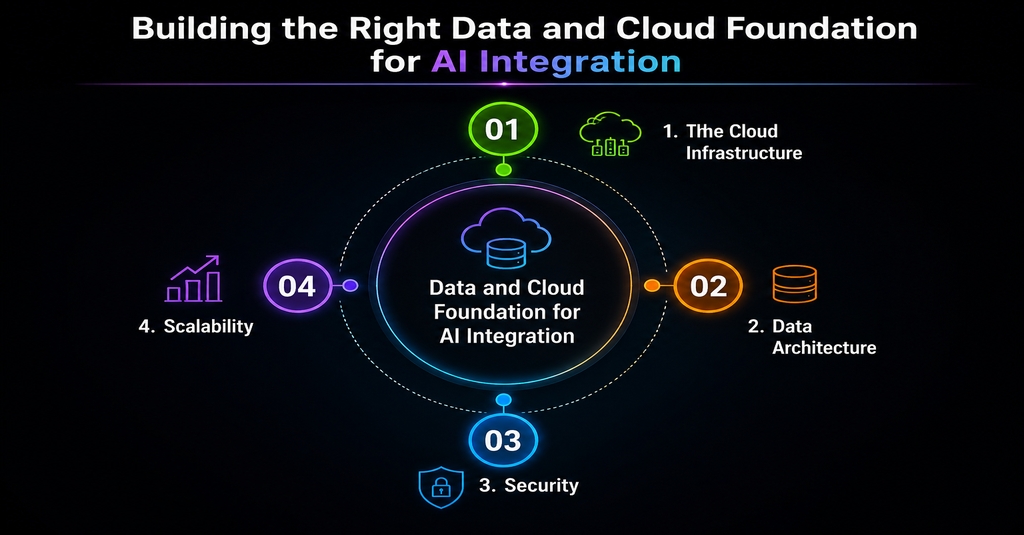
1. The Cloud Infrastructure
It hosts the AI application or model must be able to meet its requirements in terms of compute power, storage, networking, and AI-specific needs. Organizations should be able to select from a range of options on the cloud, including AWS, Microsoft Azure, Google Cloud, and others, depending on their requirements, existing infrastructure, security needs, AI offerings, regulatory compliance needs, and budget constraints. A cloud-centric approach also helps scale AI operations as needed.
2. Data Architecture:
Organizations must think about their data architecture and ensure they have an adequate system in place for storing, managing, securing, processing, and retrieving data sets of various types and sizes. There are multiple options available, including databases, data warehouses, data lakes, and vector databases, and the choice between them should be informed by the requirements of the AI application. For instance, RAG (Retrieval-Augmented Generation) can be used to provide access to a company’s knowledge repositories to large language models, thus enabling them to generate responses based on the information they have retrieved about the organization.
3. Security
It is essential that only the right personnel can access sensitive information and that data is protected at all times during processing, transit, and storage. Additionally, organizations should implement the necessary controls and procedures to govern AI activities within their infrastructure, including data privacy protocols, model governance, and security measures. This is particularly important when it comes to data sets that contain information about customers, finances, employees, and other sensitive information.
4. Scalability
Organizations must do when designing their architecture around AI is to ensure that it is future-proof and flexible enough to accommodate different AI methods and workflows. This includes utilizing such technologies as APIs, microservices, event streaming, monitoring systems, and CI/CD platforms in support of the chosen approach.
AI Integration Roadmap: From Business Idea to Successful Deployment
Using AI in a business context is more than just picking an AI model or adding a chatbot to an app. It starts with defining a problem to solve, and then choosing the right AI technologies, data, tools, and approach to implement a relevant and effective solution. Below is a list of steps that most companies should follow to get the best value for money when integrating AI into their operations.
1. Identify business goals and areas
Determine what business processes can benefit from automation first. These could be monotonous, time-consuming, error-prone, or data-heavy tasks. Some examples include shortening customer-support response time, automating document analysis, improving planning accuracy, and/or enhancing personalization.
2. Prioritize potential use cases
Not all business problems require an AI solution. When choosing which use case to prioritize, consider your business goals, data availability and quality, technical complexity, implementation time, and potential business impact. Focus on high-value targets where AI can deliver significant improvements over existing solutions.
3. Assess the relevant data, systems, and infrastructure
Evaluate what data will be needed for the AI model and how much of it is already available. At the same time, analyze the systems and tools that need to be connected or integrated with the new AI solution, including apps, databases, CRM, ERP, HRMS, and other systems.
4. Design AI Integration and choose the right AI model and technology stack
When building AI solutions, you will have to make many design choices, including which algorithms to use, what data to store, what security measures to implement, how to manage data access and permissions, etc. The specific tools will depend on the use case, but most often, you will have to work with large language models, machine learning models, natural language processing, computer vision, recommenders, RAG, AI agents, and/or other AI technologies. Finally, determine how to connect your solution to other systems, apps, and data sources, which may involve application programming interfaces (APIs), microservices, data pipelines, authentication and authorization systems, databases, vector databases, and cloud service providers.
5. Prototype and validate the proof of concept
Before developing a full-scale solution, build a prototype or a proof of concept (PoC) to demonstrate that the chosen approach works. Ensure that the solution you are building is accurate enough, performs well, and delivers on the expected business value.
6. Build and implement an AI solution
Using the validated prototype as a reference, develop a fully-fledged solution, which may involve designing, developing, and implementing new software features, connecting the AI solution to other systems and apps, building new user interfaces, and/or automating business processes.
7. Test, secure, and validate the solution
Test the new solution to ensure that it meets all functional and technical requirements. At the same time, evaluate the solution’s accuracy, response quality, security, performance, reliability, and other factors. Finally, use human moderators to review and, if necessary, improve the quality of responses, especially for critical use cases.
8. Deploy the solution
Depending on the complexity and criticality of the solution, it may be sufficient to deploy the AI solution in production and begin improving it based on real-world data and user feedback.
9. Continuously improve the solution and scale your AI efforts
Improving AI solutions is an iterative process that involves refining prompts, training data, model structure, algorithms, infrastructure, prompts, and much more. It is also useful to continually analyze the business processes being automated and improve them when possible. Most often, AI solutions benefit from being iteratively updated, rather than fully re-built from scratch every time. Finally, when you have a working solution that delivers on its promises, consider expanding its capabilities and applying similar approaches to other business functions.
Building a Secure and Compliant AI Integration Framework
Security and compliance considerations should be built into the design of an AI solution from the start, such as when the AI processes customer information, financial records, employee data, intellectual property, and other sensitive business information. The following areas help organizations protect the information that their AI applications collect, manage, share, and discard.
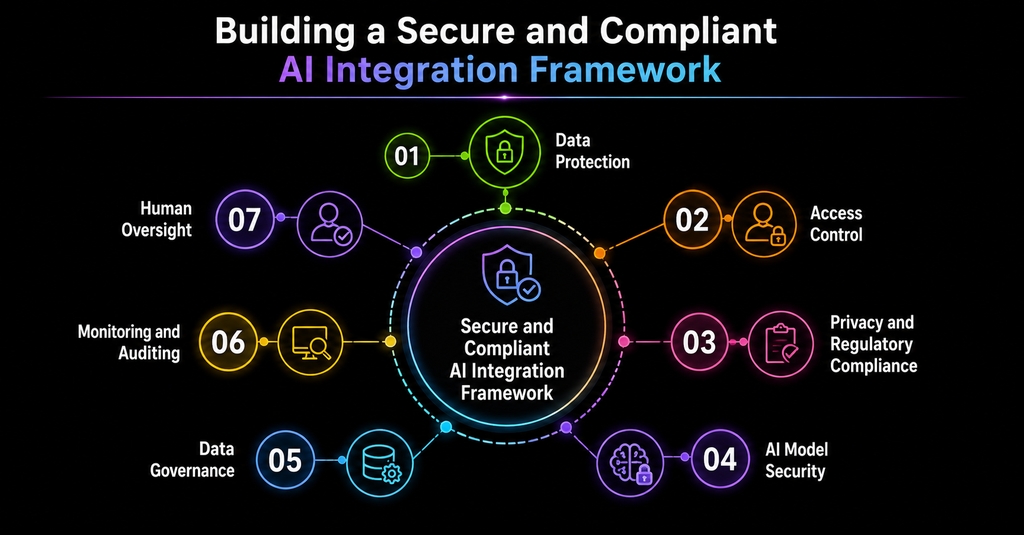
1. Data Protection
An enterprise should identify the data the AI system will access and store. The data is sensitive and should be encrypted, masked, or otherwise secured throughout its storage, processing, and transmission life-cycle to prevent its unauthorized exposure, use, or distribution.
2. Access Control
An enterprise should ensure that its AI applications use appropriate role-based controls to restrict access to authorized personnel and processes. The software should also include the necessary tools, tokens, application programming interface (API), and authentication and authorization mechanisms to protect confidential information.
3. Privacy and Regulatory Compliance
An enterprise should identify the relevant privacy and regulatory requirements for the AI application under development and the jurisdictions it operates in. For example, depending on the industry, the requirements could include protecting employee data, financial information, health records, and other personally identifiable information.
4. AI Model Security
An enterprise should ensure its AI systems have controls to protect against prompt injection attacks, unauthorized disclosure of sensitive data, model poisoning, and other threats. The firm should also consider restricting the data models its AI applications can access and use to generate outputs.
5. Data Governance
An enterprise should establish a data governance framework that ensures the confidentiality, integrity, and availability of the data its AI applications use. The framework should also specify who owns the data, how to store, process, dispose of, and access it, and how to use AI analytics tools and models.
6. Monitoring and Auditing
An enterprise should monitor its AI applications to detect and respond to data breaches, security threats, and processing errors. The process should also help identify under performing or insecure AI applications, record evidence of unauthorized access or activity, and aid in regulatory audits.
7. Human Oversight
An enterprise should implement appropriate human interventions to review, approve, or override AI results, especially when processing sensitive data. This strategy reduces the risks of errors, bias, discrimination, and inappropriate or unethical outputs and promotes accountability for AI-generated decisions.
Overcoming Key Challenges in Enterprise AI Integration
Integrating artificial intelligence into the enterprise is a complex and challenging process, which comes with serious risks of implementation failures, technology malfunctions, and poor decision-making. However, businesses must invest in making AI technologies work in tandem with existing systems since it allows for realizing substantial benefits through automation, productivity improvements, and data analytics.
1. Data quality
Artificial intelligence requires clean, relevant, accurate, and consistent data to produce reliable and valid results. Therefore, businesses must ensure that their data infrastructure is properly maintained and operated with the implementation of data-cleaning, validation rules, centralized storage, and quality monitoring tools.
2. Legacy systems
Modern enterprises operate using legacy systems that were not designed to work with innovative technologies, such as AI. The issue is solved with the help of application programming interfaces (APIs), software, middleware, and microservices that allow AI to seamlessly integrate into the existing infrastructure without replacing it.
3. Data privacy and security
Since AI systems require data to operate, businesses must ensure the confidentiality and integrity of information, which is protected by encryption, application programming interfaces (APIs), and other security measures. Moreover, it is vital to implement data masking, monitoring, and access control tools, and design appropriate governance policies.
4. Accuracy and hallucination
AI systems may provide incorrect information due to various factors, such as training data, algorithms, prompts, and contextual information. Therefore, businesses should utilize reliable and relevant data, retrieval-augmented generation (RAG), prompt engineering, model evaluation, output validation, and human moderation.
5. Scalability
Artificial intelligence systems must scale up with the increasing number of users and growing amounts of data. Businesses can achieve scalability by leveraging cloud infrastructure, caching, workload optimization, monitoring, and model selection.
6. Cost
The integration of AI into enterprise workflows requires API access, cloud storage, data preparation, model training and development, application programming interfaces (APIs), security, and maintenance, which incurs considerable costs. Thus, businesses must identify critical areas, develop a prototype, and measure effectiveness before investing in large-scale implementation.
7. Employee adoption
People may be reluctant to embrace AI systems at work due to a lack of technical knowledge, changes in operations, and concerns about job security. The issue can be resolved with proper training, the establishment of AI usage guidelines, employees’ participation in development, and collaboration between humans and machines.
8. Regulation and governance
Depending on the industry and jurisdiction, there may be specific regulations governing data privacy, AI operations, and decision-making. Thus, enterprises must develop a comprehensive governance framework that clarifies roles, responsibilities, and risk management strategies and implements data protection, monitoring, auditing, and policy enforcement measures.
Conclusion
AI integration is an increasingly important way for businesses to optimize operations, automate processes, improve customer experience, and make better decisions. From generative AI and machine learning to AI agents, predictive analytics, and intelligent document processing, businesses can adopt a wide range of AI features and functions to improve enterprise applications.
At the same time, businesses must develop an efficient strategy for AI integration that would rely on critical enablers such as data infrastructure, cloud platforms, security measures, and governance frameworks to make the most of this technology. Addressing common challenges associated with data quality, legacy systems, ethical concerns, model accuracy and fairness, scalability, costs, and user adoption will allow companies to make fewer mistakes and maximize AI performance.
The key to effective AI integration is focusing on the most compelling opportunities first, validating business value through proof of concept, adopting AI across workflows and existing systems, and continuously refining and evolving AI initiatives. Thus, organizations should develop an efficient technology plan and partner with the right AI development companies to create intelligent solutions that could scale and evolve over time.
Frequently Asked Questions
Que 1: What is AI integration for businesses?
Answer 1: AI integration is the process of connecting AI technologies with existing business applications, systems, data, and workflows.
Que 2: What are the main benefits of AI integration?
Answer 2: It can improve automation, productivity, decision-making, customer experiences, operational efficiency, and business scalability.
Que 3: Which AI technologies can businesses integrate?
Answer 3: Businesses can integrate generative AI, machine learning, NLP, computer vision, predictive analytics, recommendation engines, RAG, and AI agents.
Que 4: How long does AI integration take?
Answer 4: The timeline depends on the complexity, data requirements, integrations, customization, and scope of the AI solution.
Que 5: How can businesses ensure secure AI integration?
Answer 5: Businesses should use encryption, access controls, data governance, monitoring, secure APIs, privacy measures, and human oversight.