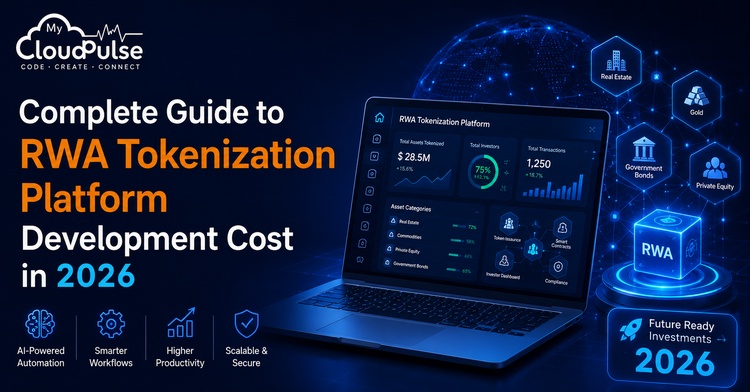
The tokenization of Real-World Assets (RWAs) is transforming the global financial ecosystem by bridging traditional assets with block chain technology. From real estate and private equity to commodities, art, and government bonds, asset tokenization enables fractional ownership, improved liquidity, faster settlements, and global accessibility.
According to a 2025 report by Boston Consulting Group (BCG) and Ripple, the global market for tokenized real-world assets (RWAs) is projected to grow from approximately USD 0.6 trillion today to USD 9.4 trillion by 2030, reaching USD 18.9 trillion by 2033 at a compound annual growth rate (CAGR) of 53%. This rapid growth is being driven by increasing institutional adoption, regulatory advancements, and the growing demand for blockchain-powered financial infrastructure.
What is an RWA Tokenization Platform?
A Real-World Asset (RWA) tokenization platform converts ownership rights of physical or traditional financial assets into blockchain-based digital tokens.
These tokens represent ownership or economic rights and can be traded securely on blockchain networks.
Examples include:
- Commercial real estate
- Residential property
- Gold & precious metals
- Artwork
- Private equity
- Stocks
- Government bonds
- Treasury bills
- Intellectual property
- Luxury collectibles
- Carbon credits
This novel method allows investors to buy tokens that stand for partial ownership rights instead of whole assets.
Key Factors Affecting RWA Tokenization Platform Development Cost
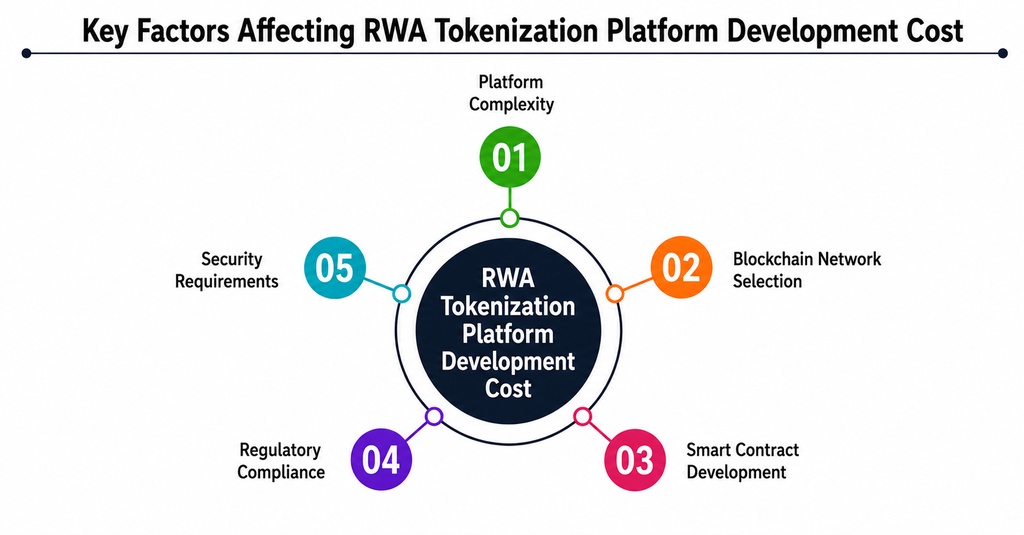
Several variables determine the overall development budget.
1. Platform Complexity
Basic MVP platforms cost significantly less than enterprise-grade solutions.
Basic Platform
Features:
- User registration
- Asset listing
- Wallet integration
- Token issuance
- Dashboard
Estimated Cost: $30,000–$60,000
Mid-Level Platform
Includes:
- Smart contracts
- KYC/AML
- Investor dashboard
- Admin panel
- Payment gateway
- Compliance tools
Estimated Cost: $60,000–$120,000
Enterprise Platform
Includes:
- Multi-chain architecture
- Institutional compliance
- AI analytics
- Liquidity engine
- Custody integration
- Security monitoring
- API ecosystem
Estimated Cost: $150,000–$400,000+
2. Blockchain Network Selection
The blockchain you choose directly impacts development complexity and ongoing transaction costs.
Popular choices include:
- Ethereum
- Polygon
- Solana
- Avalanche
- Stellar
- BNB Chain
- Hyperledger Fabric (permissioned)
- Hedera
Public blockchains provide greater accessibility, while permissioned networks are often preferred for enterprise and regulated financial environments.
3. Smart Contract Development
Smart contracts power the entire platform.
Development includes:
- Asset tokenization
- Ownership management
- Dividend distribution
- Revenue sharing
- Buy/sell execution
- Escrow
- Vesting
- Compliance logic
Cost: $10,000–$80,000
4. Regulatory Compliance
Compliance is one of the largest investments.
Required modules include:
- KYC verification
- AML screening
- Identity verification
- Investor accreditation
- GDPR compliance
- FATF compliance
- SEC-compatible architecture
- Audit logs
Estimated Cost: $15,000–$60,000
5. Security Requirements
Financial platforms demand enterprise-grade protection.
Security measures include:
- Smart contract auditing
- Multi-signature wallets
- End-to-end encryption
- Cold wallet integration
- DDoS protection
- Role-based access
- Penetration testing
- Biometric authentication
Estimated Cost: $10,000–$50,000
Essential Features of an RWA Tokenization Platform
The ecosystem that a RWA (Real-World Asset) tokenization platform provides should empower asset issuers, investors, and administrators if it is to be effective. In addition, it must to make the process of tokenizing conventional financial assets or physical assets straightforward, trustworthy, easy to understand, and compliant. The following are the characteristics of an ideal RWA tokenization platform.
1. User Registration & Secure Authentication
Advanced security capabilities, such as two-factor authentication, and the ability to register using a phone number, email, or social login should all be accessible through the platform’s one-click registration process.
Key Features:
- User registration and login
- Multi-Factor Authentication (MFA)
- Biometric authentication
- Password encryption
- Role-based access control
2. KYC & AML Verification
Compliance with regulatory norms is ensured by screening users’ identities through RWA tokenization platforms’ KYC (Know Your Customer) and AML (Anti-Money Laundering) verification tools.
Key Features:
- Identity verification
- Document upload and validation
- AML screening
- Sanctions and PEP checks
- Automated compliance workflows
3. Asset Onboarding & Verification
An onboarding mechanism that allows asset owners to register and tokenize real-world assets should be available on the RWA tokenization platform.
Key Features:
- Asset registration
- Legal document management
- Ownership verification
- Asset valuation support
- Approval workflow
4. Asset Tokenization Engine
An onboarding mechanism that allows asset owners to register and tokenize real-world assets should be available on the RWA tokenization platform.
Key Features:
- Digital token creation
- Fractional ownership
- Token supply management
- Ownership distribution
- Compliance-enabled token issuance
5. Smart Contract Management
The ability to tokenize real-world assets (RWAs) and convert them into digital tokens based on the blockchain is a crucial feature of RWA tokenization platforms.
Key Features:
- Automated token issuance
- Ownership transfer
- Revenue distribution
- Dividend payouts
- Contract upgrades and auditing
6. Investor Dashboard
Tokenization systems for RWAs can automate ownership transfers, transaction settlements, dividend payments, and compliance checks with the use of smart contracts, which in turn reduces administrative costs and risks.
Key Features:
- Portfolio overview
- Investment tracking
- Asset performance analytics
- Transaction history
- Earnings reports
7. Digital Wallet Integration
Investors should be able to utilise the RWA tokenization platform’s individualised dashboard to oversee their assets, monitor their investments in real-time, and view transaction records.
Key Features:
- Crypto wallet integration
- Multi-wallet support
- Token balance tracking
- Secure asset transfers
- Custodial and non-custodial wallet options
8. Marketplace for Buying & Selling Tokens
Users are able to safeguard the transfer and storage of digital tokens on the blockchain with the wallet feature. In order to guaranty compatibility and flexibility between chains, the best platforms also provide multi-chain support.
Key Features:
- Asset listings
- Buy and sell orders
- Secondary market trading
- Price discovery
- Transaction management
9. Payment Gateway Integration
With the help of an integrated marketplace, investors may safely purchase and sell digital assets and tokenize securities, making their assets more liquid.
Key Features:
- Credit/debit card payments
- Bank transfer support
- Cryptocurrency payments
- Stablecoin integration
- Automated payment settlement
10. Compliance & Regulatory Management
The ability to comply with rules and regulations pertaining to the financial sector and security token offerings is an essential feature of any RWA tokenization platform worth its salt.
Key Features:
- Regulatory reporting
- Audit trails
- Tax reporting
- Investor accreditation
- Jurisdiction-based complain
Technology Stack of an RWA Tokenization Platform
Choosing the right technology stack is essential for building a secure, scalable, and compliant RWA tokenization platform.
Frontend
- React.js
- Next.js
- Vue.js
Backend
- Node.js
- NestJS
- Python
- Java
- Go
Blockchain
- Ethereum
- Polygon
- Solana
- Avalanche
- Hyperledger Fabric
Smart Contracts
- Solidity
- Rust
How Asset Type Impacts RWA Tokenization Platform Development Cost
The cost of developing an RWA (Real-World Asset) tokenization platform depends substantially on the specific asset type that is going to be tokenized. Each asset category has its own set of requirements, specifications, nuances, and regulation to consider during the development process.
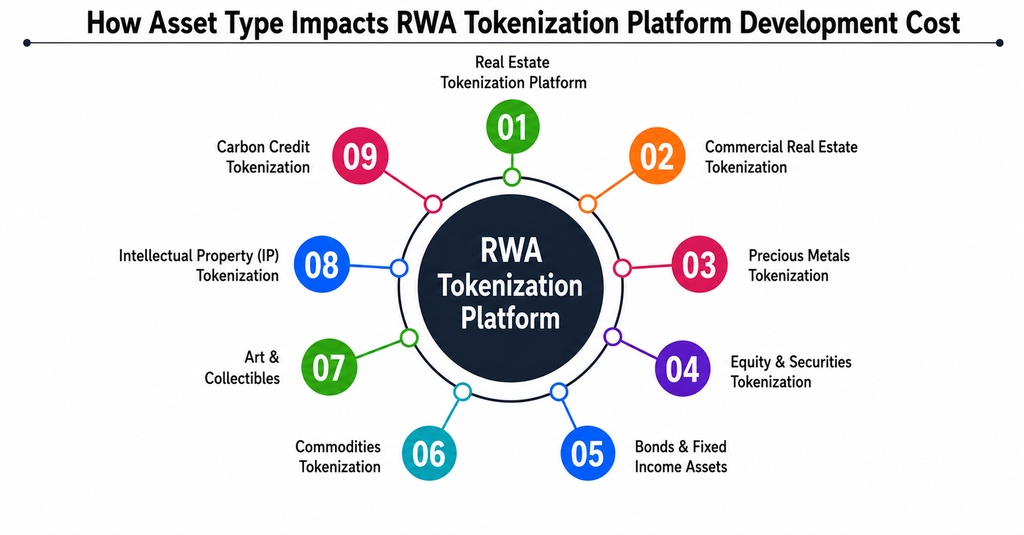
Below is an illustrative list of how much (approximately) the development of each asset type tokenization platform may cost in 2026:
| Asset Type | Estimated Development Cost (USD) | Estimated Timeline |
| Real Estate Tokenization | $80,000 – $250,000 | 5–8 Months |
| Commercial Real Estate | $120,000 – $300,000 | 6–9 Months |
| Precious Metals (Gold, Silver) | $70,000 – $180,000 | 4–6 Months |
| Equity & Securities Tokenization | $100,000 – $300,000 | 6–10 Months |
| Bonds & Fixed Income Assets | $90,000 – $250,000 | 5–8 Months |
| Commodities Tokenization | $80,000 – $220,000 | 5–7 Months |
| Art & Collectibles | $60,000 – $180,000 | 4–6 Months |
| Intellectual Property (IP) Rights | $90,000 – $220,000 | 5–7 Months |
| Carbon Credits | $80,000 – $200,000 | 5–7 Months |
1. Real Estate Tokenization Platform
Real Estate tokenization is one of the most popular and promising use cases of RWA platforms since it allows creating investment opportunities for both individuals and organizations to invest in real estate, which, in turn, provides liquid access to income from rent payments or sales profits.
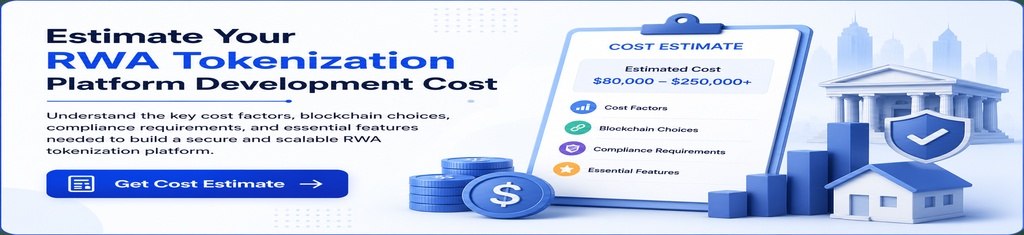
Estimated Cost: $80,000–$250,000
2. Commercial Real Estate Tokenization
The features of such a product depend on the type of real estate – commercial or residential. Commercial property has a more substantial set of specifications and functionalities involved, like multi-stakeholder management, lease agreements, and revenue distribution schemes.
Estimated Cost: $120,000–$300,000
3. Precious Metals Tokenization
Gold, silver, or platinum such platforms allow their users to purchase portions of various metals, and their tokenization features may include integration with vaults, price oracles, and custodian services.
Estimated Cost: $70,000–$180,000
4. Equity & Securities Tokenization
This type of asset tokenization presupposes heavy compliance, management, shareholder relationship features, and functionalities regarding dividend distribution and voting participation.
Estimated Cost: $100,000–$300,000
5. Bonds & Fixed Income Assets
Bonds, issued by governments or corporations, have features similar to stocks but with the accent on the regular payment of coupons and their distribution to bondholders via smart contracts.
Estimated Cost: $90,000–$250,000
6. Commodities Tokenization
A wide range of commodities may also be subject to tokenization, from natural gas and oil to agricultural products and precious metals. In addition to standard RWA features, commodity tokenization products may require custody and price oracle integration.
Estimated Cost: $80,000–$220,000
7. Art & Collectibles
This variety of tokenization services presupposes the implementation of NFT-related features, such as provenance tracking, ownership control, digital representations of valuable items, and more.
Estimated Cost: $60,000–$180,000
8. Intellectual Property (IP) Tokenization
Such product category focuses on copyrights and patents, featuring licensing management, NFT ownership functionality, and smart contract-based rights distribution.
Estimated Cost: $90,000–$220,000
9. Carbon Credit Tokenization
This type of tokenization platform development is a bleeding edge, featuring carbon offsetting-related functionalities, compliance, reporting, and verification features.
Estimated Cost: $80,000–$200,000
How Businesses Are Leveraging RWA Tokenization Platforms
Companies are improving their control over physical and financial assets through Real-World Asset (RWA) tokenization. The capacity to tokenize tangible assets is helping companies increase the liquidity of their holdings, facilitate fractional ownership, reduce expenses, and draw in new investors. This section provides a few top-notch instances of RWA tokenization platforms in action.
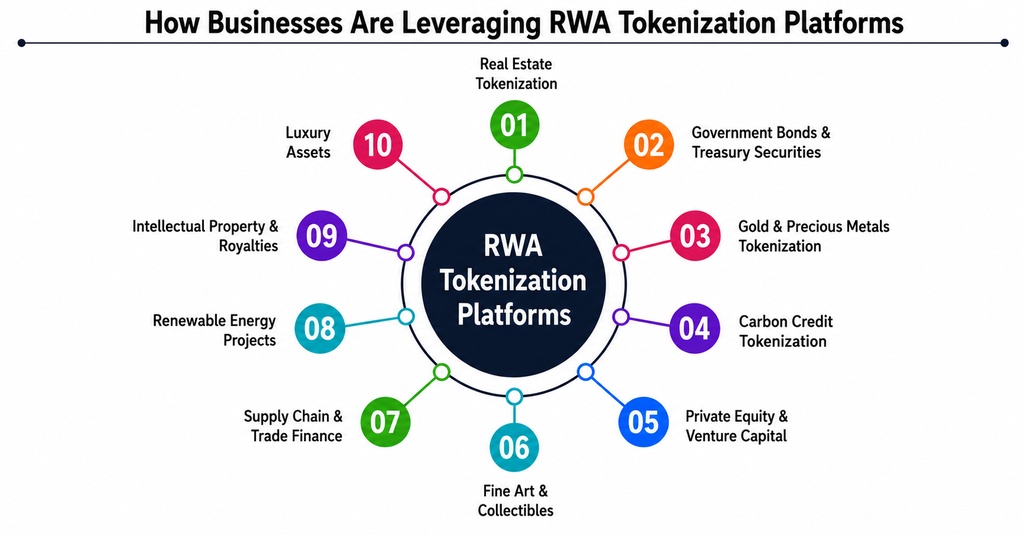
1. Real Estate Tokenization
Real estate is one of the largest and fastest-growing use cases for RWA tokenization. Property developers and investment firms tokenize residential, commercial, and mixed-use properties to enable fractional ownership and attract a wider pool of investors.
Example
RealT is a platform that allows investors to acquire tokens representing ownership in rental homes in the US and then earn revenue from such properties.
Business Benefits:
- Fractional property ownership
- Increased liquidity
- Global investor participation
- Faster property transactions
2. Government Bonds & Treasury Securities
Tokenizing assets, like as government bonds, allows financial institutions to provide speedier settlement and more transparency for institutional investors.
Example
BUIDL, a secularized bond fund co-founded by BlackRock and Secularize, promises investors exposure to money market funds with fast settlement through the issuance of bonds made possible by blockchain technology.
Business Benefits:
- Faster settlements
- Improved transparency
- Lower operational costs
- Enhanced liquidity
3. Gold & Precious Metals Tokenization
To diversify their treasury management techniques and provide investors with exposure to the gold market, many corporations are considering tokenizing physical precious metals such as gold, silver, platinum, and others.
Example
One to one, PAX Gold is backed by real gold in secure vaults. Buyers of PAXG tokens can easily swap them for gold by transferring them from their wallets.
Business Benefits:
- Secure ownership
- 24/7 trading
- Reduced storage complexity
- Fractional investment opportunities
4. Carbon Credit Tokenization
Carbon credit tokenization is being considered by several platforms and organisations as a means to verify the legitimacy of carbon credits and create an easier market for selling them.
Example
A more open and accessible carbon credit market can be built with the help of Toucan Protocol’s blockchain platform, which allows for the conversion of carbon credits into tokens.
Business Benefits:
- Transparent carbon markets
- Improved traceability
- Global trading access
- Automated retirement of credits
5. Private Equity & Venture Capital
Tokenizing funds is a common practice among private equity firms. This allows investors to easily access their assets and helps more people participate in private markets.
Example
Venture capital funds, private equity firms, and other asset classes suitable for private placements can benefit from Securitize’s suite of products and services, which enable organisations to issue and manage tokenized securities.
Business Benefits:
- Fractional investment
- Streamlined fundraising
- Enhanced liquidity
- Automated compliance
6. Fine Art & Collectibles
Tokenizing art collections can give investors more liquidity and diversification, which is why several galleries and collectors are considering doing so.
Example
Unlike conventional blockchain-based tokenization, Masterworks’ ownership structure allows investors to buy shares in physical artwork.
Business Benefits:
- Lower investment barriers
- Broader investor participation
- Diversified portfolios
- Improved liquidity
7. Supply Chain & Trade Finance
Companies are considering tokenizing their receivables, such as invoices, to give sellers more liquidity and investors more alternatives for funding.
Example
With the use of blockchain technology, trade finance platforms are thinking about adopting tokenized receivables to speed up the financing and settlement processes for invoices.
Business Benefits:
- Faster financing
- Reduced paperwork
- Improved cash flow
- Greater transparency
8. Renewable Energy Projects
Tokenizing solar farms and other energy assets is something that solar companies are attempting to do. This gives investors an opportunity to diversify their holdings while still making money from renewable energy.
Example
Tokenizing sustainable energy projects has been a tactic used by energy providers. This allows investors to buy into solar farms in fractions and earn money depending on the amount of electricity generated.
Business Benefits:
- Easier capital raising
- Fractional ownership
- Transparent revenue distribution
- Global investment opportunities
9. Intellectual Property & Royalties
A lot of artists are thinking about tokenizing their rights so that record companies and publishers may use programmable agreements to fairly share royalties.
Example
Blockchain technology is being considered by music and publishing companies as a potential solution to the problem of how to automatically compensate rights holders for their content’s usage.
Business Benefits:
- Automated royalty payments
- Transparent ownership records
- Faster licensing
- Reduced administrative costs
10. Luxury Assets
Tokenization can create a more liquid market for high-end products like jewellery, watches, vehicles, yachts, and more.
Example
While the real items are kept in safe vaults, investors can buy fractions of valuable commodities using digital tokens that have been created for a number of high-end collectibles on different blockchain platforms.
Business Benefits:
- Fractional ownership
- Increased liquidity
- Secure digital records
- Global investor access
Why Businesses Are Adopting RWA Tokenization Platforms
Across industries, businesses are embracing RWA tokenization because it offers:
- Fractional ownership for high-value assets
- Access to global investors
- Improved asset liquidity
- Faster settlement through blockchain
- Reduced operational and administrative costs
- Transparent ownership records
- Automated compliance and smart contract execution
- Enhanced security and auditability
Conclusion
Businesses can benefit greatly from the tokenization of real-world assets, which brings several benefits like as greater accessibility, liquidity, transparency, and flexibility in transactions. Businesses can now sell digital representations of various real-world assets on the market by tokenizing them using blockchain-based platforms.
The selected blockchain, extra features, security level, and team skills have a significant impact on the RWA tokenization platform cost in 2026. Platform minimum viable products (MVPs) typically cost $30k–$60,000, while enterprise-level apps with blockchain integration and institutional-level security can cost more than $400k.
In general, you can achieve great outcomes with careful preparation, a distributed launch timetable, and the support of a professional blockchain development company. Companies eyeing the multi-billion dollar tokenized asset market should give significant consideration to developing RWA platforms in light of the market’s projected growth.
FAQs
Que 1: What is an RWA Tokenization Platform?
Answer 1: An RWA tokenization platform uses blockchain to represent ownership rights of real-world assets as digital tokens.
Que 2: How much does an RWA Tokenization Platform Cost in 2026?
Answer 2: Development typically costs $30,000–$400,000+, depending on features, blockchain, security, and compliance requirements.
Que 3: Which Assets can be Tokenized?
Answer 3: Real estate, gold, bonds, equities, commodities, artwork, carbon credits, intellectual property, and other valuable assets can be tokenized.
Que 4: How long does RWA Platform Development take?
Answer 4: Development can take approximately 4–10 months, depending on platform complexity and asset type.
Que 5: Which Technologies are used for RWA Tokenization?
Answer 5: Common technologies include Ethereum, Polygon, Solana, Avalanche, Hyperledger Fabric, Solidity, Rust, React.js, and Node.js.