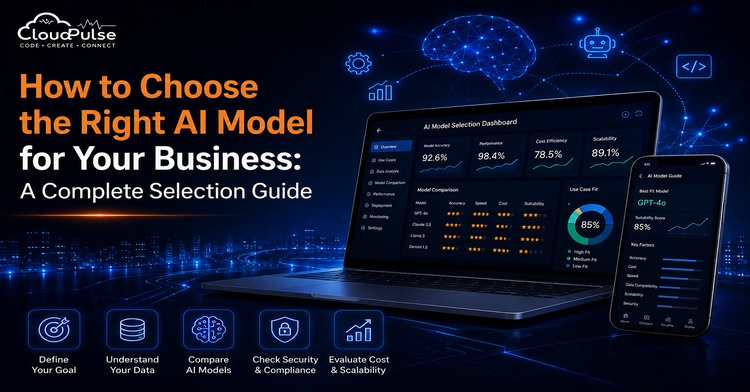
Businesses may automate processes, analyse data more accurately, and enhance consumer experiences with the use of artificial intelligence (AI). Nevertheless, how can businesses narrow down their AI choices to just the right one? Because different models excel at handling different types of problems and data sets, it would be impossible to generalize about the optimum AI solution.
There is a plethora of options for artificial intelligence solutions that businesses must examine before settling on one.
These options range from generative AI and big language models to computer vision, voice recognition, and predictive machine learning models. Scalability, accuracy, cost, security, integration, reaction time, complexity, and a host of other factors are all part of this. The most important considerations for selecting an appropriate AI model for a business will be covered in this essay.
Understanding AI Model Development
When discussing the process of creating an AI model to accomplish specific technical or business objectives, the phrase “AI model development” encompasses the entire life-cycle of the model. It entails taking in data, cleaning it up, training it using the pattern recognition algorithm of choice, and finally, creating an AI model that produces the expected outcomes. Computer vision, deep learning, predictive modelling, generative adversarial networks, NLP, and other methods could be used in the building of AI models, depending on the goals.
When creating AI models, businesses have the option of starting from scratch or improving upon an existing architecture. Either way, you want a model that takes performance, security, scalability, cost, and other things into account and produces accurate and efficient results.
Different Types of AI Models for Business Applications
Businesses can build or apply diverse artificial intelligence (AI) models depending on their goals, data needs, and application requirements. Some of the leading types of business AI models include the following:
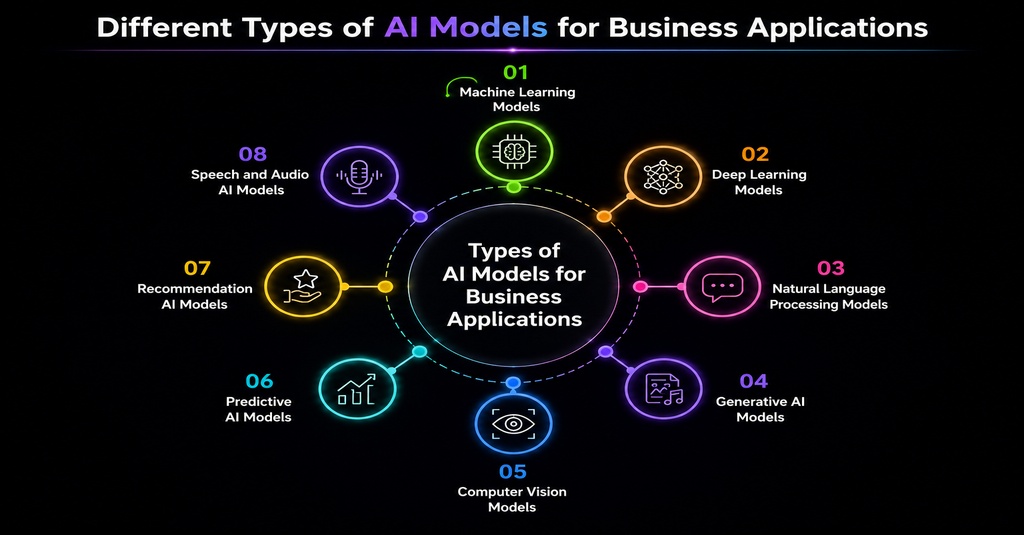
1. Machine Learning Models
Machine learning (ML) models utilize historical data to create patterns that help make predictions or decisions. These patterns are useful in achieving specific goals, and the information can be generated into decisions, forecasts, classifications, or recommendations.
2. Deep Learning Models
Deep learning is a broad range of ML techniques that use multiple neural layers to interpret data. These models are useful in analyzing data sets using neural networks. As a result, they can handle high-level abstraction problems, including autonomous driving, computer vision, speech recognition, and generative AI.
3. Natural Language Processing Models
Natural language processing (NLP) is a type of AI that helps computers understand, analyze, and generate human languages. It is possible to use NLP to build chatbots, sentiment analysis tools, or AI assistants that can comprehend and respond to queries naturally.
4. Generative Artificial Intelligence (AI) Models
This category of AI models focuses on creating new information, including text, images, audio, video, and computer code. Leading generative models include large language models (LLMs). Businesses can use these AI systems for various applications, from chatbots to automation systems, and virtual assistants.
5. Computer Vision Models
Computer vision refers to enabling machines to interpret and understand visual information embedded in images or videos. Different computer vision models handle specific tasks, such as quality control, medical image analysis, facial recognition, and autonomous cars.
6. Predictive AI Models
Businesses can use predictive models to make projections about future events or trends. These AI systems analyze historical data and learn patterns that can help make predictions, automate decision-making, and improve operations. Some typical use cases of predictive models include forecasting demand and sales, automating financial processes, and predicting customer behaviors.
7. Recommendation AI Models
Recommendation models can automatically suggest activities, items, or services based on the information provided by businesses or users. These AI systems are useful in empowering businesses to enhance customer engagement and sales by understanding what customers want or need. In addition, such models are handy in recommending products, services, and content, including movies, books, and social media posts.
8. Speech and Audio AI Models
Speech and audio AI models can be used to recognize text, analyze speeches, detect audio patterns, and build virtual assistants like Siri and Alexa. Moreover, this technology can be helpful in making customer service operations more seamless and efficient.
Key Factors for Selecting the Right AI Model
It takes more than just comparing their results to find the optimal AI model. At the heart of this process is a thorough comprehension of the business goals, data, technical requirements, budget, and intended outcomes.
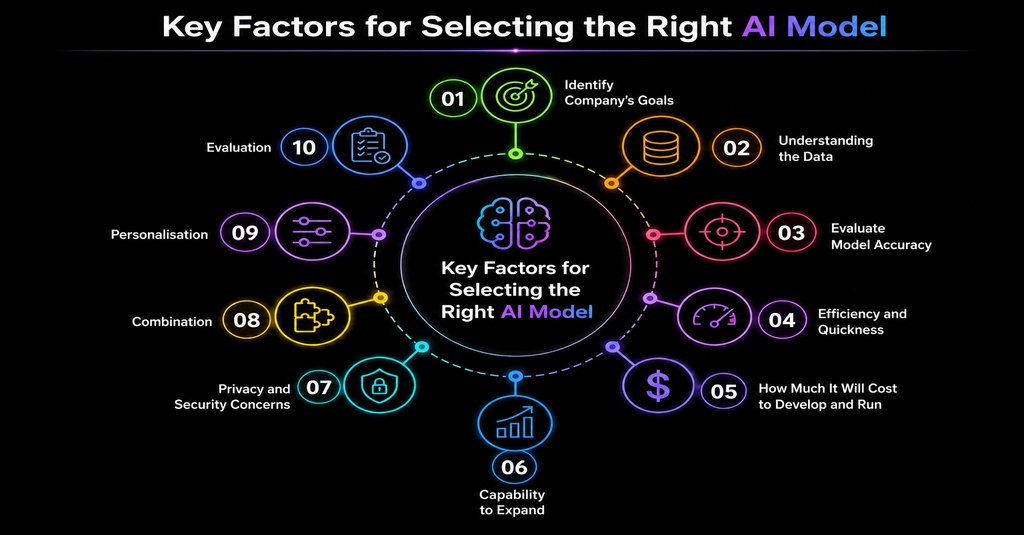
1. Identify the Company’s Goals
Knowing what you’re trying to solve is the first step in selecting the appropriate AI model. The goal of your task is the ultimate determinant of the optimal model to choose. The business purpose will determine the breadth of the model in cases where artificial intelligence is being used to automate customer service, anticipate future trends, analyse documents, detect fraud, or produce content.
2. Understanding the Data
Tell me the data set that you intend to feed into the model. To choose the most appropriate AI model for your job, you must consider the quantity, variety, quality, and accessibility of your data sets. Think about if the data is structured or unstructured, and if it arrives in text, photos, audio, or video.
3. Evaluate Model Accuracy
Think about how precise the results are when deciding on the best AI model. You should also think about whether or not you require improved accuracy, what makes it better, and how to measure the best AI model using these criteria.
4. Efficiency and Quickness
The performance and speed of the AI model should be taken into account, particularly for specific tasks. Whether your task calls for rapid results, continuous processing, or batch processing, knowing this is vital.
5. How Much It Will Cost to Develop and Run
The best artificial intelligence model for a company is usually determined by the costs. No matter how big or little your budget is, you’ll have to pick a model. You need to think about the model’s cloud, API key, training, and development expenses as well.
6. Capability to Expand
Ensure that the AI model you select can grow alongside your company. While handling queries, think about the model’s characteristics and how straightforward it is to deploy on various cloud infrastructure levels.
7. Privacy and Security Concerns
To run their operations smoothly and safely while protecting their customers’ and data’s privacy, most companies and organisations use AI technology. Also, think about the AI model’s privacy settings and security measures, especially if it will handle sensitive information.
8. Combination
Consider the model’s compatibility with your existing technology infrastructure before making a final decision on an AI system. Make sure it integrates properly with your databases, apps, and APIs, for example. Implementation of the model should also not be difficult.
9. Personalisation
Learning whether the model can be customised to meet your unique requirements is crucial because some AI models provide more customisation choices than others. To further improve performance, think about if it permits retrieval-augmented generation or rapid engineering.
10. Evaluation
In order to assess the performance, accuracy, cost, security, and other requirements of an AI model, a proof of concept or pilot must be conducted before its adoption and implementation.
Step-by-Step AI Model Development Lifecycle
AI model development involves going through a certain number of steps before a successful AI model is created to meet specific business needs. The steps discussed below are followed when developing AI models:
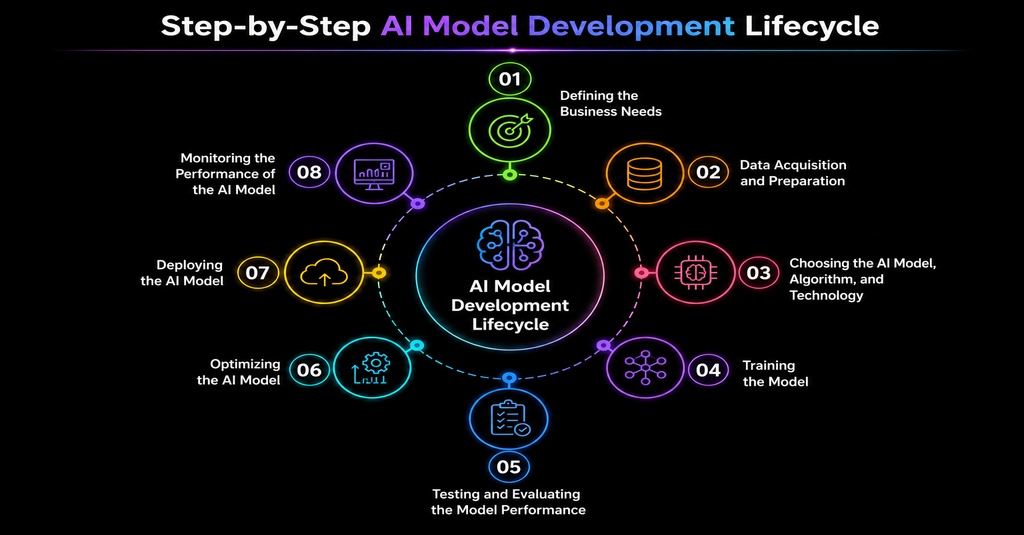
1. Defining the Business Needs
To start with, it is important to define the business needs, problems, goals, audiences, expectations, and success metrics. It is always advisable to clearly understand the problem being addressed, which aids in identifying the required AI model.
2. Data Acquisition and Preparation
The next step is to collect the data needed to develop the AI model and prepare it for training. This includes getting the data set or information from databases, API, applications, documents, or any other source so that it is clean, organized, and free for use.
3. Choosing the AI Model, Algorithm, and Technology
At this point, the developer needs to choose the most appropriate AI model, algorithm, or technology for a given business need. Apart from picking the best technology to develop the AI model, one must also consider other factors such as business objectives, data, and budget.
4. Training the Model
At this point, the chosen AI algorithm, technology, or model is being trained to be able to meet the intended purpose or perform the required set of tasks. For models that are built from existing foundation models, this step could take a different angle, such as fine-tuning.
5. Testing and Evaluating the Model Performance
The fifth step entails testing and evaluating the performance of the AI model. Here, the developer should conduct tests to establish the level of accuracy, precision, recall, F1 score, and other performance indicators to determine the areas that may need improvement.
6. Optimizing the AI Model
The sixth step is to optimize the AI model to help it achieve the desired performance while also reducing the cost of operations. It is at this point that one can think of ways of improving the prompt, training data, fine-tuning, or model architecture to meet the intended business needs.
7. Deploying the AI Model
After optimizing the AI model, it is time to deploy the model to the selected application, cloud platform, or software where it will be used. The deployment process must also be done carefully to ensure that everything works as intended.
8. Monitoring the Performance of the AI Model
Finally, it is important to monitor the performance of the AI model on a regular basis after deployment and ensure that it is operating at its best. One should monitor aspects such as performance, accuracy, costs, security, data, and other aspects that could affect the results. In addition, developers may need to optimize or update the AI model based on the business needs.
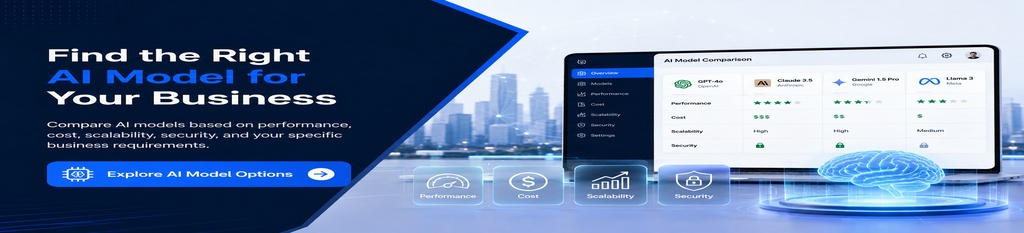
Key Criteria for Evaluating an AI Model Before Deployment
Before putting your company’s AI model in production, you need to make sure it can actually perform as expected, meeting technical, security, and business requirements. These checks can prevent you from wasting resources and time on a model that does not live up to its expectations when deployed.
1. Accuracy and Reliability
Test your model using sample data to see if it performs the intended task with a sufficient accuracy level. You should also assess whether the model can consistently deliver accurate results.
2. Performance and Response Time
Measure your model’s processing power, speed, latency, throughput, and consumption to see if it meets performance requirements, especially if it has to deliver real-time results.
3. Data Quality and Generalization
Check if your model works consistently across various types of data rather than just the data it was trained on.
4. Security
Analyze what security risks and vulnerabilities your model might have and assess how sensitive data is handled within the model.
5. Scalability
Test how well your model can scale to accommodate more users, processing power, data, and other demands without compromising performance.
6. Cost-Efficiency
Estimate how much your model will cost to operate and maintain and ensure these costs are justified by the benefits it brings to the business.
7. Bias
Make sure that your model does not produce biased results that could undermine its performance in specific categories or affect the end-users disproportionately. You can mitigate bias through testing and training.
8. Compatibility
Check if your model is compatible with other software, databases, APIs, cloud services, applications, and business processes.
9. Explainability
Evaluate your model’s ability to explain, or be explained, to different stakeholders, if needed, particularly if the model delivers critical results.
10. Pilot Testing
You should always perform a pilot test and collect metrics before launching the model in production to understand how it will perform in a real-world setting and if there are any shortcomings or costs you need to address.
Major Challenges in AI Model Development
A number of technological, operational, and business obstacles can make developing an AI model difficult. It is easier to overcome obstacles and make a good product if you know about them in advance.
1. Wasted Time or Scarce Information: For AI models to learn and produce reliable predictions, a large amount of data is required for training. Having inadequate or badly organised data, however, could reduce the model’s performance.
2. How to Pick the Perfect Model: It can be quite a challenge to determine which AI model or technology is most suited for a specific business case due to the wide variety of options available. Concurrently, consider precision, affordability, efficiency, and scalability.
3. Development: Exorbitant Expenses: There are several steps and seasoned experts needed to create an AI model. In addition, the cost of infrastructure, hardware, cloud storage, and other related technologies can add up quickly.
4. Personal Information Security: Concerns about privacy and ethics may arise when AI systems handle personal data, particularly in situations where sensitive information is vulnerable to theft.
5. Skewed Data Models: If a model is trained on a biased dataset, it may end up producing erroneous results due to the model’s inherent bias. Because of this, it’s crucial to test the system on various populations and check that the dataset is current and useful.
6. Problems with Technical Debt: There is often a lot of technical work involved in integrating new AI models with preexisting software, databases, systems, and APIs.
7. Inability to Grow: Developers should check the model’s scalability, even if a functional prototype gives good results. An adequate amount of infrastructure is necessary for an AI system to work properly so that a large amount of data or requests does not slow it down.
8. Drift in models: It is critical to update an AI model frequently since its performance could degrade when faced with new or different data. This is of utmost importance for real-time data processing or customer request systems that are dynamic.
9. Missing Competencies: The development of an AI solution necessitates expertise in numerous technological domains, such as data science, software engineering, infrastructure, and security, among others. Finding seasoned experts with the right set of skills can be a real challenge.
10. Important Moral and Legal Factors: Regulatory compliance, privacy, transparency, and bias are some of the ethical and legal issues that a business should consider while using AI.

Conclusion
Choosing the right AI model is crucial for businesses that want to obtain accurate results using artificial intelligence. Various factors should be considered when choosing the best predictive model, including business goals, data, accuracy, performance, cost, scalability, security, integration, and customization. Therefore, companies should not choose the best-selling or most sophisticated AI model but focus on their needs and objectives.
The model development process, which includes requirement definition, data preparation, model design, training, testing, and deployment, should be accurate to ensure the final solution performs well. In addition, businesses should consider potential challenges that may arise while developing AI models, including data issues, model bias, security, technical debt, scalability, model drift, and staffing. Thus, companies should thoroughly assess these factors to choose the right AI model and benefit from its use.
Finally, businesses should consider these factors and conduct pilot testing when choosing the best AI model for their needs. It will help them obtain high performance, reduce costs and risks, scale solutions effectively, and obtain other benefits. Therefore, an accurate choice of an AI model will enable firms to develop efficient solutions.
Frequently Asked Questions
Que 1: What is AI model development?
Answer 1: AI model development is the process of creating, training, testing, deploying, and maintaining an AI model for a specific business or technical purpose.
Que 2: How do I choose the right AI model for my business?
Answer 2: Consider your business goals, data, accuracy requirements, cost, scalability, security, performance, and integration needs.
Que 3: What are the main types of AI models?
Answer 3: Common types include machine learning, deep learning, NLP, generative AI, computer vision, predictive, recommendation, and speech AI models.
Que 4: How much does AI model development cost?
Answer 4: The cost varies depending on the model complexity, data requirements, development approach, infrastructure, features, and customization needs.
Que 5: Why should an AI model be tested before deployment?
Answer 5: Testing helps verify accuracy, performance, security, scalability, cost-efficiency, and reliability before the model is used in a production environment.