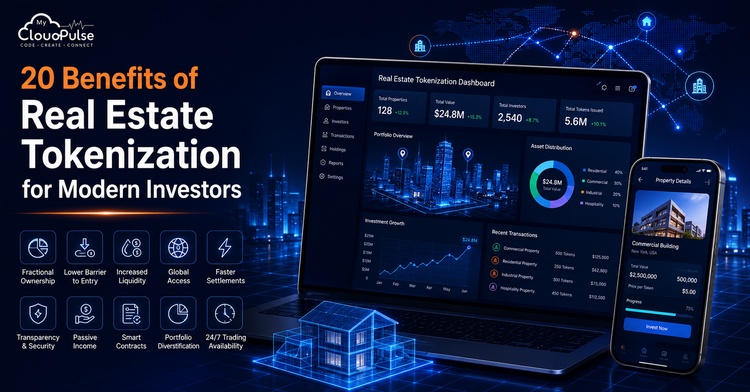
Real Estate has long been regarded as a lucrative asset class, but the barrier to entry can sometimes be prohibitively high for individual investors. Liquidity, complexity, significant price tags, and large up-front costs associated with real-asset investments can be a challenge for would-be market participants.
Real Estate Tokenization Development can provide a potential workaround to some of these hurdles by digitizing either ownership of or a claim on real assets through the issuance of digital tokens on a blockchain platform. Instead of a private individual or institution buying a property, it could be broken down into smaller portions sold to different investors in proportion to the amount of equity they can purchase. Real Estate Tokenization Development will likely play a critical role in the ongoing evolution of financial markets, as banks, real-asset firms, and investors become increasingly familiar with the opportunities presented by tokenized RWAs.
The real-world assets market can provide several benefits, but it also has its risks and limitations. For both private investors and institutions, the chance to participate in the lucrative real-asset market with a smaller investment footprint and take advantage of blockchain’s efficiencies is undoubtedly a draw. The ability to tokenize real estate and other liquid assets is also a compelling prospect for private-property owners seeking to raise capital.
Current Market Situation of Real Estate Tokenization Development
The real estate market development trends may be described as somewhat paradoxical. On the one hand, property remains one of the most substantial asset classes in the world, with huge volumes of investments. On the other hand, traditional real estate investment opportunities are associated with significant risks, barriers to entry (e.g., large upfront capital requirements), liquidity, and complex ownership structures. Furthermore, blockchain technology is becoming entrenched in the financial system, with traditional banks and asset managers experimenting with the digitalization of real-world assets. The IMF reports that tokenization is adopted in regulated finance for its ability to streamline settlements, introduce programmability, and ensure compliance.
The blockchain-based tokenization also refers to Real Estate Tokenization Development assets that help to show interest, such as in property-backed assets. For example, if anyone purchases a tokenized fraction that is related to be the property-based investment vehicle like a REIT. These types of tokens reflect a specific ownership power that can be issued on blockchain.
It is crucial to understand that, despite increasing interest, the adoption of Real Estate Tokenization Development remains marginal. As of now, in 2026, according to the analysis, the global property market size is estimated at around $300 trillion, of which tokenized assets constitute less than 0.1%. The market analysis demonstrates that tokenization adoption is at an early stage in most countries.
However, the situation in 2026 fundamentally differs from previous years in that institutional players have acknowledged the value of blockchain technology. In particular, the article states that in 2026, banks and asset managers tokenize various assets, including real estate, and regulators are considering how existing property law frameworks interact with novel tokenized assets.
Why Real Estate Tokenization Development Is Gaining Attention in 2026
Real estate has always been a popular and reliable investment, yet the traditional method of dealing with property can be challenging for smaller investors. Namely, buying a property always requires a considerable amount of capital, along with a lengthy procedure involving lots of paperwork. Similarly, selling a property can also be a time-consuming process compared to, say, stocks.

Thus, it is reasonable that Real Estate Tokenization Development is becoming a hot topic in the modern economic sphere. The main idea behind it is using blockchain technology to store any relevant information about the property in digital tokens. The latter means that a shared ownership of a property can be divided and tracked digitally and, by extension, facilitate the transaction process for everybody involved.
On both sides, there is enough motivation to embrace the opportunity that blockchain technology offers. First of all, Real Estate Tokenization Development fits perfectly into the ongoing trend of digitizing conventional assets. Financial institutions are interested in the opportunities to build infrastructure on top of blockchain, with tokens serving as an essential part of it. With the growing popularity of distributed ledger technology (DLT), more and more investors are drawn to the idea of making their investment holdings more accessible by digitizing them on the blockchain. Apart from that, tokenization can also make the process of buying/selling a property run smoothly. It is possible due to features like smart contracts, which allow regulating many aspects of real estate, including regular income collection or even ownership transfer.
It should be clear that Real Estate Tokenization Development is not magic for property ownership; it is necessary to understand the tokenization industry and also have to know about its peculiarities and problems. These two things will combine in tokenization, in which only some concepts belong to modernization. Additionally, it is concluded that rules, regulations, ownership, safety, valuation, authentication, and liquidity of assets. Before investing in digital assets, have to be know about risks associations. For example: Tokenized properties depend upon real estate markets, so a user cannot easily and quickly sell their assets in an emergency.
Therefore, tokenization is a modern method for transactions and the development of property ownership in digital asset markets. In 2026, it is not easy to determine its importance. Hence, for enhancing investment holdings through the tokenization aspects while using blockchain techniques that makes more effective and smart aspects as compare to traditional methods. For real estate owners and developers its also provides some additional benefits and gives ideas about increasing revenue while entering a bigger pool of potential investors or users. Although to stay in financial markets, the Real Estate Tokenization Development process can be used for future achievements.
Real Estate Tokenization Development Can Transform Property Investment in 20 Ways in 2026
Digitalization and investments in new digital assets are two major benefits provided through the Real Estate Tokenization Development aspects that are emerging in the property and financial markets. An appropriate capital amount, a paper trail, and a selling procedure are necessary for conventional real estate. If a customer has a certificate of ownership on blockchain, Real Estate Tokenization can be changed and modified as per the requirements.
In the property fraction have chance to create compelling arguments for investors or users; it can be resolved through hundreds of thousands or millions of dollars for a project while wanted to be small percentage of a Real Estate Tokenization Development project. Additionally, with the help of a large number of investors, developers can make developments at a large scale.
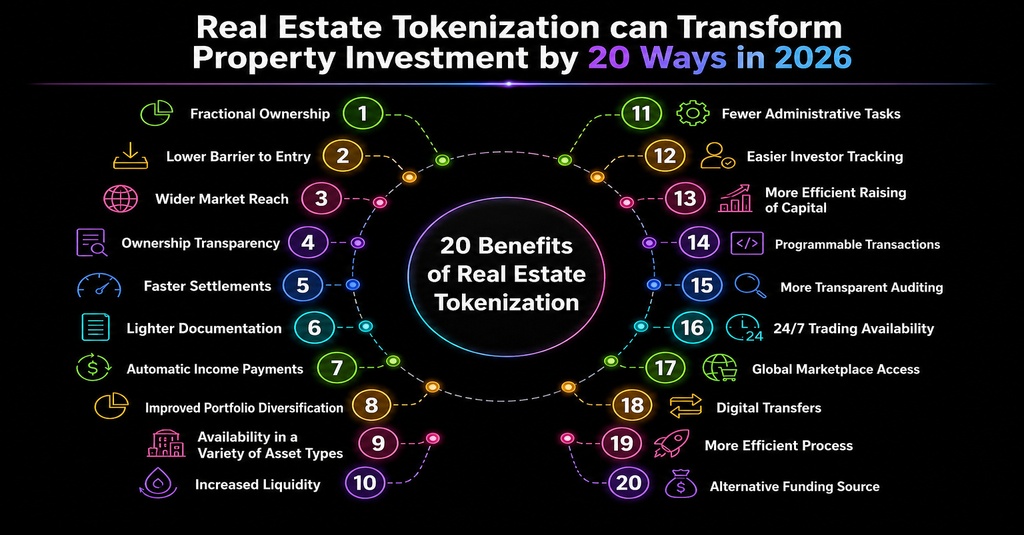
For attracting investors, developers, and organizations in 2026, here are 20 major benefits of Real Estate Tokenization Development :
1. Fractional Ownership – Investors can own a share of the property and not the whole asset.
2. Lower Barrier to Entry – Breaking down investments into smaller pieces allows individuals to get involved with a lower initial investment.
3. Wider Market Reach – Tokenization can allow access to a larger market.
4. Ownership Transparency – The use of blockchain can provide investors with a digital paper trail.
5. Faster Settlements – Digitization can reduce the time it takes to perform certain transactions.
6. Lighter Documentation – Records and ownership can be tracked digitally rather than manually.
7. Automatic Income Payments – Smart contracts can make it easier to receive payments from the investment.
8. Improved Portfolio Diversification – Fractional ownership can provide investors with more opportunities to diversify their portfolio.
9. Availability in a Variety of Asset Types – The tokenization of different types of real estate such as residential, commercial, hospitality, industrial, and mixed-use can offer more options to investors.
10. Increased Liquidity – If a secondary market is available for the tokenized property, it can offer a better way to resell the investment.
11. Fewer Administrative Tasks – The automation process can reduce clerical work on both sides of the transaction.
12. Easier Investor Tracking – Digitization can make it easier to track records and portfolios.
13. More Efficient Raising of Capital – The crowdfunding aspect of tokenization can give business owners a larger pool of potential investors to choose from.
14. Programmable Transactions – Smart contracts can be programmed to carry out specific tasks.
15. More Transparent Auditing – The use of blockchain can make audits more accessible for investors.
16. 24/7 Trading Availability – Investors can trade outside of regular business hours.
17. Global Marketplace Access – Investors can find opportunities worldwide.
18. Digital Transfers – The ownership of tokens can be transferred digitally.
19. More Efficient Process – Automation and digitization can minimize redundant tasks.
20. Alternative Funding Source – Developers can choose to tokenize their real estate crowdfunding campaigns as an alternative way to raise capital and a chance to build a digital real estate market and ecosystem.
Real Estate Tokenization Development: Key Advantages for Investors and Developers
Investors and developers can take advantages from the Real Estate Tokenization Development, but both aspects have different benefits. Tokens are not easily available because, by using tokens, investors can easily access, be flexible, and make transparency about the real estate tokenization, and that can be brought due to this investors are eager to get tokens. There are some benefits that are related to the developers and property owners that are highly linked to attracting a high number of investors, expansion of business, and optimizing management of their digital assets.
The traditional method of tokenization is targeting investing in properties rather than the replacements in a new platform of investments, whereas the current or modern trend of Real Estate Tokenization Development is all about the complementing.
Benefits for for Investors
1. One way in which investors might benefit from Real Estate Tokenization Development is by increasing their exposure to the real estate sector. To do this, you can allow them to invest in a smaller out-of-facility (OOF) of the property in accordance with the size of the token they acquire.
2. Tokenizing real estate allows investors to diversify their holdings in the market. On top of that, they stand to gain from the fact that blockchain technology, which represents their investment, offers transparency and trustworthiness, consistent revenue distribution, and accelerated transactions.
3. Since trading on a secondary market is a possibility, investors benefit from this approach’s flexibility because it allows them to sell their tokens if they wish.
4. Diversification is another advantage that investors may reap from Real Estate Tokenization Development. An investor can spread their funds across multiple properties or locations rather than putting all their eggs in one basket by purchasing a large stake in only one.
Benefits for Real Estate Developers and Owners
1. Obtaining sufficient funds to finance a project is connected to the advantages of Real Estate Tokenization Development for developers and owners. True, developers had a tough time getting investors’ money before blockchain technology came along, since traditional real estate investing had such high hurdles to entry.
2. Tokenization, if done right, can provide developers with a new way to raise capital, one that can entice more investors with smaller stakes in the property.
3. Also, developers will have the chance to optimize a lot of investor management processes with the blockchain-based system that is likely to be applied in the Real Estate Tokenization Development setup. Paperwork, transaction recording, distribution of revenues, reporting, and other processes can all be simplified with smart contracts.
Investors vs. Developers: What Difference Does It Make?
| For Investors | For Developers |
| Fewer entry barriers | New source of capital |
| Can make fractional investments | Access to larger pool of investors |
| Increase portfolio diversification | More flexible funding structures |
| Receive digital ownership records | Automated investor management |
| Simpler research process | Easier reporting and record keeping |
| Funds transferred faster | Increased transparency for stakeholders |
| Automatic income distributions | Potentially less administrative work |
| Access to a range of properties | Can develop new offerings |
Conclusion
Real Estate Tokenization Development is a relatively new concept with the potential to revolutionize the sector. The main advantage of putting it into action is that it makes some parts of this investment type more transparent and accessible.
First, if tokenization were to materialize, investors might have more options for purchasing real estate, diversifying their holdings, collecting asset information more efficiently, and transferring assets more quickly. On the flip side, tokenization provides a fresh funding opportunity for developers and property owners. Furthermore, blockchain technology allows for the automation of a plethora of tedious tasks associated with settlement, accounting, and payments.
Keep in mind that tokenization does not eliminate all real estate-related worries, despite its many advantages. Consequently, the investment is inextricably bound up with the asset’s value, which the investor has limited control over. Despite the emergence of a new method of attracting investment, Real Estate Tokenization Development is still open to regulation. State regulation will persist in several areas of this investment type, such as ownership, value, accounting, and taxation. In addition, the platform’s credibility, the standard of its output, and the demand for tokens on secondary markets all have an impact on liquidity.
FAQs
The questions below are frequently asked about Real Estate Tokenization Development :
Que 1: What do we understand by Real Estate Tokenization Development ?
Answer 1: It refers to encoding real estate rights of investments or ownership interests in digital tokens on a blockchain.
Que 2: What is the biggest advantage of Real Estate Tokenization Development ?
Answer 2: The biggest benefit of tokenization is that fractional ownership can be predicted in the tokenization process so that investors can purchase a certain percentage of real estate ownership rather than the overall assets.
Que 3: Does tokenization make real estate more liquid?
Answer 3: Tokenization can make liquid of real estate in only one situation where a compliant secondary market exists in which investors can sell their tokens.
Que 4: What are the benefits for real estate developers of using tokenization?
Answer 4: Because it streamlines project ownership management and makes the investment offer more accessible to a wider market, tokenization is a fantastic fundraising tool for real estate developers.
Que 5: Is tokenized real estate risk-free?
Answer 5: Tokenized real estate is not entirely safe from dangers related to regulations, property, markets, laws, liquidity, technology, and platforms.