Introduction
The travel and accommodation industry has changed dramatically because of platforms like Airbnb. Earlier, travelers mostly depended on hotels, travel agents, or offline recommendations. Today, users want flexible stays, local experiences, trusted hosts, simple payments, instant booking, and complete trip management from one mobile app.
Airbnb has become one of the most successful examples of a travel marketplace app. It connects guests with hosts who offer homes, apartments, villas, rooms, boutique stays, experiences, and services. The platform is powerful because it serves both sides of the marketplace: guests looking for stays and hosts looking to earn from their properties or services.
Developing an app like Airbnb means building a complete rental marketplace, not just a booking app. The app must include search, maps, listings, calendars, secure payments, host dashboards, guest profiles, chat, reviews, admin control, dispute handling, cancellation rules, and commission management.
For an advanced version, it may also include AI recommendations, smart pricing, fraud detection, property verification, multilingual support, group trip planning, and travel add-ons. The final cost depends on platform type, features, design quality, backend complexity, development location, and third-party integrations.
Market Stats for Vacation Rental App Development
The vacation rental and short-term rental industry continues to grow because travelers want flexible, private, and experience-based stays. Demand is also supported by digital booking platforms, remote work, domestic tourism, and the rise of mobile-first travel planning.
| Market Segment | Current Value / Forecast | Growth Indicator |
| Global vacation rental market | USD 101.7 billion in 2025; projected USD 121.9 billion by 2033 | CAGR of 3.7% from 2026 to 2033 |
| Vacation rental market projection | USD 109.40 billion in 2026; projected USD 136.78 billion by 2031 | CAGR of 4.57% from 2026 to 2031 |
| Short-term rental market | USD 138.05 billion in 2025; estimated USD 153.06 billion in 2026 | Projected to reach USD 371.54 billion by 2035 at 10.41% CAGR |
| Airbnb performance | 491.5 million Nights and Experiences Booked in 2024 | Up 10% year-over-year |
| Airbnb gross booking value | USD 81.8 billion in 2024 | Up 12% year-over-year |
| Airbnb revenue | USD 11.1 billion in FY 2024 | Up 12% year-over-year |
According to Grand View Research, the global vacation rental market was valued at USD 101.7 billion in 2025 and is expected to reach USD 121.9 billion by 2033. Mordor Intelligence projects the market to reach USD 136.78 billion by 2031. Precedence Research estimates stronger growth in the global short-term rental market, predicting it may reach USD 371.54 billion by 2035.
Airbnb’s own performance also proves the demand for this business model. In 2024, the company recorded 491.5 million Nights and Experiences Booked, USD 81.8 billion Gross Booking Value, and USD 11.1 billion revenue. These numbers show that rental marketplaces can become highly scalable when they solve both guest and host needs.
For entrepreneurs, travel businesses, real estate companies, and hospitality startups, this creates a strong opportunity. However, success depends on choosing the right niche, solving trust issues, providing smooth booking flows, and creating value for both guests and hosts.
Why Build an App Like Airbnb?
An Airbnb-like app can be developed for many business models. You can build a general vacation rental platform, luxury villa rental app, homestay booking app, student accommodation app, corporate rental marketplace, co-living platform, hotel plus rental marketplace, or experience booking platform.
The biggest advantage of this model is scalability. A marketplace does not always need to own properties. Instead, it connects property owners with travelers and earns commission, subscription fees, service charges, listing fees, or promotional revenue.
Another reason to build such an app is the growing demand for personalized travel. Many users no longer want only a standard hotel room. They want private homes, unique stays, pet-friendly properties, family-friendly houses, workation stays, local experiences, and flexible long-term stays.
A well-built Airbnb-like app can also serve local markets where global platforms may not fully meet user needs. For example, a regional rental app can focus on local payment methods, local language, verified hosts, domestic tourism, religious travel, medical travel, student stays, or budget family stays.
Core Features for Developing an App Like Airbnb
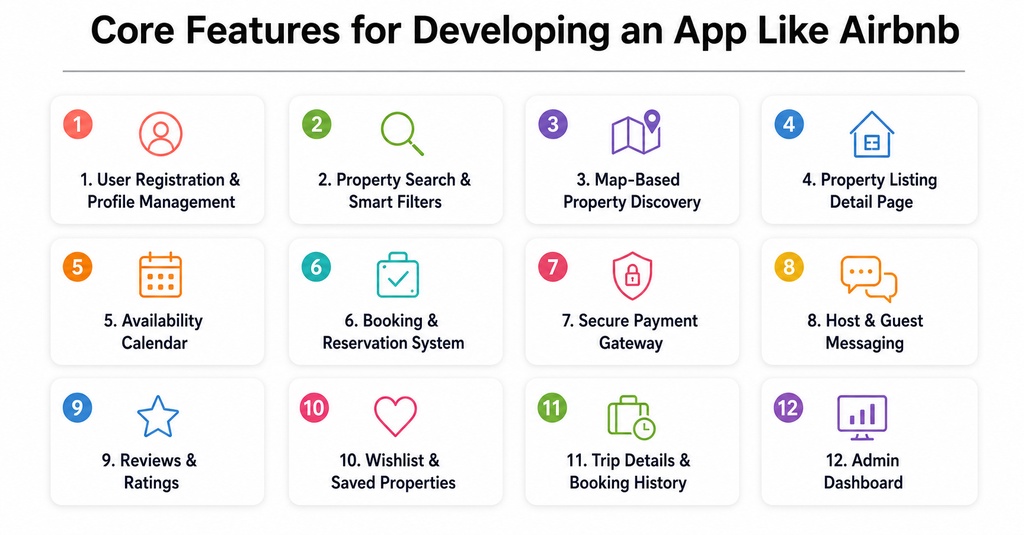
1. User Registration and Profile Management
Guests and hosts should be able to sign up using email, phone number, Google, Apple, or social login. The profile should include name, photo, contact details, identity verification status, saved payment methods, booking history, reviews, and preferences. For hosts, the profile should include property ownership details, payout method, tax details, identity proof, and listing management access.
2. Property Search and Smart Filters
Search is the most important feature of an Airbnb-like app. Users should be able to search by city, location, check-in date, check-out date, number of guests, price range, property type, amenities, rating, cancellation policy, and availability. Advanced filters can include pet-friendly stays, pool, kitchen, parking, Wi-Fi, workspace, beachfront, mountain view, entire home, private room, shared room, and accessibility features.
3. Map-Based Property Discovery
A rental app must include map-based search. Users should be able to see properties on a map, compare prices by location, check nearby attractions, and understand distance from important places. Map integration can be done using Google Maps, Mapbox, or Apple Maps.
4. Property Listing Detail Page
Each property should have a detailed page with a title, description, photos, amenities, house rules, location, price, cleaning fee, taxes, availability, cancellation policy, host details, ratings, and reviews. The listing page should also show trust signals such as verified host, verified property, host badge, guest ratings, and response time.
5. Availability Calendar
A real-time calendar helps guests see available dates and helps hosts manage bookings. The system should prevent double bookings and update availability instantly after every reservation. Hosts should be able to block dates, change prices for specific days, set minimum stay rules, and manage seasonal availability.
6. Booking and Reservation System
The booking system should support instant booking and request-to-book options. It should calculate the total amount, including nightly price, service fee, cleaning fee, taxes, discounts, and security deposit if required. A transparent price breakdown helps reduce booking drop-offs.
7. Secure Payment Gateway
Payments are a critical part of an Airbnb-like app. The app should support credit cards, debit cards, wallets, UPI, net banking, PayPal, Stripe, Razorpay, or local payment gateways depending on the target market. The platform should hold payments securely and release payouts to hosts based on the booking policy.
8. Host and Guest Messaging
In-app messaging allows guests and hosts to communicate before and after booking. Users can ask questions about check-in, amenities, location, rules, or special requests. This feature improves communication and reduces dependency on phone calls or external messaging apps.
9. Reviews and Ratings
Reviews help guests choose reliable properties and help hosts build credibility. After checkout, guests should be able to rate the stay based on cleanliness, location, communication, value, accuracy, and overall experience. Hosts should also be able to review guests.
10. Wishlist and Saved Properties
A wishlist allows users to save properties they like and compare them later. This feature is useful because users often explore many listings before booking. Wishlists can also support group planning.
11. Trip Details and Booking History
Users should be able to access all trip details in one place, including booking confirmation, check-in time, entry code, Wi-Fi details, address, host contact, cancellation rules, and payment receipt.
12. Admin Dashboard
The admin panel is required to manage users, hosts, properties, bookings, commissions, refunds, cancellations, reports, disputes, promotions, and platform analytics. Without a strong admin panel, it becomes difficult to operate the marketplace at scale.
Advanced Features of an Airbnb-Like App
1. AI-Powered Recommendations
AI can recommend properties based on user behavior, location, previous bookings, price range, travel group, and preferred amenities. This improves personalization and increases booking conversion.
2. AI Review Highlights
Instead of asking users to read hundreds of reviews, AI can summarize important review points such as location, cleanliness, family-friendliness, Wi-Fi quality, host behavior, and check-in experience. This feature saves time and helps users make faster decisions.
3. Dynamic Pricing for Hosts
Dynamic pricing helps hosts adjust prices based on demand, season, weekends, events, occupancy, competitor pricing, and local trends. This can improve host earnings and platform revenue.
4. Identity and Property Verification
Trust is one of the biggest challenges in rental marketplaces. The app should support identity verification, document verification, phone verification, email verification, property ownership verification, and manual property approval.
5. Flexible Payment Options
Flexible payment options can increase bookings. These may include partial payment, pay later, wallet credits, coupon codes, gift cards, and split payment between group travelers.
6. Experiences and Services
Airbnb has expanded beyond home rentals into Experiences and Services. A similar app can offer local activities, personal chefs, photography, spa services, training sessions, tours, luggage storage, and more.
7. Shared Itinerary and Group Planning
Group travel is common in vacation rentals. A shared itinerary lets travelers save places, view reservations, add activities, and plan together.
8. Multilingual and Multi-Currency Support
If the app targets international users, it should support multiple languages and currencies. This helps users book confidently in their preferred language and currency.
9. Fraud Detection and Risk Management
A rental marketplace must protect users from fake listings, fake guests, payment fraud, duplicate accounts, fake reviews, and suspicious transactions. AI-based fraud detection, manual moderation, secure payment holding, and identity verification can reduce risk.
10. Host Performance Analytics
Hosts should be able to see listing views, booking conversion, revenue, occupancy rate, cancellation rate, average rating, and pricing suggestions. These analytics help hosts improve their listing quality and earn more.
Process to Develop an App Like Airbnb
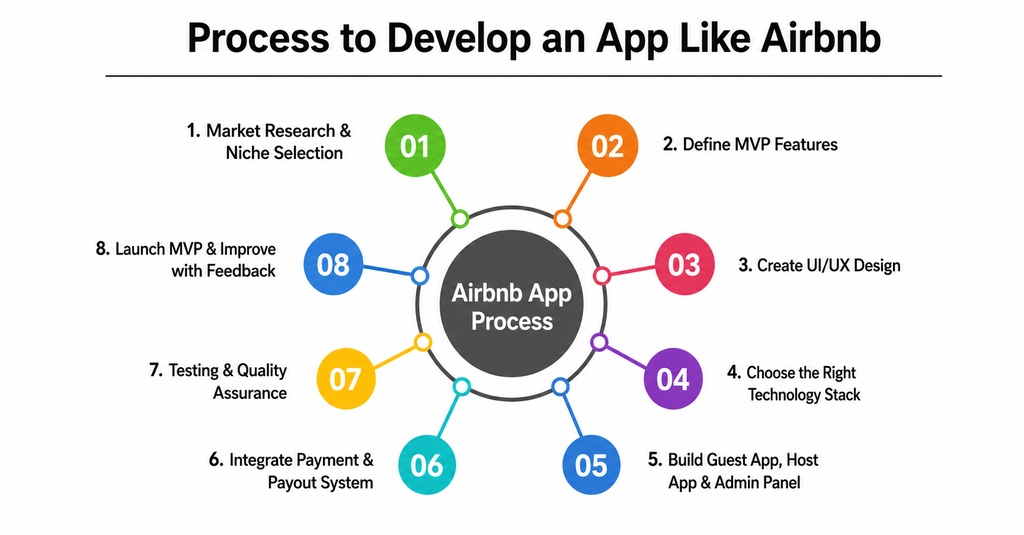
1. Start with Market Research and Niche Selection
The first step is to decide what type of rental marketplace you want to build. You can target vacation homes, luxury villas, budget homestays, student rooms, corporate housing, religious travel stays, or local experiences. A focused niche is better than copying Airbnb completely from day one.
2. Define MVP Features
The MVP should include guest registration, host registration, property listing, search, filters, map view, booking, payment, messaging, reviews, notifications, and admin panel. Avoid adding too many advanced features at the beginning.
3. Create UI/UX Design
The design should be clean, visual, and booking-focused. The guest app should focus on discovery and trust. The host app should focus on listing management, calendar, pricing, and payouts. The admin panel should focus on control and analytics.
4. Choose the Right Technology Stack
For mobile app development, businesses can choose React Native, Flutter, Swift, or Kotlin based on budget, performance needs, and platform strategy. Backend development can be handled with technologies such as Node.js, Python, Java, Go, or Ruby on Rails. To support real-time performance and scalability, the platform may also use PostgreSQL, MongoDB, Redis, Elasticsearch, AWS, Google Cloud, Azure, Firebase, Cloudflare, and scalable storage services.
5. Build Guest App, Host App, and Admin Panel
An Airbnb-like platform typically consists of three main parts: a guest app, a host app, and an admin panel. The guest app helps users search, book, pay, chat, and manage trips. The host app helps property owners create listings, manage availability, update prices, communicate with guests, and track earnings. The admin panel helps the business owner manage the full marketplace.
6. Integrate Payment and Payout System
The payment system must support guest payments and host payouts. It should handle refunds, cancellations, taxes, commission, security deposits, failed payments, and payment disputes. Marketplace payment logic is more complex than normal eCommerce payment logic.
7. Add Testing and Quality Assurance
Testing should cover booking flow, date availability, payment processing, cancellation rules, refund logic, messaging, notifications, map accuracy, search results, and host payouts. A small bug in booking or payment can create serious user trust problems.
8. Launch MVP and Improve with User Feedback
Launch the app in one city, region, or niche first. Track user behavior, booking conversions, failed payments, host response times, cancellation rates, and customer complaints. After collecting feedback, improve the app and gradually add advanced features.
Cost to Develop an App Like Airbnb
The cost to develop an app like Airbnb depends on the number of apps, feature complexity, UI/UX quality, backend architecture, payment logic, admin dashboard, and development team location. A basic app costs less, while complex apps with custom backend, AI, real-time chat, map search, payment systems, and admin dashboards need a higher budget.
| App Type | Estimated Cost | Timeline |
| Basic rental booking MVP | $40,000-$80,000 | 3-5 months |
| Airbnb-like app with guest and host modules | $80,000-$150,000 | 5-7 months |
| Full platform with guest app, host app, admin panel, payments, chat, and maps | $150,000-$300,000 | 7-10 months |
| Advanced marketplace with AI, dynamic pricing, multi-currency, and fraud detection | $300,000-$500,000+ | 10-14 months |
The final cost also depends on whether you build separate native apps for iOS and Android or use cross-platform development. Third-party integrations such as maps, payment gateways, SMS, email, identity verification, cloud hosting, analytics, and customer support tools also add to the total cost.
A practical way to control cost is to launch an MVP first. Build the core booking flow, validate the market, onboard reliable hosts, and then add advanced features such as AI recommendations, dynamic pricing, shared itinerary, and fraud detection.
Required Team Structure to Develop an App Like Airbnb
To build an Airbnb-like app, you need a skilled development team with experience in marketplaces, travel technology, payments, and scalable backend systems.
| Team Member | Responsibility |
| Project Manager | Plans roadmap, timeline, communication, and delivery |
| Business Analyst | Converts business goals into feature documentation |
| UI/UX Designer | Designs guest app, host app, admin panel, and booking flow |
| Mobile App Developers | Build iOS and Android apps |
| Backend Developers | Build APIs, booking system, payments, chat, and admin logic |
| Frontend Developer | Builds web platform and admin dashboard |
| QA Engineers | Test features, payments, booking flow, and security |
| DevOps Engineer | Manages cloud hosting, deployment, scaling, and monitoring |
| Security Specialist | Handles data protection, fraud prevention, and secure payments |
| Marketing/SEO Specialist | Helps launch and promote the platform |
For an MVP, you can begin with 6-8 people. For a full-scale platform, you may need 12-18 specialists depending on the complexity.
Monetization Methods for an Airbnb-Like App
1. Commission from Bookings
The most common monetization model is commission. The platform charges a percentage from hosts, guests, or both.
2. Guest Service Fee
The platform can charge guests a service fee during booking. This fee can cover platform usage, customer support, payment processing, and security.
3. Host Subscription Plans
Hosts can pay monthly or yearly for premium tools such as advanced analytics, featured placement, smart pricing, priority support, and multi-property management.
4. Featured Listings
Hosts can pay to promote their properties at the top of search results or in special categories. This model works well once the platform has enough traffic.
5. Cancellation and Convenience Fees
The platform can earn through cancellation charges, rescheduling fees, early check-in requests, late checkouts, and other convenience services.
6. Travel Add-Ons
The app can sell travel insurance, airport transfers, local tours, food experiences, car rentals, luggage storage, and concierge services.
7. B2B Property Management Tools
The platform can offer software tools to property managers, hotels, co-living brands, and rental agencies. This can become a strong recurring revenue model.
Challenges in Developing an App Like Airbnb
Building an Airbnb-like app is attractive, but it also has challenges. The biggest challenge is trust. Guests must trust hosts, hosts must trust guests, and both must trust the platform.
The second challenge is supply. Without enough quality listings, guests will not book. Without enough guests, hosts will not join. This two-sided marketplace problem requires strong launch planning.
The third challenge is booking accuracy. Availability calendars, pricing, cancellation rules, and payouts must work correctly. Any mistake can lead to disputes and refunds.
The fourth challenge is legal compliance. Short-term rental rules vary by city, state, and country. The platform may need to handle taxes, permits, local restrictions, identity checks, and data privacy rules.
The fifth challenge is customer support. Travel problems are urgent. If a guest cannot check in or a host faces property damage, the platform must respond quickly.
Conclusion
Developing an app like Airbnb is a strong business opportunity because the vacation rental, short-term rental, and digital travel markets are growing. Travelers want flexible stays, unique experiences, secure payments, verified hosts, and easy trip management. Hosts want simple listing tools, better visibility, secure payouts, and higher occupancy.
The cost to develop an app like Airbnb can start from around $40,000-$80,000 for a basic MVP and can reach $150,000-$300,000 for a full marketplace with guest app, host app, admin panel, payment gateway, chat, maps, and booking management. An advanced platform with AI, dynamic pricing, multi-currency support, fraud detection, and travel add-ons may cost $300,000-$500,000+.
The best approach is to start with a focused MVP. Build the core booking experience first, test it in a specific market, onboard quality hosts, improve trust and support, and then expand into advanced features. A successful Airbnb-like app is not only about technology. It is about trust, supply quality, smooth booking, local market understanding, and a strong user experience.
FAQs
Que1: How much does it cost to develop an app like Airbnb?
The cost usually ranges from $40,000 to $80,000 for a basic MVP, $150,000 to $300,000 for a full marketplace, and $300,000 to $500,000+ for an advanced app with AI, dynamic pricing, multi-currency payments, fraud detection, and complex admin tools.
Que 2: How long does it take to build an Airbnb-like app?
A basic MVP can take around 3-5 months. A full-featured Airbnb-like platform with guest app, host app, admin panel, payments, chat, maps, and reviews can take 7-10 months. An advanced platform may take 12 months or more.
Que 3: What are the must-have features of an Airbnb-like app?
The must-have features include user registration, property search, map view, filters, listing pages, availability calendar, booking system, secure payment, host-guest chat, reviews, wishlists, notifications, trip details, host dashboard, and admin panel.
Que 4: What technology stack is best for an Airbnb-like app?
React Native or Flutter can be used for cross-platform mobile apps. Swift and Kotlin are good for native apps. Node.js, Python, Java, Go, or Ruby on Rails can be used for backend development. PostgreSQL, MongoDB, Redis, Elasticsearch, AWS, Google Cloud, and Firebase can support database and infrastructure needs.
Que: 5 How does an Airbnb-like app make money?
An Airbnb-like app can make money through booking commissions, guest service fees, host service fees, subscription plans, featured listings, cancellation fees, travel add-ons, insurance, local experiences, and B2B property management tools.