Introduction
The electric vehicle industry is no longer limited to car manufacturers. It has created a complete digital ecosystem around charging, payments, energy management, fleet operations, route planning, and customer experience. One of the strongest examples of this ecosystem is Electrify America, a public EV charging network and mobile app that helps EV drivers find, access, pay for, and monitor charging sessions across a large fast-charging network.
Developing an app like Electrify America means building more than a simple map-based station finder. A serious EV charging app must connect users, charging stations, payment systems, maps, energy data, station operators, customer support teams, and sometimes even vehicles through standards such as OCPP, OCPI, and ISO 15118. The goal is to make charging simple: find a station, plug in, pay, charge, and continue the journey.
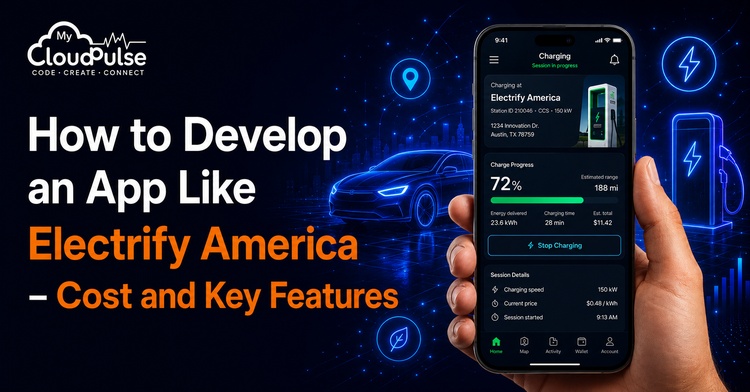
The Electrify America app provides real-time charging station availability, connector details, contactless payments, membership plans, charging progress, alerts, and session history. Its app listing also highlights start/stop charging from the phone, favorite stations, receipt emails, CarPlay compatibility, and Plug&Charge support for compatible vehicles.
For startups, energy companies, fleet operators, malls, highway businesses, real estate owners, and charge point operators, this type of app offers a strong business opportunity. The demand is rising because EV owners need reliable charging access, station operators need better utilization, and governments are pushing cleaner transportation.
Market Stats
The EV charging market is growing quickly because EV adoption, public charging demand, and government infrastructure investment are increasing at the same time. According to the International Energy Agency, electric car sales grew by 20% globally in 2025 and exceeded 20 million units. That means one in every four new cars sold worldwide in 2025 was electric.
Public charging infrastructure is expanding along with EV sales. IEA data shows that the global stock of public charging points reached more than 7 million by the end of 2025. China remained the largest public charging market, representing more than 65% of public charging points worldwide, and its public charging infrastructure grew from nearly 3.4 million points at the end of 2024 to over 4.7 million by the end of 2025.
The global EV charging infrastructure market also shows strong commercial potential. Grand View Research valued the global electric vehicle charging infrastructure market at USD 40.2 billion in 2025 and projected it to grow from USD 50.3 billion in 2026 to USD 238.8 billion by 2033, at a CAGR of 25.0% from 2026 to 2033.
The United States is also a major opportunity. Grand View Research estimated the U.S. EV charging infrastructure market at USD 6.41 billion in 2025 and projected it to reach USD 24.07 billion by 2030, growing at a CAGR of 30.3% from 2025 to 2030.
Software is becoming a separate growth engine within the EV charging industry. Global Market Insights valued the EV charging management software platform market at USD 3.4 billion in 2025 and projected it to grow from USD 4.3 billion in 2026 to USD 31.5 billion by 2035, at a CAGR of 24.8%. This shows that the opportunity is not only in installing chargers but also in building apps and platforms that manage charging experiences, billing, station monitoring, analytics, and energy optimization.
Why Electrify America Is a Strong Reference Model
Electrify America succeeds because it solves a major EV driver problem: charging uncertainty. Drivers want to know where chargers are, whether they are available, what connector they support, how fast they charge, how much charging will cost, and whether the session can be started without friction.
The company says it has more than 5,600 Hyper-Fast EV chargers in North America and is the largest open Hyper-Fast charging network in the United States. This network scale gives the app real utility because the software is connected to a large physical charging footprint.
Another important factor is charging speed. Electrify America supports Hyper-Fast charging up to 350 kW, which is valuable for highway travel, long-distance EV trips, and users who do not want to spend long periods waiting at a charging station.
Its membership strategy also improves retention. Electrify America offers a free Pass membership and a paid Pass+ membership. The app listing states that Pass+ costs $7 per month and can help users save about 25% on charging. This gives users a reason to create an account, return to the same network, and prefer Electrify America over competitor networks.
A special feature is Plug&Charge. Electrify America has stated that its public fast chargers support Plug&Charge for compatible vehicles, using ISO 15118. This reduces the need to open an app, scan a code, or tap a card for every session.
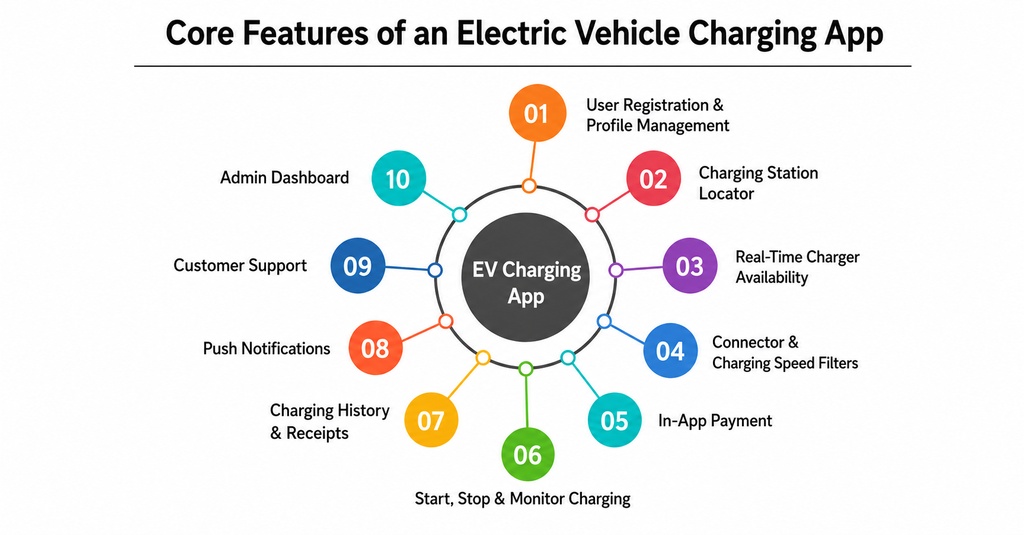
Core Features of an Electric Vehicle Charging App
The core features of an EV charging app must focus on convenience, trust, and session completion. Users should be able to find the right charger, reach it easily, pay securely, track the charging session, and get support if something goes wrong.
1. User Registration and Profile Management
Users should be able to sign up through email, phone number, Google, Apple, or social login. The profile should store vehicle type, connector preference, payment methods, membership plan, favorite stations, charging history, and notification settings. Vehicle profile data helps the app recommend suitable chargers instead of showing incompatible options.
2. Charging Station Locator
The station locator is the heart of the app. Users should search by current location, destination, city, highway route, connector type, charging speed, availability, pricing, and nearby amenities. The app should include map view, list view, distance, estimated travel time, station photos, opening hours, and station status.
3. Real-Time Charger Availability
Real-time status tells users whether a charger is available, in use, offline, under maintenance, or temporarily unavailable. This feature reduces frustration and avoids wasted trips. Charger status should come from the backend charging management system, often through OCPP or a similar protocol.
4. Connector and Charging Speed Filters
The app should allow filtering by CCS, CHAdeMO, Type 2, J1772, NACS/J3400, AC Level 2, DC fast charging, ultra-fast charging, and power rating. This is essential because different EVs support different connectors and maximum charging speeds.
5. In-App Payment
The app should support credit cards, debit cards, digital wallets, prepaid balances, promo codes, and subscription plans. Payments should be secure, PCI-compliant, and transparent. Guest payment should also be considered because forcing every user to register can reduce conversion.
6. Start, Stop, and Monitor Charging
Users should be able to start charging, stop charging, see energy delivered, session duration, estimated cost, charging speed, battery percentage where available, and notifications when charging is complete.
7. Charging History and Receipts
The app should store completed sessions, kWh delivered, total cost, taxes, discounts, station name, date, start time, end time, and payment method. This is useful for personal budgeting, business reimbursement, tax records, and fleet reporting.
8. Push Notifications
Notifications can inform users when a charger becomes available, charging starts, charging stops, battery reaches a target state of charge, payment fails, idle fees are about to begin, or the station goes offline.
9. Customer Support
EV charging problems can be urgent. The app should provide live chat, phone support, ticket creation, refund requests, charger issue reporting, and troubleshooting guides.
10. Admin Dashboard
The admin side should include charger monitoring, pricing control, user management, refunds, station information management, revenue reports, maintenance tickets, and support tools.
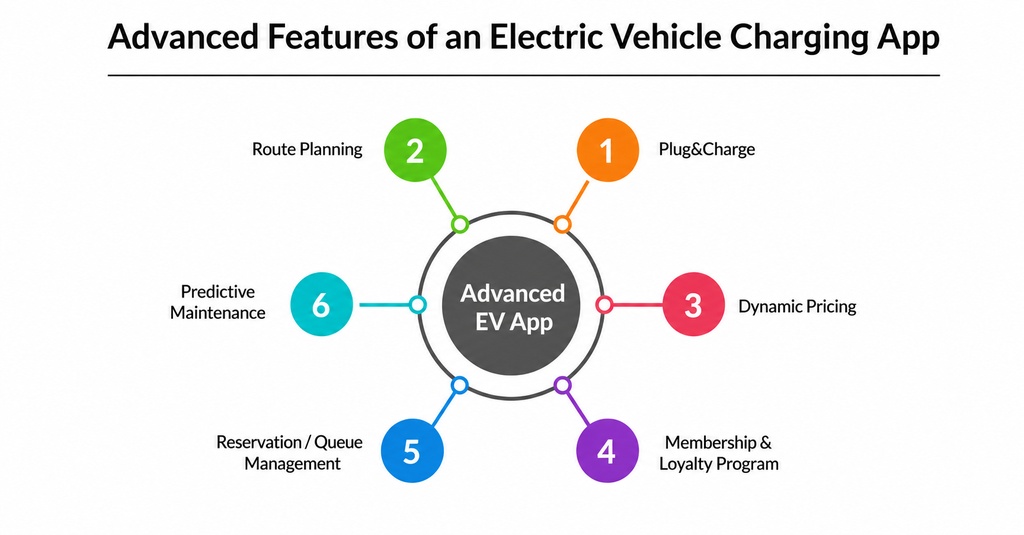
Advanced Features of an Electric Vehicle Charging App
Advanced features help an EV charging app move beyond basic station discovery. These features improve automation, loyalty, fleet usage, revenue optimization, and long-term scalability.
1. Plug&Charge
Plug&Charge allows compatible users to plug in the vehicle and automatically authenticate and pay without manually starting the session in the app. This requires ISO 15118, certificate handling, charger compatibility, and backend payment integration.
2. Route Planning
Users enter destination, current battery level, vehicle model, range, and preferred charging speed. The app recommends the best charging stops along the route, making long-distance EV travel more predictable.
3. Dynamic Pricing
Pricing can change based on location, demand, energy cost, time of day, charger speed, membership level, and grid conditions. The app must show pricing clearly before the session begins.
4. Membership and Loyalty Program
A subscription model can offer discounted charging, reward points, free credits, referral bonuses, priority support, and partner offers. This helps increase repeat usage.
5. Reservation or Queue Management
Users can reserve chargers, join a waitlist, receive charger-open alerts, or get an estimated wait time. This is useful at busy locations such as highways, malls, and urban charging hubs.
6. Predictive Maintenance
The backend can analyze charger performance, failed sessions, error codes, and usage patterns to detect problems before chargers go offline.
How to Develop an App Like Electrify America
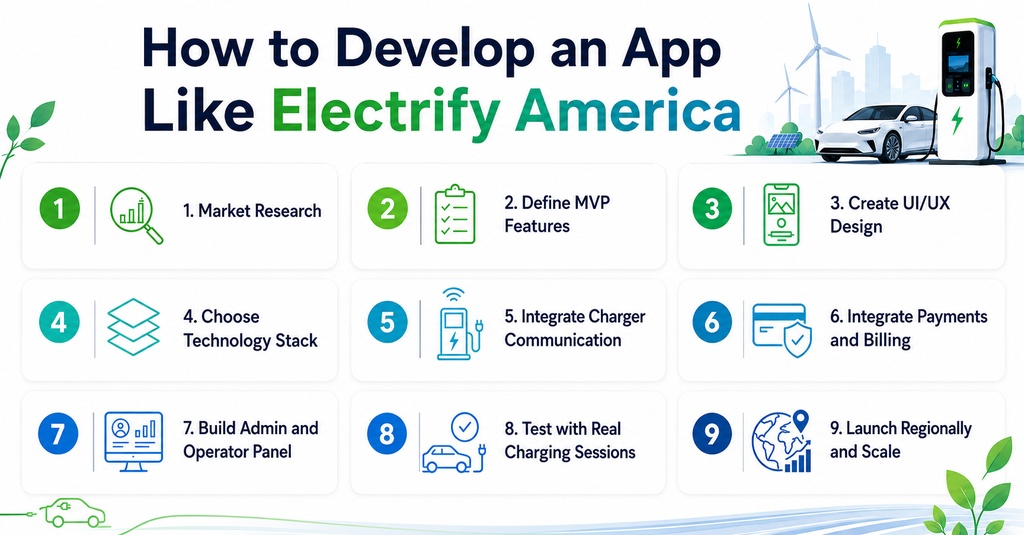
The development process should start with a practical MVP and then scale toward advanced network features. EV charging apps become expensive when teams attempt to build every advanced feature from day one. A phased roadmap reduces risk and helps the business validate demand early.
Step 1: Market Research and Business Model
Decide whether you are building for public EV drivers, private charging stations, fleets, hotels, malls, highways, apartments, or corporate campuses. Also decide whether you will own chargers, aggregate third-party chargers, provide white-label software, or build a full charge point operator platform.
Step 2: Define MVP Features
For the first version, include user registration, station locator, map integration, charger details, real-time availability, payment, session start/stop, notifications, charging history, and admin dashboard. Features like Plug&Charge and fleet billing can be added later.
Step 3: Create UI/UX Design
Design simple flows for finding a charger, reviewing availability, starting a session, tracking progress, paying, and receiving receipts. The app should work well even when the user is in a hurry or has low battery anxiety.
Step 4: Choose Technology Stack
For mobile app development, we can choose React Native, Flutter, Swift, or Kotlin based on budget, performance needs, and platform strategy. Backend development can be handled with technologies such as Node.js, Python, Java, or Go. To support real-time performance and scalability, the platform may also use PostgreSQL, Redis, cloud storage, WebSockets, MQTT, and reliable cloud services.
Step 5: Integrate Charger Communication
Use OCPP for charger-to-backend communication, OCPI for roaming and partner networks, and ISO 15118 for Plug&Charge. This is one of the most complex parts of the project.
Step 6: Integrate Payments and Billing
Integrate payment gateways such as Stripe, Adyen, Braintree, Razorpay, or local payment providers. The billing system should handle pre-authorization, refunds, tax invoices, wallet credits, subscriptions, promo codes, and failed payments.
Step 7: Build Admin and Operator Panel
The admin panel should help operators monitor chargers, update station details, manage pricing, view revenue, handle support tickets, track failed sessions, and generate reports.
Step 8: Test with Real Charging Sessions
Testing must include app testing, charger communication testing, payment testing, GPS accuracy testing, load testing, security testing, and real charging session testing with different chargers and vehicles.
Step 9: Launch Regionally and Scale
Start with a limited region, monitor charger utilization, failed sessions, app crashes, payment issues, and user complaints. Improve reliability and support workflows before expanding.
How Much Does It Cost to Develop an App Like Electrify America?
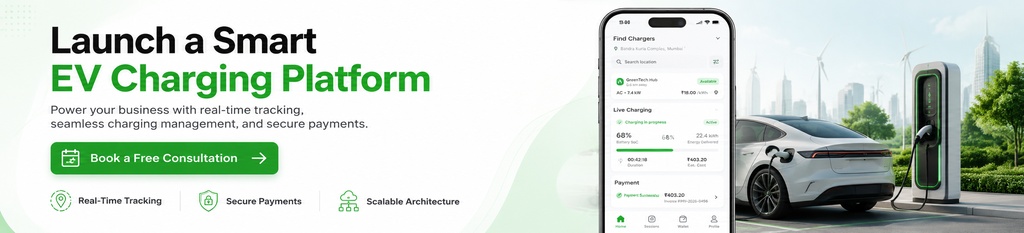
The cost depends on app complexity, number of platforms, backend architecture, real-time charger integration, payment features, OCPP/OCPI integration, Plug&Charge, analytics, and admin tools. Industry estimates for EV charging management software often range from around USD 40,000 to USD 250,000, depending on the scope and feature complexity.
A simple EV charger locator app can be developed at a lower cost because it mainly needs maps, station data, filters, and user accounts. A complete charging network app is more expensive because it needs real-time charger communication, secure payments, session control, billing logic, charger monitoring, and operator dashboards.
A full enterprise platform with Plug&Charge, dynamic pricing, roaming, fleet management, predictive maintenance, and energy optimization requires a significantly larger budget because it combines mobile app development, backend engineering, protocol integration, cybersecurity, cloud architecture, and hardware testing.
The cost below is a practical estimate for planning. Actual cost can change based on the country of development, hourly rates, charger hardware, API availability, compliance requirements, and design complexity.
| App Type | Estimated Cost | Timeline | Included Scope |
| Basic EV charger locator app | $35,000 – $70,000 | 3 – 4 months | Map, station list, filters, user profile, basic reviews |
| MVP like Electrify America | $70,000 – $120,000 | 4 – 6 months | Station locator, real-time status, payment, history, notifications |
| Full charging app with admin panel | $120,000 – $250,000 | 6 – 9 months | Session control, OCPP integration, support dashboard, analytics |
| Advanced EV charging platform | $250,000 – $450,000 | 9 – 12 months | OCPI, route planning, fleet tools, dynamic pricing, reporting |
| Enterprise-grade network platform | $450,000 – $800,000+ | 12+ months | Plug&Charge, high availability, energy optimization, predictive maintenance |
This software cost does not include physical charging hardware, installation, electrical work, utility upgrades, permits, site leases, charger maintenance, or customer support operations. Ongoing app maintenance should also be planned, including mobile OS updates, backend maintenance, server costs, support, security patches, and third-party licenses.
Required Team Structure to Develop an EV Charging App
An app like Electrify America needs a cross-functional team because the product combines mobile experience, backend systems, real-time infrastructure, payments, EV protocols, data analytics, and operations. A small MVP can be built with a lean team, but a full charging network platform requires a larger engineering and operations setup.
| Role | Responsibility |
| Product Manager | Defines roadmap, user flows, priorities, and release plan |
| Business Analyst | Converts business requirements into technical documentation |
| UI/UX Designer | Designs the mobile app, admin dashboard, maps, and charging flows |
| Mobile Developers | Build iOS and Android apps using native or cross-platform technology |
| Backend Developers | Build APIs, payment logic, charger communication, admin systems, and databases |
| OCPP/EV Protocol Engineer | Handles charger integration, OCPP, OCPI, ISO 15118, and hardware communication |
| DevOps Engineer | Manages cloud infrastructure, deployment, scaling, monitoring, and uptime |
| QA Engineers | Test app, backend, payments, charger sessions, and edge cases |
| Security Specialist | Handles authentication, encryption, PCI compliance, and security audits |
| Data Analyst | Builds usage, revenue, utilization, and energy reports |
| Support/Operations Team | Handles customer support, refund issues, station problems, and maintenance tickets |
For an MVP, a smaller team of 6 to 8 people can work. For a full charging network platform, a business may need 12 to 20+ people across product, engineering, QA, DevOps, security, analytics, and operations.
Monetization Methods
A charging app can generate revenue in several ways. The right model depends on whether the company owns chargers, manages third-party chargers, aggregates networks, or sells software to other operators.
1. Charging Session Commission
Charge users per kWh, per minute, or per session and keep a margin after energy and operating costs.

2. Subscription Plans
Offer paid memberships with discounted charging, priority support, lower idle fees, loyalty points, or monthly credits.
3. Fleet Charging Plans
Sell monthly or usage-based plans to taxi fleets, delivery companies, logistics firms, rental companies, and corporate EV fleets.
4. White-Label Software
Provide the app and admin panel to hotels, malls, parking operators, apartments, and local charging businesses under their own brand.
5. Advertising and Partnerships
Promote nearby cafes, restaurants, malls, insurance providers, EV accessories, car service centers, or energy brands.
6. Roaming Revenue
Use OCPI-based roaming partnerships to earn revenue when users from partner networks charge at your stations or your users charge through partner networks.
7. Data and Analytics
Offer privacy-safe, anonymized insights to station owners, city planners, energy companies, and fleet managers.
Challenges to Consider When Develop an App Like Electrify America
The biggest challenge is reliability. EV drivers may be stranded if charger data is inaccurate, payment fails, or the app cannot start a session. The app must show correct availability and handle errors clearly.
The second challenge is hardware fragmentation. Different chargers, connectors, firmware versions, and protocols can behave differently. A strong testing plan is required before launch.
The third challenge is payment complexity. Charging sessions may fail, stop midway, deliver less power than expected, or create disputes. Refunds, pre-authorizations, receipts, taxes, and billing rules must be handled properly.
The fourth challenge is scalability. If your network grows from 50 chargers to 5,000 chargers, your backend must handle real-time events, station monitoring, customer support, and analytics without downtime.
The fifth challenge is user trust. EV users expect accurate station data, transparent pricing, reliable support, and simple charging flows. A confusing app can damage the brand even if the charging hardware is strong.
Conclusion
Develop an app like Electrify America is a high-potential business idea because the EV market, public charging infrastructure, and charging management software sectors are growing rapidly. But success depends on more than creating a clean mobile app. You need reliable station data, real-time charger communication, secure payments, strong backend infrastructure, smart pricing, customer support, and a scalable admin system.
Electrify America’s success comes from combining a large charging network, Hyper-Fast charging, real-time availability, contactless payment, membership pricing, Plug&Charge, third-party map visibility, and congestion management. A new app can compete by focusing on reliability, transparent pricing, route planning, fleet features, local partnerships, and excellent user experience.
The estimated cost to develop an app like Electrify America can start around $70,000 for an MVP and reach $250,000 to $800,000+ for a full enterprise-grade EV charging platform. The right approach is to start with a focused MVP, test it in a limited market, integrate chargers properly, and then scale into advanced features such as Plug&Charge, dynamic pricing, fleet management, and energy optimization.
FAQs
1. How much does it cost to develop an app like Electrify America?
A basic EV charging app can cost around $35,000 to $70,000, while a full app with real-time charger status, payments, admin dashboard, notifications, and charging history can cost $120,000 to $250,000. An advanced enterprise platform with Plug&Charge, OCPP, OCPI, fleet tools, analytics, and energy management can cost $450,000 to $800,000+.
2. How long does it take to build an EV charging app?
A simple MVP may take 3 to 4 months. A full-featured EV charging app usually takes 6 to 9 months. An advanced network management platform can take 12 months or more, especially if it includes charger hardware integration, Plug&Charge, fleet billing, and real-time monitoring.
3. What are the must-have features of an EV charging app?
The must-have features include user registration, station locator, map navigation, real-time charger availability, connector filters, payment integration, start/stop charging, charging progress, notifications, charging history, receipts, and an admin dashboard.
4. What is the main USP of Electrify America?
Electrify America’s main USP is its large open Hyper-Fast charging network in the United States, combined with 350 kW charging, real-time charger data, membership pricing, Plug&Charge, and a mobile app that helps users locate, pay, and monitor charging sessions.
5. Can I build an EV charging app without owning charging stations?
Yes. You can build an aggregator app that lists third-party charging stations, a white-label platform for station owners, or a roaming-based app using partner networks. However, if you want real-time availability, in-app payments, and session control, you need integrations with charging networks or charger management systems.