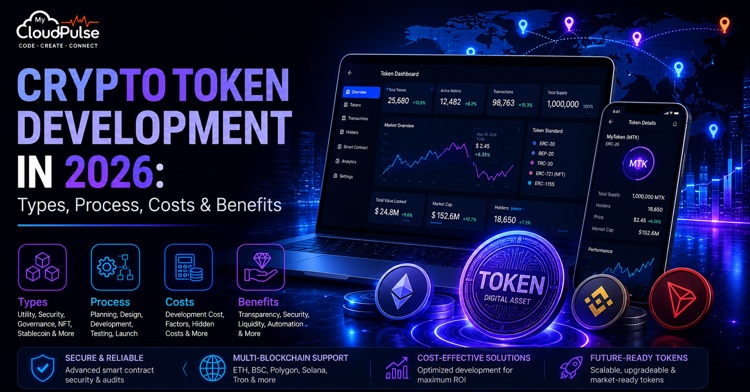
The cryptocurrency industry has evolved far beyond Bitcoin and simple digital payments. In 2026, crypto tokens have become the foundation of decentralized finance (DeFi), Web3 applications, NFT ecosystems, blockchain gaming, tokenized real-world assets (RWAs), digital identity, and enterprise blockchain solutions. Businesses, startups, financial institutions, and even governments are increasingly leveraging blockchain technology to create secure, transparent, and programmable digital assets that power the next generation of digital economies.
Crypto token development has emerged as a strategic investment for organizations looking to raise capital, improve customer engagement, enable decentralized governance, or build innovative blockchain-based products. Unlike cryptocurrencies that operate on their own blockchain, crypto tokens are typically created on established blockchain networks such as Ethereum, BNB Chain, Solana, Polygon, Avalanche, or Base, allowing businesses to launch secure and scalable digital assets with lower development costs and faster deployment.
The rapid adoption of tokenization is being driven by several factors, including growing institutional interest in blockchain, increasing demand for decentralized applications (dApps), advancements in smart contracts, and clearer regulatory frameworks across many regions. From utility tokens and governance tokens to security tokens and stablecoins, organizations now have multiple options to design token ecosystems that align with their business goals.
What Is Crypto Token Development? Market Overview & Growth Outlook
Today, crypto token development has become one of the fastest-growing areas in the blockchain industry. Businesses across finance, gaming, healthcare, real estate, supply chain, and entertainment are leveraging tokenization to improve transparency, automate transactions, reduce operational costs, and create new revenue streams. The increasing adoption of decentralized finance (DeFi), NFT marketplaces, blockchain gaming, and asset tokenization has significantly accelerated the demand for secure and scalable crypto token solutions.
Global Market Size
The global blockchain and tokenization ecosystem is experiencing rapid expansion as enterprises increasingly integrate blockchain into their digital transformation strategies. According to industry reports, the global tokenization market was valued at approximately USD 3.95 billion in 2025 and is projected to reach USD 4.7 billion in 2026, growing to nearly USD 15.9 billion by 2034 at a 16.4% CAGR.
At the same time, blockchain-based asset tokenization is witnessing even faster growth. The global asset tokenization market is estimated at USD 2.1 trillion in 2026 and is forecast to reach USD 24.5 trillion by 2033, driven by increasing institutional adoption, regulatory advancements, and the tokenization of real estate, securities, commodities, and other real-world assets.
Additionally, the on-chain tokenized real-world asset (RWA) market has expanded rapidly, with its market capitalization surpassing USD 19.3 billion by Q1 2026, highlighting the growing confidence of enterprises and investors in blockchain-based digital assets.
As governments introduce clearer regulatory frameworks and enterprises continue adopting Web3 technologies, crypto token development is expected to remain a key driver of digital innovation. Organizations investing in token development today are well-positioned to capitalize on the growing demand for decentralized applications, programmable digital assets, and blockchain-powered financial ecosystems.
Crypto Tokens vs. Cryptocurrencies: Understanding the Key Differences
Although the terms crypto token and cryptocurrency (crypto coin) are often used interchangeably, they represent two distinct types of digital assets. Understanding the difference is essential for businesses, investors, and entrepreneurs planning to enter the blockchain ecosystem.
A cryptocurrency (or coin) is a digital currency that operates on its own native blockchain. For example, Bitcoin runs on the Bitcoin blockchain, while Ether (ETH) powers the Ethereum blockchain. Coins are primarily designed to function as a medium of exchange, store of value, and transaction fee payment within their respective networks. They also help secure blockchain operations through consensus mechanisms such as Proof of Work (PoW) or Proof of Stake (PoS).
In contrast, a crypto token is a digital asset created on an existing blockchain using smart contracts. Instead of having its own blockchain, a token leverages established networks such as Ethereum (ERC-20), BNB Chain (BEP-20), Solana, Polygon, or Avalanche. Tokens can represent utility, governance rights, ownership of assets, rewards, access to decentralized applications (dApps), or even tokenized real-world assets (RWAs). Their flexibility makes them ideal for Web3 projects, DeFi platforms, NFT marketplaces, blockchain games, and enterprise applications.
Crypto Token vs. Cryptocurrency (Coin)
| Feature | Crypto Token | Cryptocurrency (Coin) |
| Blockchain | Built on an existing blockchain | Operates on its own blockchain |
| Creation | Developed using smart contracts | Requires building and maintaining a blockchain |
| Primary Purpose | Utility, governance, rewards, asset representation, fundraising | Digital payments, value transfer, network security |
| Development Cost | Lower due to existing infrastructure | Higher because a dedicated blockchain must be developed |
| Examples | USDT, LINK, UNI, AAVE, SHIB | Bitcoin (BTC), Ether (ETH), Solana (SOL), Litecoin (LTC) |
| Common Standards | ERC-20, BEP-20, SPL, ERC-721, ERC-1155 | Native blockchain protocols |
Types of Crypto Tokens: Which One Is Right for Your Business?
Crypto tokens are designed to serve different purposes within blockchain ecosystems. Depending on your business model, you can develop a token that facilitates payments, grants governance rights, represents ownership of real-world assets, or provides access to digital services. Choosing the right token type is one of the most important decisions when planning a blockchain project.
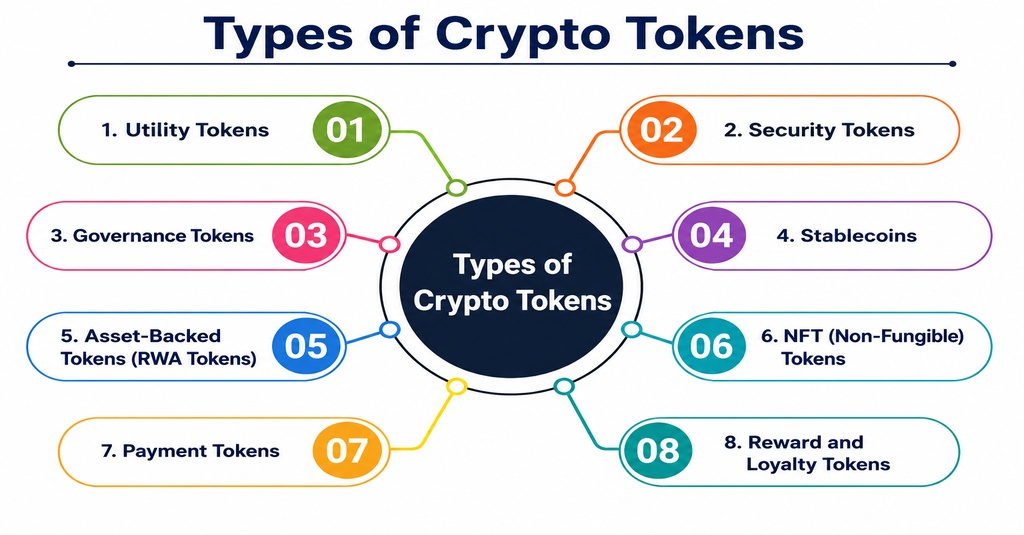
Here are the most common types of crypto tokens businesses develop today:
1. Utility Tokens
Utility tokens provide users with access to a product, service, or feature within a blockchain ecosystem. They are commonly used in decentralized applications (dApps), blockchain gaming, SaaS platforms, and Web3 marketplaces. These tokens are not intended as investments but instead function as digital access keys.
Examples: BAT, FIL, GRT
Common Use Cases:
- Access platform features
- Pay transaction or service fees
- Reward active users
- In-app purchases
2. Security Tokens
Security tokens represent ownership in real-world financial assets such as company shares, bonds, investment funds, or real estate. They are regulated financial instruments and must comply with applicable securities laws.
Examples: Tokenized company shares, digital bonds
Common Use Cases:
- Equity fundraising
- Fractional ownership
- Investment platforms
- Real estate tokenization
3. Governance Tokens
Governance tokens allow holders to participate in decision-making within decentralized projects. Token holders can vote on protocol upgrades, treasury management, fee structures, and ecosystem proposals.
Examples: UNI, AAVE, COMP
Common Use Cases:
- DAO governance
- Community voting
- Protocol upgrades
- Treasury decisions
4. Stablecoins
Stablecoins are cryptocurrencies whose value is pegged to stable assets such as the US Dollar, Euro, or gold. They minimize price volatility while enabling fast and low-cost blockchain transactions.
Examples: USDT, USDC, DAI
Common Use Cases:
- Cross-border payments
- Digital payments
- DeFi lending
- Trading and settlements
5. Asset-Backed Tokens (RWA Tokens)
Asset-backed tokens represent ownership of physical or financial assets such as real estate, gold, commodities, artwork, invoices, or carbon credits. They enable fractional ownership and improve liquidity for traditionally illiquid assets.
Examples:
- Tokenized real estate
- Gold-backed tokens
- Tokenized commodities
Common Use Cases:
- Real estate investment
- Commodity trading
- Fractional ownership
- Asset tokenization
6. NFT (Non-Fungible) Tokens
NFTs are unique digital assets that represent ownership of a specific item or piece of content. Unlike standard crypto tokens, each NFT has a distinct identity and cannot be exchanged on a one-to-one basis.
Examples:
- Digital artwork
- Gaming collectibles
- Event tickets
- Music rights
Common Use Cases:
- Digital collectibles
- Gaming assets
- Intellectual property
- Digital identity
7. Payment Tokens
Payment tokens are designed primarily to facilitate peer-to-peer transactions and digital payments. They enable secure, fast, and borderless transfers without relying on traditional financial intermediaries.
Examples: XRP, LTC
Common Use Cases:
- Merchant payments
- International remittances
- Online transactions
- Payment gateways
8. Reward and Loyalty Tokens
Businesses use reward tokens to encourage customer engagement and retain loyal users. These tokens can be earned through purchases, referrals, or platform participation and later redeemed for products, discounts, or exclusive benefits.
Common Use Cases:
- Customer loyalty programs
- Referral rewards
- Cashback systems
- Membership benefits
Ethereum Token Development: Understanding ERC-20, ERC-721 & Modern Token Standards
Ethereum remains the most popular blockchain for crypto token development due to its mature ecosystem, robust security, extensive developer community, and support for smart contracts. Since introducing token standards, Ethereum has enabled businesses to launch interoperable digital assets that work seamlessly with wallets, exchanges, decentralized applications (dApps), and DeFi protocols.
Today, Ethereum token development goes far beyond simple cryptocurrencies. Businesses can create utility tokens, governance tokens, NFTs, tokenized real-world assets (RWAs), gaming assets, and stablecoins using standardized smart contracts. The most widely used Ethereum token standards are ERC-20, ERC-721, and ERC-1155, each designed for different use cases.
1. ERC-20: The Standard for Fungible Tokens
ERC-20 is the most widely adopted Ethereum token standard. It defines a common set of rules that allow tokens to interact seamlessly with wallets, exchanges, and decentralized applications. Every ERC-20 token is fungible, meaning each token has the same value and can be exchanged on a one-to-one basis.
2. ERC-721: The Standard for Non-Fungible Tokens (NFTs)
ERC-721 introduced the concept of non-fungible tokens (NFTs), where every token is unique and cannot be exchanged on a one-to-one basis like ERC-20 tokens. Each NFT contains unique metadata that represents ownership of a specific digital or physical asset.
3. ERC-1155: The Multi-Token Standard
ERC-1155 is a more advanced Ethereum standard that allows developers to manage both fungible and non-fungible tokens within a single smart contract. This reduces deployment costs, simplifies token management, and improves transaction efficiency.
Which Ethereum Token Standard Should You Choose?
| Token Standard | Token Type | Ideal Use Cases |
| ERC-20 | Fungible | Utility tokens, stablecoins, DeFi, governance, payments |
| ERC-721 | Non-Fungible | NFTs, digital art, collectibles, gaming assets |
| ERC-1155 | Fungible & Non-Fungible | Blockchain games, metaverse platforms, NFT ecosystems |
How to Develop a Crypto Token: Step-by-Step Development Process
Developing a crypto token involves much more than writing a smart contract. A successful token requires careful planning, the right blockchain network, secure coding practices, regulatory compliance, and post-launch support. Whether you’re building a utility token, governance token, stablecoin, or tokenized real-world asset (RWA), following a structured development process helps ensure your project is secure, scalable, and ready for adoption.
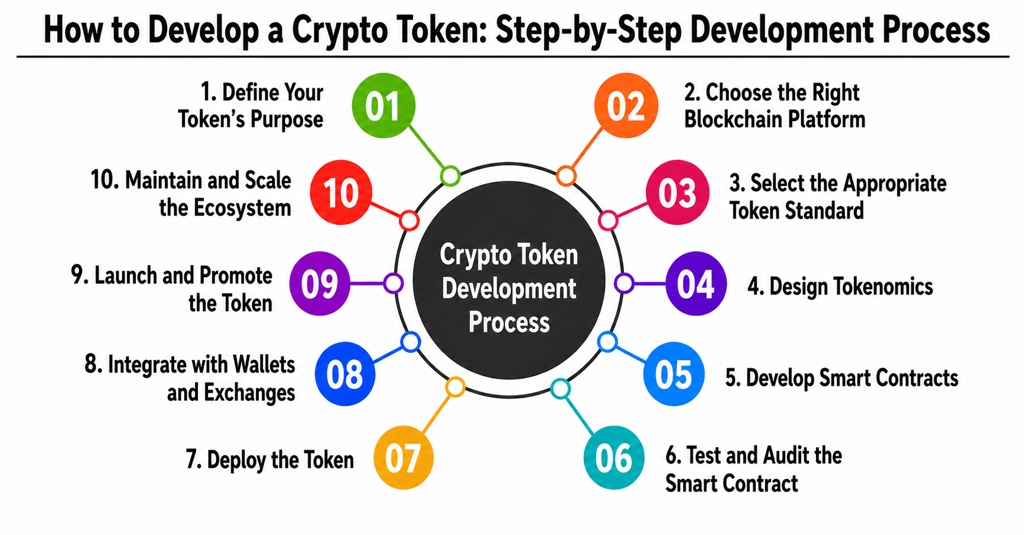
Step 1: Define Your Token’s Purpose
The first step is identifying why your token is needed. Define its role within your ecosystem and the value it will provide to users.
Key Considerations:
- Business objectives
- Target audience
- Token utility
- Total supply and distribution
- Tokenomics model
Step 2: Choose the Right Blockchain Platform
Select a blockchain network that aligns with your scalability, security, transaction cost, and ecosystem requirements.
Popular Blockchain Choices:
- Ethereum
- BNB Chain
- Solana
- Polygon
- Avalanche
- Base
Factors to Consider:
- Transaction fees
- Network speed
- Smart contract support
- Community adoption
- Security
Step 3: Select the Appropriate Token Standard
The token standard determines how your token functions and interacts with wallets, exchanges, and decentralized applications.
Common Standards:
- ERC-20 – Fungible tokens
- ERC-721 – Non-fungible tokens (NFTs)
- ERC-1155 – Multi-token standard
- BEP-20 – BNB Chain tokens
- SPL – Solana Program Library tokens
Step 4: Design Tokenomics
Tokenomics defines the economic model of your token and plays a major role in its long-term success.
Key Components:
- Total token supply
- Initial distribution
- Vesting schedules
- Staking rewards
- Burning mechanism
- Inflation or deflation strategy
Step 5: Develop Smart Contracts
Smart contracts contain the rules that govern your token’s behavior. They automate transactions, ownership transfers, minting, burning, and other functionalities.
Development Includes:
- Token creation
- Transfer logic
- Minting and burning
- Ownership controls
- Administrative permissions
- Security features
Step 6: Test and Audit the Smart Contract
Before deployment, the smart contract should undergo rigorous testing and an independent security audit to identify vulnerabilities.
Testing Includes:
- Unit testing
- Functional testing
- Stress testing
- Security auditing
- Bug fixing
Step 7: Deploy the Token
Once testing is complete, deploy the smart contract to the chosen blockchain network.
Deployment Tasks:
- Mainnet deployment
- Contract verification
- Wallet integration
- Block explorer verification
Step 8: Integrate with Wallets and Exchanges
To improve accessibility and adoption, integrate your token with popular wallets and cryptocurrency exchanges.
Popular Wallets:
- MetaMask
- Trust Wallet
- Coinbase Wallet
Integration Includes:
- Wallet compatibility
- Exchange listings
- Liquidity provisioning
- Token metadata
Step 9: Launch and Promote the Token
A successful launch requires more than technical deployment. Marketing and community engagement are critical for attracting users and investors.
Launch Activities:
- Website launch
- Whitepaper publication
- Community building
- Social media marketing
- Token sale or airdrop
- Partnership announcements
Step 10: Maintain and Scale the Ecosystem
Token development doesn’t end after launch. Continuous monitoring, upgrades, and community support ensure long-term success.
Post-Launch Activities:
- Smart contract upgrades (if supported)
- Security monitoring
- Governance implementation
- Feature enhancements
- Regulatory compliance
- Community management

Crypto Token Development Cost in 2026: Pricing Breakdown & Key Cost Factors
The cost of crypto token development depends on several factors, including the blockchain platform, token type, smart contract complexity, security requirements, compliance needs, and post-launch support. A simple ERC-20 utility token can be developed at a relatively low cost, while enterprise-grade projects with advanced tokenomics, staking, governance, cross-chain compatibility, and security audits require a significantly larger investment.
According to industry pricing guides and blockchain development providers, the cost of crypto token development typically ranges from approximately $5,000 for a basic ERC-20 or BEP-20 token to $150,000 or more for enterprise-grade token ecosystems with advanced smart contracts, security audits, DeFi features, and regulatory compliance.
Estimated Crypto Token Development Cost
| Project Type | Estimated Cost |
| Basic Utility Token (ERC-20/BEP-20) | $5,000 – $15,000 |
| Standard Crypto Token with Custom Features | $15,000 – $40,000 |
| DeFi Token with Staking & Governance | $40,000 – $80,000 |
| Stablecoin Development | $50,000 – $100,000 |
| Asset-Backed (RWA) Token | $60,000 – $120,000 |
| Enterprise Crypto Token Platform | $100,000 – $150,000+ |
Note: These are estimated development costs and may vary depending on project complexity, technology stack, regulatory requirements, and the development team’s location and expertise.
Top Business Use Cases of Crypto Token Development
Crypto token development is transforming industries by enabling secure, transparent, and decentralized digital ecosystems. From financial services and real estate to gaming and healthcare, businesses are leveraging blockchain-based tokens to improve operational efficiency, create new revenue streams, and enhance customer engagement. Below are some of the most impactful use cases of crypto token development in 2026.
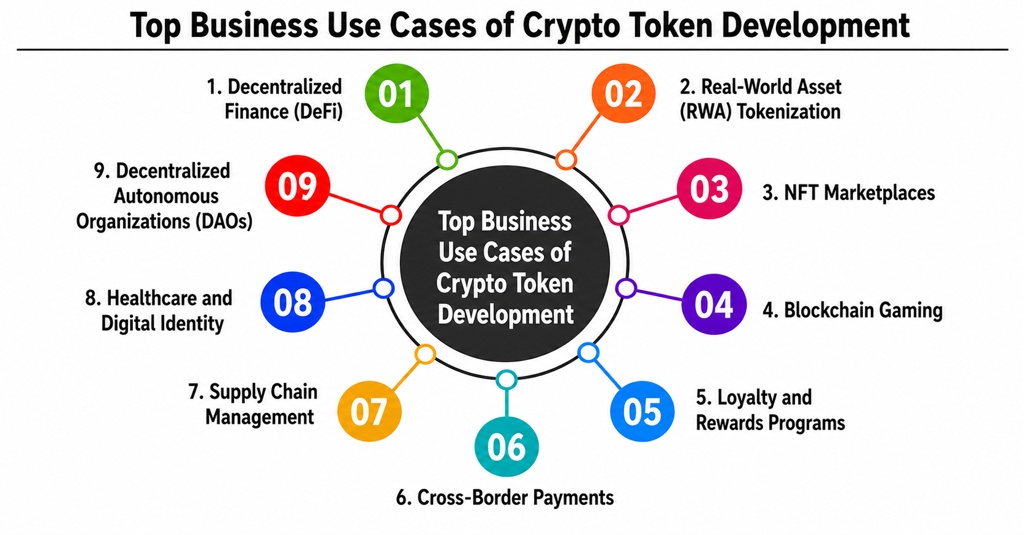
1. Decentralized Finance (DeFi)
DeFi platforms use crypto tokens to provide financial services without relying on traditional intermediaries such as banks. Users can lend, borrow, stake, trade, and earn rewards directly through smart contracts.
2. Real-World Asset (RWA) Tokenization
Businesses are tokenizing physical assets such as real estate, gold, artwork, commodities, and private equity to enable fractional ownership, improve liquidity, and simplify global investment.
3. NFT Marketplaces
Non-Fungible Tokens (NFTs) represent unique digital assets and ownership rights. NFT marketplaces use blockchain tokens to buy, sell, and trade digital collectibles and intellectual property.
4. Blockchain Gaming
Gaming companies use crypto tokens to create play-to-earn ecosystems where players can own, trade, and monetize in-game assets.
5. Loyalty and Rewards Programs
Businesses are replacing traditional loyalty points with blockchain-based reward tokens that are secure, transferable, and easy to redeem across multiple platforms.
6. Cross-Border Payments
Crypto tokens enable fast, secure, and cost-effective international transactions without the delays and fees associated with traditional banking systems.
7. Supply Chain Management
Blockchain tokens improve supply chain transparency by securely tracking products, verifying authenticity, and recording every stage of the logistics process.
8. Healthcare and Digital Identity
Healthcare providers and digital identity platforms use blockchain tokens to secure sensitive information while giving users greater control over their data.
9. Decentralized Autonomous Organizations (DAOs)
Governance tokens empower communities to participate in decentralized decision-making by voting on proposals, protocol upgrades, and treasury management.
Conclusion
Crypto token development has become a cornerstone of the modern blockchain economy, enabling businesses to create secure, transparent, and programmable digital assets for a wide range of applications. From decentralized finance (DeFi) and NFT marketplaces to real-world asset (RWA) tokenization, blockchain gaming, and enterprise solutions, crypto tokens are transforming how organizations raise capital, engage users, and build decentralized ecosystems.
Choosing the right blockchain platform, token standard, and tokenomics model is critical to the long-term success of any crypto project. Equally important are secure smart contract development, rigorous security audits, regulatory compliance, and continuous post-launch maintenance. While development costs can vary based on project complexity, investing in a well-designed token ecosystem helps businesses reduce operational costs, improve transparency, and unlock new revenue opportunities.
As blockchain technology continues to evolve in 2026 and beyond, crypto token development will remain a key driver of Web3 innovation. Whether you’re a startup launching your first utility token or an enterprise exploring asset tokenization, partnering with an experienced blockchain development company can help you build a secure, scalable, and future-ready token ecosystem that delivers lasting value.
Frequently Asked Questions (FAQs)
Que 1: What is crypto token development?
Answer 1: Crypto token development is the process of creating digital tokens on an existing blockchain network such as Ethereum, BNB Chain, Solana, or Polygon using smart contracts. These tokens can represent utility, governance rights, digital assets, rewards, stablecoins, or tokenized real-world assets and are commonly used in DeFi platforms, NFT marketplaces, Web3 applications, and enterprise blockchain solutions.
Que 2: Which blockchain is best for crypto token development?
Answer 2: The ideal blockchain depends on your project’s goals and requirements.
- Ethereum – Best for DeFi, enterprise applications, and broad ecosystem support.
- BNB Chain – Lower transaction fees and faster processing.
- Solana – High-speed transactions with low costs.
- Polygon – Ethereum-compatible with improved scalability.
- Avalanche – High-performance blockchain for decentralized applications.
- Base – Scalable Ethereum Layer-2 network for modern Web3 applications.
Que 3: How long does it take to develop a crypto token?
Answer 3: Development timelines vary depending on the project’s complexity and required features.
- Basic ERC-20 or BEP-20 Token: 1–2 weeks
- Custom Utility or Governance Token: 3–6 weeks
- DeFi or Stablecoin Project: 6–12 weeks
- Enterprise Token Platform with Advanced Features: 3–6 months
Que 4: How much does crypto token development cost?
Answer 4: The cost of crypto token development depends on the blockchain platform, smart contract complexity, security requirements, and project scope. According to industry pricing guides, development costs typically range from $5,000 for a basic token to $150,000+ for enterprise-grade token ecosystems with advanced features such as staking, governance, cross-chain functionality, and comprehensive security audits.
Que 5: Why should businesses invest in crypto token development?
Answer 5: Crypto tokens provide businesses with a secure and efficient way to build decentralized ecosystems, automate transactions, and create new digital business models. They can be used for fundraising, customer rewards, governance, digital payments, asset tokenization, and decentralized finance. By adopting crypto token development, businesses can improve transparency, enhance customer engagement, reduce operational costs, and position themselves for growth in the rapidly expanding Web3 economy.