In today’s fast-evolving digital landscape, businesses are under constant pressure to innovate, scale, and deliver seamless user experiences. However, many organizations still rely on legacy applications that were not designed to handle modern demands such as cloud computing, AI integration, and real-time data processing. These outdated systems often result in high maintenance costs, security vulnerabilities, and limited scalability. This is where an Application Modernization Roadmap becomes essential, providing a structured approach to transform legacy systems into modern, agile, and future-ready applications that align with evolving business needs.
Application modernization is the process of transforming legacy systems into modern, agile, and scalable applications using advanced technologies like cloud computing, microservices, and automation. A well-defined application modernization roadmap provides a structured approach to upgrade existing systems while minimizing risks and ensuring business continuity.
In 2026, application modernization is no longer optional—it is a strategic necessity for organizations aiming to stay competitive, reduce technical debt, and improve operational efficiency. A clear roadmap helps businesses align technology with goals, optimize costs, and accelerate digital transformation.
Market Stats
The application modernization market is growing rapidly due to increasing digital transformation initiatives across industries.
📊 Market Growth & Insights
- Large enterprises account for over 62% of modernization adoption, while SMEs are growing at around 15% annually.
- Around 70–90% of legacy systems are expected to require modernization in the coming years.
- Businesses are increasingly adopting cloud-native architectures, AI, and microservices to modernize applications.
📈 Key Growth Drivers
- Rising technical debt in legacy systems
- Need for scalability and flexibility
- Increased adoption of cloud and AI technologies
- Demand for better user experience and performance
🌍 Industry Trends
- Shift toward microservices and containerization
- Increased focus on DevOps and CI/CD pipelines
- Adoption of hybrid and multi-cloud strategies
🔮 Future Outlook
Application modernization will continue to evolve with AI-driven automation, low-code platforms, and intelligent cloud infrastructure, making systems more adaptive and efficient.
Core Features of Application Modernization Roadmap
A successful application modernization roadmap relies on a set of core features that ensure a smooth transition from legacy systems to modern, scalable applications. These foundational elements help businesses improve performance, reduce costs, and enhance user experience.
🔍 Application Assessment & Portfolio Analysis
The first core feature involves evaluating existing applications to understand their performance, dependencies, and business value. This includes identifying outdated components, technical debt, and areas that require immediate attention.
Why it matters:
Helps prioritize modernization efforts and reduces unnecessary risks.
🧩 Modern Architecture Design
Modernization requires transitioning from monolithic systems to flexible architectures such as microservices and API-driven models. This enables better scalability, faster updates, and easier maintenance.
Why it matters:
Improves system agility and supports future growth.
☁️ Cloud Migration Capability
Cloud adoption is a key feature of modernization. Migrating applications to cloud platforms allows businesses to reduce infrastructure costs, improve performance, and access advanced services.
Why it matters:
Ensures scalability, reliability, and cost efficiency.
🔐 Security & Compliance Integration
Modern applications must include strong security measures such as encryption, identity management, and compliance with industry standards. This is especially important when handling sensitive data.
Why it matters:
Protects systems from cyber threats and ensures regulatory compliance.
⚙️ DevOps & Automation
Automation tools and DevOps practices streamline development, testing, and deployment processes. CI/CD pipelines enable faster releases and continuous improvements.
Why it matters:
Reduces development time and increases efficiency.
📊 Performance Monitoring & Optimization
Real-time monitoring tools help track system performance, detect issues, and optimize operations. Businesses can use analytics to improve application reliability and user experience.
Why it matters:
Ensures long-term stability and performance.
🎯 Final Insight
Core features provide the foundation for successful application modernization, enabling businesses to build scalable, secure, and high-performing systems that meet modern digital demands.
Advanced Features of Application Modernization Roadmap
To fully unlock the benefits of application modernization, businesses must integrate advanced features that enhance scalability, performance, and intelligence. These capabilities go beyond basic upgrades and enable organizations to build future-ready digital systems.
🤖 AI & Intelligent Automation
Artificial Intelligence plays a key role in modern applications by enabling predictive analytics, automated workflows, and smarter decision-making. AI can analyze user behavior, detect anomalies, and optimize system performance, reducing manual effort and improving efficiency.
📡 Microservices & Containerization
Modernized applications often adopt microservices architecture, where applications are broken into smaller, independent services. Containerization tools like Docker and Kubernetes help manage these services efficiently, allowing faster deployment, scalability, and easier maintenance.
🔗 API-First Development
API-driven architecture enables seamless integration with third-party services, mobile apps, and cloud platforms. This ensures flexibility and allows businesses to expand their ecosystem without rebuilding entire systems.
☁️ Multi-Cloud & Hybrid Cloud Support
Advanced applications leverage multi-cloud or hybrid cloud environments to improve reliability, avoid vendor lock-in, and optimize costs. This approach ensures high availability and better disaster recovery.
📊 Advanced Data Analytics
Modern applications use real-time analytics and dashboards to provide actionable insights. Businesses can track performance, user behavior, and operational metrics to make data-driven decisions.
🔐 Zero Trust Security Model
Security is enhanced through zero trust architecture, where every user and device is continuously verified. Features like multi-factor authentication, encryption, and access control ensure robust data protection.
🎯 Final Insight
Advanced features transform application modernization from a simple upgrade into a powerful digital transformation strategy, enabling businesses to innovate, scale, and stay competitive in a rapidly evolving technological landscape.
Development Process of Application Modernization Roadmap
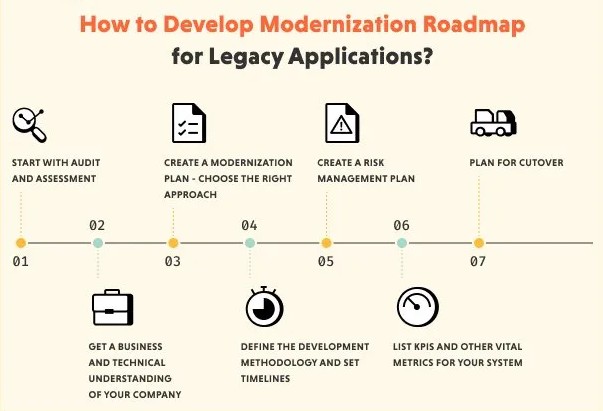
Application modernization is a structured approach to transforming legacy systems into scalable, efficient, and future-ready applications. Since these systems are critical to business operations, the process must be carefully planned and executed to minimize risks and disruptions.
🔍 Step 1: Assessment & Discovery
The process begins with evaluating existing applications, infrastructure, and dependencies. This includes identifying performance issues, technical debt, and areas that require improvement. Clear business goals and user requirements are also defined at this stage.
🎯 Step 2: Strategy & Planning
Based on the assessment, organizations choose the most suitable modernization strategy—such as rehosting, replatforming, refactoring, or rebuilding. A detailed roadmap is created, outlining timelines, resources, and expected outcomes.
🧩 Step 3: Architecture Design
A modern architecture is designed using cloud-native technologies, microservices, and APIs. This ensures scalability, flexibility, and seamless integration with other systems.
💻 Step 4: Development & Migration
Developers begin transforming the application by updating code, migrating data, and integrating modern tools and platforms. This phase often happens in stages to reduce disruption to existing operations.
🧪 Step 5: Testing & Quality Assurance
Thorough testing is conducted to ensure functionality, performance, and security. This includes regression testing, load testing, and vulnerability assessments.
🚀 Step 6: Deployment
The modernized application is deployed using automated CI/CD pipelines. Businesses may opt for phased rollouts to ensure stability and minimize risks.
📈 Step 7: Monitoring & Optimization
After deployment, continuous monitoring and updates are essential to maintain performance, fix issues, and scale the system as needed.
🎯 Final Insight
A well-defined development process ensures smooth modernization, enabling businesses to build secure, scalable, and high-performing applications aligned with modern digital demands.
Required Team Structure
Application modernization is a complex initiative that requires a cross-functional team with expertise in legacy systems, cloud technologies, security, and modern development practices. Since modernization involves transforming existing applications without disrupting business operations, having the right team structure is essential for success.
A well-balanced team typically consists of 8–15 professionals, depending on the scale and complexity of the project.
👨💼 1. Product Manager (Strategic Leader)
The Product Manager oversees the entire modernization initiative and ensures alignment with business objectives.
Key responsibilities:
- Define modernization roadmap and priorities
- Coordinate between stakeholders and technical teams
- Track KPIs such as performance, cost savings, and user adoption
Why it matters:
Ensures the project delivers measurable business value.
📊 2. Business Analyst (Requirement Specialist)
The Business Analyst plays a critical role in understanding legacy systems and translating business needs into technical requirements.
Key responsibilities:
- Analyze existing workflows and system dependencies
- Define use cases and documentation
- Identify risks and improvement areas
Why it matters:
Reduces miscommunication and ensures efficient execution.
☁️ 3. Cloud Architect (Infrastructure Expert)
The Cloud Architect designs the target architecture for modernization.
Key responsibilities:
- Define cloud strategy (AWS, Azure, GCP)
- Design scalable and secure infrastructure
- Plan migration and deployment strategies
Why it matters:
Ensures scalability, performance, and cost optimization.
💻4. Application Modernization Roadmap
Developers are responsible for rebuilding or refactoring applications using modern technologies.
Key responsibilities:
- Develop APIs and microservices
- Refactor legacy code
- Build modern user interfaces
Why it matters:
Ensures functionality, performance, and user experience.
⚙️ 5. DevOps Engineer (Automation & Deployment)
DevOps engineers streamline development and deployment processes.
Key responsibilities:
- Implement CI/CD pipelines
- Automate testing and deployment
- Monitor system performance
Why it matters:
Accelerates delivery and ensures system reliability.
🔐 6. Security Specialist (Critical Role)
Security is essential during modernization, especially when handling sensitive data.
Key responsibilities:
- Implement security frameworks
- Ensure compliance (GDPR, HIPAA, etc.)
- Conduct vulnerability assessments
Why it matters:
Protects systems and builds trust.
🧪 7. QA Engineer (Quality Assurance)
QA engineers ensure the modernized application performs as expected.
Key responsibilities:
- Functional and performance testing
- Regression testing during migration
- Identify and fix bugs
Why it matters:
Prevents failures and ensures a smooth transition.
📊 8. Data Engineer / Data Analyst
Data experts handle migration and optimization of data systems.
Key responsibilities:
- Manage data migration and transformation
- Ensure data integrity and consistency
- Provide analytics and insights
Why it matters:
Ensures accurate and reliable data handling.
🎨 9. UI/UX Designer (User Experience Expert)
Designers improve usability and modernize the interface.
Key responsibilities:
- Create intuitive designs and workflows
- Enhance user experience
- Ensure responsiveness across devices
Why it matters:
Improves adoption and user satisfaction.
🎧 10. Support & Maintenance Team
Post-deployment support ensures system stability.
Key responsibilities:
- Monitor system performance
- Resolve issues and bugs
- Provide updates and enhancements
Why it matters:
Ensures long-term success and reliability.
👥 Team Structure Based on Project Stage
🚀 MVP / Initial Stage (6–8 Members)
- Product Manager
- Cloud Architect
- 2–3 Developers
- QA Engineer
- DevOps (part-time)
📈 Growth Stage (8–12 Members)
- Add Business Analyst
- Security Specialist
- UI/UX Designer
- Data Analyst
🌍 Enterprise Stage (12–15+ Members)
- Dedicated DevOps and security teams
- Data engineers and AI specialists
- Full support and maintenance teams
🎯 Final Insight
A strong team structure is the backbone of successful application modernization. By bringing together experts in cloud, development, security, and business strategy, organizations can ensure a smooth transition from legacy systems to modern, scalable applications.
Investing in the right team not only accelerates development but also reduces risks and ensures long-term success in the digital transformation journey.
Monetization Methods of Application Modernization Roadmap
Application modernization is not only a technical upgrade but also a significant business opportunity. Organizations and service providers can generate revenue through multiple monetization models by offering modernization solutions, tools, and services tailored to different business needs. In 2026, a hybrid monetization approach is commonly used to maximize profitability and scalability.
💰 Subscription Model (SaaS-Based Platforms)
One of the most effective monetization strategies is offering modernization tools and platforms as Software-as-a-Service (SaaS). Businesses can charge clients a monthly or yearly subscription fee for access to cloud-based modernization solutions, dashboards, and automation tools. Pricing tiers can vary based on features, number of users, or resource usage. This model ensures predictable recurring revenue and long-term customer relationships.
📦 Enterprise Licensing
Large organizations often require customized modernization solutions tailored to their infrastructure and business processes. Companies can offer enterprise licenses with one-time or annual fees, along with additional charges for support, maintenance, and upgrades. This model is particularly profitable due to high-value contracts and long-term commitments.
📊 Consulting & Strategy Services
Application modernization requires deep expertise in architecture, cloud migration, and system integration. Offering consulting services—such as roadmap planning, technology selection, and implementation strategy—can generate significant revenue. Many businesses are willing to pay premium fees for expert guidance that reduces risk and accelerates transformation.
🌐 API & Integration Monetization
Modern applications rely heavily on APIs for connectivity and integration. Companies can monetize APIs by charging clients for access to integration services, data exchange, or usage-based API calls. This approach is especially valuable for platforms that enable seamless interaction between legacy systems and modern applications.
💼 Customization & Implementation Services
Every organization has unique requirements, making customization a key revenue stream. Businesses can charge for tailoring applications, migrating legacy systems, and integrating third-party tools. Implementation services, onboarding, and training programs further add to the revenue potential.
☁️ Cloud & Managed Services
Offering managed cloud services, including hosting, monitoring, and maintenance, provides an ongoing revenue stream. Businesses can charge for infrastructure management, performance optimization, and security updates.
🎯 Final Insight
A successful monetization strategy in application modernization combines subscriptions, consulting, licensing, and service-based models. By offering flexible pricing and value-driven services, businesses can create sustainable revenue streams while helping organizations successfully transition into modern, scalable digital ecosystems.
Application Modernization Roadmap: Estimated Cost
The cost of application modernization varies widely depending on the size of the organization, the complexity of legacy systems, and the chosen modernization strategy. Unlike building a new application from scratch, modernization involves assessing existing infrastructure, migrating data, re-architecting systems, and ensuring minimal disruption to ongoing operations—making cost estimation more nuanced.
💸 Cost Breakdown
- Small-Scale Projects ($20,000 – $80,000)
These typically involve simple “lift-and-shift” (rehosting) strategies where applications are migrated to the cloud with minimal changes. Ideal for startups or small businesses, this approach focuses on reducing infrastructure costs without significantly altering application architecture. - Mid-Scale Modernization ($80,000 – $300,000)
This includes partial refactoring, replatforming, and integration with modern tools such as APIs, cloud services, and analytics platforms. Businesses at this level aim to improve performance, scalability, and user experience while maintaining core functionalities. - Enterprise-Level Modernization ($300,000 – $2M+)
Large enterprises often require complete transformation, including microservices architecture, containerization, AI integration, and multi-cloud deployment. These projects involve extensive data migration, security upgrades, and compliance implementation, making them resource-intensive but highly impactful.
⏱️ Development Timeline
- Basic Migration: 3–6 months
- Moderate Modernization: 6–10 months
- Full Enterprise Transformation: 10–18+ months
📊 Key Cost Factors
Several factors influence the overall cost of application modernization:
- Application Complexity: Number of modules, dependencies, and integrations
- Data Migration Requirements: Volume and sensitivity of data
- Modernization Strategy: Rehosting vs. refactoring vs. rebuilding
- Technology Stack: Cloud platforms, frameworks, and tools used
- Security & Compliance: Industry regulations and data protection standards
- Team Expertise: Skilled professionals increase efficiency but may raise costs
💡 Cost Optimization Tips
- Start with an MVP or phased modernization approach
- Prioritize high-impact applications first
- Use cloud-native and open-source technologies
- Automate testing and deployment processes
🎯 Final Insight
While application modernization requires a significant investment, the long-term benefits—such as reduced operational costs, improved performance, enhanced security, and greater scalability—far outweigh the initial expenses. A well-planned strategy ensures that businesses maximize ROI while building future-ready systems that can adapt to evolving technological demands.
Conclusion
Application modernization has become a strategic imperative for organizations aiming to remain competitive in an increasingly digital-first world. As legacy systems continue to limit scalability, innovation, and performance, businesses must adopt a structured and forward-thinking approach to transform their applications. A well-defined application modernization roadmap not only helps reduce technical debt but also enables organizations to align their technology infrastructure with evolving business goals.
In 2026, modernization is no longer just about migrating to the cloud—it’s about building intelligent, agile, and future-ready systems. By leveraging modern technologies such as microservices, AI, automation, and cloud-native architectures, businesses can significantly improve operational efficiency, accelerate time-to-market, and deliver enhanced user experiences.
However, successful modernization requires careful planning, the right technology stack, and a skilled team. Organizations must evaluate their existing systems, choose the appropriate modernization strategy, and implement changes in a phased and controlled manner to minimize risks and disruptions. Continuous monitoring and optimization are equally important to ensure long-term performance and scalability.
Moreover, investing in application modernization unlocks new opportunities for innovation, integration, and monetization. It empowers businesses to respond quickly to market changes, integrate with emerging technologies, and scale operations efficiently.
🎯 Final Insight
Application modernization is not just an upgrade—it is a long-term digital transformation strategy. Businesses that embrace modernization today will gain a competitive edge, improve resilience, and position themselves for sustained growth in the ever-evolving technological landscape.
FAQs
It is the process of updating legacy systems using modern technologies like cloud and microservices.
It ranges from $20,000 to $2M+ depending on complexity.
Improved scalability, reduced costs, better performance, and enhanced security.
Typically, 3–12 months based on project scope.
Rehosting, replat forming, refactoring, rebuilding, and replacing.