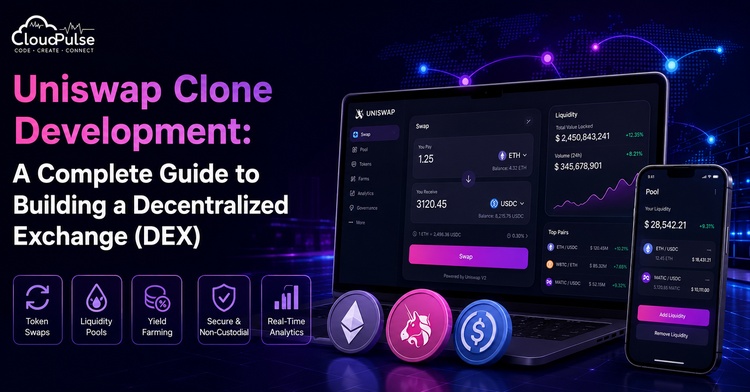
An integral part of the blockchain ecosystem, decentralised exchanges (DEXs) are seeing more activity as decentralised finance (DeFi) changes the face of the financial sector. Users are able to trade cryptocurrencies straight from their wallets with Uniswap’s Automated Market Maker (AMM) architecture, which eliminates the need for centralised intermediaries. Businesses and entrepreneurs have been motivated to create comparable platforms that are customised to meet their specific needs and target audiences, thanks to its permissionless nature, openness, and security.
Businesses can design a feature-rich decentralised exchange that mimics Uniswap’s fundamental operation with their own branding, enhanced trading capabilities, bespoke features, and blockchain support through Uniswap clone development. A Uniswap clone is a more efficient, economical, and scalable alternative to starting from scratch when it comes to entering the DeFi sector, which is experiencing significant growth.
How it operates, important features, technological stack, development method, cost aspects, benefits, problems, and best practices for creating a safe and effective decentralised exchange in 2026 are all covered in this comprehensive guide to Uniswap clone development. Launching a competitive DEX that satisfies the increasing demands of Web3 customers is no easy feat, but this article will help you grasp the ins and outs of it, whether you’re a startup, crypto entrepreneur, or company.
Decentralized Exchange (DEX) Market Size & Growth Outlook in 2026
Reasons for the considerable growth of the decentralised exchange (DEX) market include the increasing demand for self-custody, the rise of multi-chain blockchain ecosystems, and the rapid acceptance of decentralised financing (DeFi). Millions of consumers in 2026 are turning to decentralised exchanges (DEXs) as their go-to platform for crypto trading because of its security, transparency, and lack of reliance on centralised intermediaries.
From 2025–2030, the worldwide decentralised finance (DeFi) industry is expected to expand at a CAGR of 53.7%, reaching a value of USD 231.19 billion, according to Grand View Research. Decentralised exchanges handle daily trading volumes totalling billions of dollars across top blockchain networks, according to DefiLlama, demonstrating the growing popularity of DeFi and DEX platforms globally.
You can get software that works just like the Uniswap DEX with all of its essential features by purchasing a Uniswap clone script. It is built utilising AMM technology and smart contracts so users may trade cryptocurrencies straight from their wallets, make trading pools liquid, and receive incentives decentralizedly.
What Is a Uniswap Clone Script?
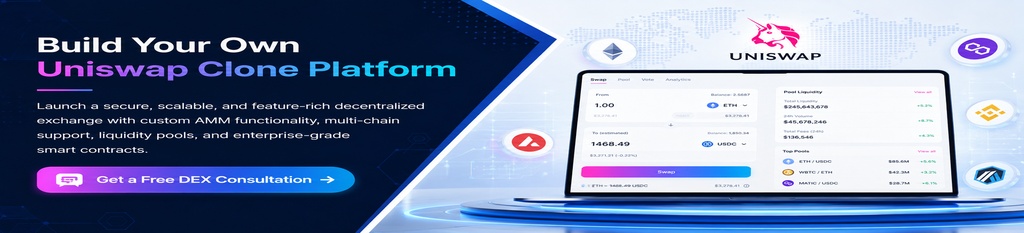
Instead of starting from square one when building a decentralised exchange, you can save a tonne of time, money, and headaches by using a Uniswap clone script. A decentralised trading environment may be built from the ground up by businesses using the platform to their liking by adding their own branding, supported blockchain networks, token pairs, trading fees, governance model, and advanced DeFi capabilities.
Why Does a Uniswap Clone Script Matter?
The growing adoption of decentralized finance (DeFi) has created strong demand for secure, transparent, and user-friendly decentralized exchanges. A Uniswap clone script allows startups, crypto exchanges, fintech companies, and blockchain enterprises to capitalize on this opportunity by launching a scalable DEX quickly.
Key reasons why it matters include:
- Faster Time-to-Market: Launch a decentralized exchange in weeks instead of spending months on custom development.
- Lower Development Costs: Reuse a tested architecture while reducing engineering expenses.
- Proven AMM Model: Leverage Uniswap’s Automated Market Maker mechanism for seamless, permissionless token swaps.
- High Customizability: Add unique features such as staking, yield farming, governance, cross-chain swaps, analytics dashboards, and custom fee structures.
- Enhanced Security: Integrate audited smart contracts, multi-signature controls, and security best practices to protect user funds.
- Multi-Chain Compatibility: Support leading blockchain networks such as Ethereum, BNB Chain, Polygon, Arbitrum, Base, Avalanche, and Solana (through compatible implementations).
- Revenue Generation: Earn income through trading fees, liquidity pool fees, token listings, premium services, and ecosystem token appreciation.
- Scalable DeFi Infrastructure: Expand your platform with additional DeFi services like lending, borrowing, NFT integration, and decentralized governance as your business grows.
How Does a Uniswap Clone Platform Work? A Step-by-Step Overview
A Uniswap clone platform operates as a decentralized exchange (DEX) that enables users to trade cryptocurrencies directly from their wallets without relying on a centralized intermediary. Instead of matching buyers and sellers through an order book, it uses Automated Market Maker (AMM) technology and smart contracts to execute trades instantly and transparently.
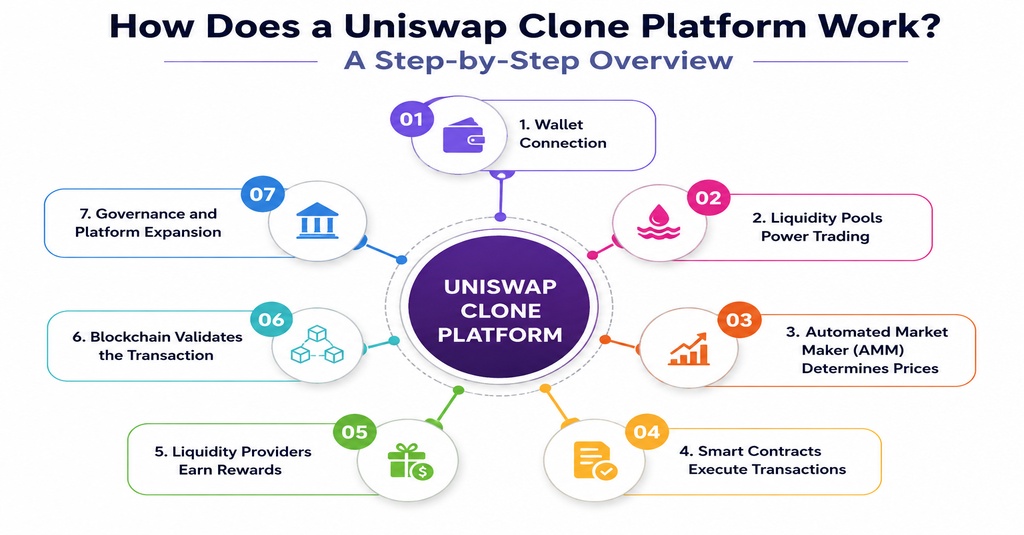
1. Wallet Connection
Users begin by connecting a compatible crypto wallet such as MetaMask, Trust Wallet, Coinbase Wallet, or WalletConnect. Since the platform is non-custodial, users retain complete control of their private keys and digital assets throughout the trading process.
2. Liquidity Pools Power Trading
Instead of traditional buy and sell orders, a Uniswap clone relies on liquidity pools. Liquidity providers (LPs) deposit pairs of tokens into these pools, creating the liquidity required for users to swap assets at any time.
3. Automated Market Maker (AMM) Determines Prices
The platform uses an Automated Market Maker (AMM) algorithm to calculate token prices based on the available liquidity in each pool. As users buy or sell tokens, the ratio of assets in the pool changes, automatically adjusting the exchange price without requiring a centralized market maker.
4. Smart Contracts Execute Transactions
Once a user confirms a token swap, blockchain-based smart contracts automatically verify the transaction, calculate exchange rates and trading fees, execute the swap, and update the liquidity pool. This process eliminates intermediaries and ensures secure, transparent, and tamper-proof trading.
5. Liquidity Providers Earn Rewards
Users who contribute token pairs to liquidity pools receive Liquidity Provider (LP) tokens, representing their share of the pool. In return, they earn a portion of the trading fees generated by every transaction, creating a passive income opportunity.
6. Blockchain Validates the Transaction
Every swap is recorded on the underlying blockchain network, where validators or miners confirm the transaction. Once verified, the exchanged tokens are transferred directly to the user’s wallet, ensuring complete transparency and immutability.
7. Governance and Platform Expansion
Many Uniswap clone platforms include governance tokens that allow community members to vote on protocol upgrades, fee structures, and ecosystem developments. Businesses can also extend the platform by integrating staking, yield farming, cross-chain swaps, limit orders, analytics dashboards, and NFT-based DeFi utilities.
Custom Crypto Exchange Development vs. Uniswap Clone Development: Which Is the Better Choice?
Businesses planning to launch a decentralized cryptocurrency exchange often face an important decision: build a crypto exchange from scratch or deploy a Uniswap clone solution. While both approaches can result in a fully functional decentralized exchange (DEX), they differ significantly in terms of development time, cost, customization, scalability, and business risk. The right choice depends on your project goals, budget, timeline, and long-term vision.
| Factor | Custom Crypto Exchange Development | Uniswap Clone Development |
| Development Time | Typically 8–18 months, depending on complexity | Usually 3–8 weeks with customization |
| Development Cost | High due to custom architecture and extensive testing | More cost-effective with a pre-built foundation |
| Time-to-Market | Slower product launch | Faster deployment and quicker market entry |
| Customization | Unlimited flexibility to build unique features | High customization while retaining proven DEX functionality |
| Technology Risk | Higher due to building every component from scratch | Lower, as the core architecture is already tested |
| Security | Requires extensive smart contract development and audits | Built on battle-tested smart contract architecture with additional audits recommended |
| Scalability | Fully scalable but requires significant development effort | Easily scalable with support for advanced DeFi integrations |
| Blockchain Support | Can support any blockchain with custom implementation | Supports Ethereum and can be extended to BNB Chain, Polygon, Arbitrum, Base, Avalanche, and other EVM-compatible networks |
| Maintenance | Ongoing development and infrastructure management required | Easier maintenance with modular upgrades and feature enhancements |
| Best For | Enterprises building highly specialized blockchain ecosystems | Startups, crypto businesses, and enterprises seeking a faster and cost-efficient DEX launch |
Essential Features Every Uniswap Clone Platform Should Include
Building a successful Uniswap clone requires more than replicating the basic functionality of a decentralized exchange. To compete in the rapidly evolving DeFi ecosystem, your platform should deliver a secure, scalable, and seamless trading experience while supporting advanced features that attract both traders and liquidity providers.
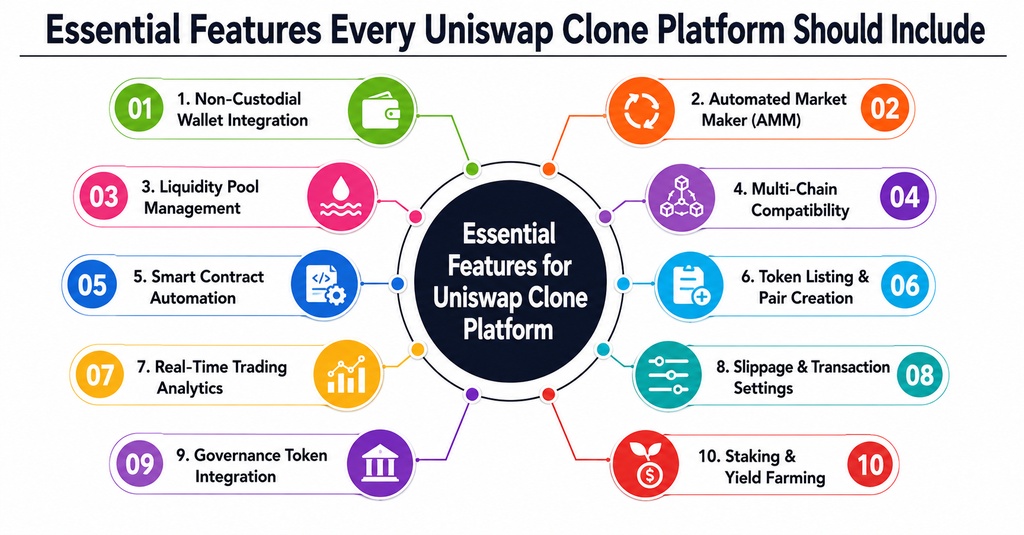
Here are the essential features every modern Uniswap clone platform should include:
1. Non-Custodial Wallet Integration
Allow users to connect wallets such as MetaMask, Trust Wallet, Coinbase Wallet, and WalletConnect without creating traditional accounts. This ensures users maintain complete control over their private keys and digital assets.
2. Automated Market Maker (AMM)
Implement an AMM protocol that enables instant token swaps through liquidity pools instead of traditional order books. This provides continuous liquidity and efficient decentralized trading.
3. Liquidity Pool Management
Enable users to create liquidity pools, deposit token pairs, withdraw liquidity, and receive LP tokens while earning a share of trading fees.
4. Multi-Chain Compatibility
Support multiple blockchain networks such as Ethereum, BNB Chain, Polygon, Arbitrum, Base, Avalanche, and other EVM-compatible chains to increase accessibility and reduce transaction costs.
5. Smart Contract Automation
Use secure smart contracts to execute token swaps, manage liquidity pools, distribute fees, and automate all trading operations without intermediaries.
6. Token Listing & Pair Creation
Allow administrators or community-approved users to list new tokens and create trading pairs, making the platform more flexible and attractive for emerging crypto projects.
7. Real-Time Trading Analytics
Provide users with live token prices, trading volume, liquidity metrics, price charts, transaction history, and market trends for informed decision-making.
8. Slippage & Transaction Settings
Offer customizable slippage tolerance, transaction deadlines, and gas fee settings, enabling users to optimize their trading experience during market volatility.
9. Governance Token Integration
Launch a governance token that allows community members to vote on protocol upgrades, fee structures, treasury management, and future platform developments.
10. Staking & Yield Farming
Increase user engagement by allowing token holders to stake assets or participate in yield farming programs to earn additional rewards beyond trading.
Technology Stack for Modern Uniswap Clone Development in 2026
Building a high-performance Uniswap clone requires a modern technology stack that ensures security, scalability, speed, and seamless interoperability across blockchain networks. From smart contract development to frontend frameworks and cloud infrastructure, selecting the right technologies is essential for delivering a reliable decentralized exchange (DEX).
Below are the core technologies powering modern Uniswap clone development in 2026:
| Technology Layer | Recommended Technologies | Purpose |
| Blockchain Networks | Ethereum, BNB Chain, Polygon, Arbitrum, Base, Avalanche, Optimism | Host smart contracts and process decentralized transactions |
| Smart Contract Languages | Solidity, Vyper | Develop secure AMM logic, liquidity pools, governance, and token swap contracts |
| Token Standards | ERC-20, ERC-2612, ERC-721, ERC-1155 | Support fungible tokens, gas-efficient approvals, and NFT integration |
| Frontend Development | React.js, Next.js, TypeScript | Build a fast, responsive, and SEO-friendly user interface |
| Wallet Integration | MetaMask SDK, WalletConnect, Coinbase Wallet SDK, Trust Wallet | Enable secure non-custodial wallet connectivity |
| Web3 Libraries | Ethers.js, Viem, Wagmi | Connect frontend applications with blockchain smart contracts |
| Backend Technologies | Node.js, NestJS, Express.js | Manage APIs, notifications, analytics, and off-chain services |
| Database | PostgreSQL, MongoDB, Redis | Store analytics, user preferences, logs, and caching data |
| Indexing Protocols | The Graph, Subgraphs | Retrieve blockchain data efficiently for dashboards and trading history |
| Cross-Chain Infrastructure | LayerZero, Wormhole, Axelar, Chainlink CCIP | Enable cross-chain messaging and asset transfers |
| Oracle Services | Chainlink, Pyth Network | Deliver reliable real-time price feeds and external market data |
| Security Tools | OpenZeppelin Contracts, Hardhat, Foundry, Slither | Secure smart contracts through standardized libraries, testing, and vulnerability analysis |
| Cloud & DevOps | AWS, Google Cloud, Docker, Kubernetes, GitHub Actions | Ensure scalable deployment, monitoring, and continuous integration |
| Analytics & Monitoring | Dune Analytics, Grafana, Prometheus | Monitor protocol performance, user activity, and platform health |
Step-by-Step Process to Build a Successful Uniswap Clone Platform
Developing a Uniswap clone involves much more than copying an existing decentralized exchange. A successful platform requires strategic planning, secure smart contracts, an intuitive user interface, rigorous testing, and continuous maintenance. Following a structured development process helps businesses launch a scalable, secure, and feature-rich decentralized exchange (DEX) that meets the evolving demands of the DeFi ecosystem.
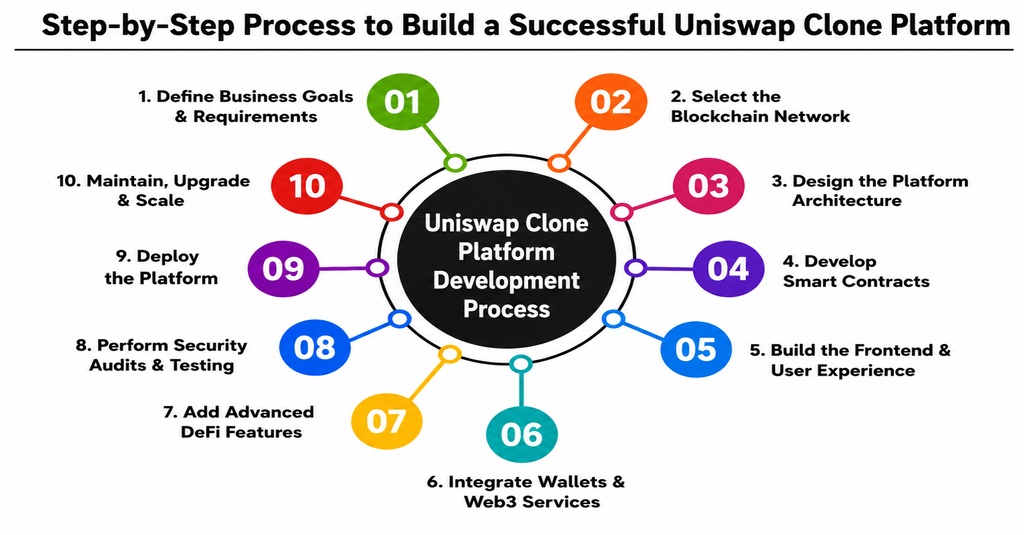
1. Define Business Goals & Requirements
Start by identifying your business objectives, target audience, supported blockchain networks, revenue model, and essential features. Decide whether your platform will focus on token swaps, staking, yield farming, governance, cross-chain trading, or a complete DeFi ecosystem.
2. Select the Blockchain Network
Choose the blockchain that best aligns with your project’s goals. Popular options include Ethereum, BNB Chain, Polygon, Arbitrum, Base, Avalanche, and Optimism. Many businesses also opt for multi-chain support to reach a broader user base and reduce transaction costs.
3. Design the Platform Architecture
Create the technical architecture for your decentralized exchange, including liquidity pools, Automated Market Maker (AMM) logic, wallet integration, governance mechanisms, backend services, and frontend components. A scalable architecture simplifies future upgrades and feature additions.
4. Develop Smart Contracts
Build secure smart contracts that handle token swaps, liquidity pools, trading fees, governance, staking, and reward distribution. Use industry-standard libraries and follow best practices to ensure transparency and reliability.
5. Build the Frontend & User Experience
Develop a responsive and user-friendly interface that allows users to connect wallets, swap tokens, provide liquidity, view analytics, and manage their assets effortlessly across desktop and mobile devices.
6. Integrate Wallets & Web3 Services
Integrate popular wallets such as MetaMask, WalletConnect, Trust Wallet, and Coinbase Wallet. Ensure smooth interaction between the frontend and blockchain using modern Web3 libraries for secure, non-custodial transactions.
7. Add Advanced DeFi Features
Differentiate your platform by integrating features such as staking, yield farming, governance voting, cross-chain swaps, token launchpads, referral programs, real-time analytics, and customizable trading settings.
8. Perform Security Audits & Testing
Conduct comprehensive testing of smart contracts, frontend functionality, APIs, and wallet integrations. Perform internal security assessments and third-party smart contract audits to identify and eliminate vulnerabilities before deployment.
9. Deploy the Platform
Deploy smart contracts to the selected blockchain network, configure the production infrastructure, and launch the decentralized exchange. Verify contract addresses and monitor the platform closely during the initial launch phase.
10. Maintain, Upgrade & Scale
After launch, continuously monitor platform performance, release security updates, optimize gas efficiency, improve user experience, and introduce new features based on market trends and community feedback. Regular maintenance ensures long-term platform stability and competitiveness.
Uniswap Clone Development Cost in 2026: Complete Pricing Breakdown
The cost of developing a Uniswap clone platform depends on several factors, including the platform’s complexity, supported blockchain networks, security requirements, custom features, UI/UX design, and third-party integrations. Businesses can choose between a basic MVP for faster market entry or an enterprise-grade decentralized exchange with advanced DeFi capabilities.
Below is an estimated cost breakdown for Uniswap clone development in 2026.
| Development Stage | Estimated Cost (USD) |
| Basic Uniswap Clone (Core DEX Features) | $20,000 – $40,000 |
| Standard Platform (Custom UI, Multi-Wallet Support, Analytics) | $40,000 – $80,000 |
| Advanced Uniswap Clone (Staking, Yield Farming, Governance, Multi-Chain) | $80,000 – $150,000 |
| Enterprise-Grade DEX Platform (Cross-Chain, Advanced Security, Custom DeFi Ecosystem) | $150,000 – $300,000+ |
Key Factors That Influence Development Cost
1. Platform Features
The number and complexity of features significantly impact development costs. Basic token swaps require less effort than advanced functionalities such as staking, yield farming, DAO governance, cross-chain bridges, limit orders, or perpetual trading.
2. Blockchain Network Support
Developing for a single blockchain is generally more affordable. Supporting multiple networks such as Ethereum, BNB Chain, Polygon, Arbitrum, Base, and Avalanche requires additional smart contracts, testing, and infrastructure.
3. Smart Contract Development
Secure smart contracts form the foundation of a decentralized exchange. Custom AMM logic, liquidity pools, governance mechanisms, and staking protocols increase development time and cost.
4. UI/UX Design
Creating an intuitive, responsive, and mobile-friendly interface with real-time charts, wallet connectivity, and advanced trading tools requires additional frontend development.
5. Security Audits
Professional smart contract audits, penetration testing, vulnerability assessments, and bug bounty programs are essential investments that improve platform security and user trust.
6. Third-Party Integrations
Integrating wallet providers, price oracles, blockchain explorers, analytics platforms, notification services, and cross-chain bridges adds both development effort and licensing or infrastructure costs.
7. Compliance Requirements
If your platform targets regulated markets, optional KYC/AML verification, transaction monitoring, and compliance reporting tools can increase overall development expenses.
8. Post-Launch Maintenance
Ongoing costs include infrastructure hosting, blockchain node management, security updates, smart contract monitoring, feature enhancements, technical support, and performance optimization.
Conclusion
Launching a decentralised exchange (DEX) in the quickly growing DeFi ecosystem has never been easier than with Uniswap clone development. Companies may save a tonne of time and money compared to starting from scratch when they use a tried and true Automated Market Maker (AMM) methodology to provide safe, non-custodial cryptocurrency trading.
It takes more than just copying existing features, though, to release a viable Uniswap clone. Rest assured, our platform is designed with long-term stability and customer trust in mind. We prioritise secure smart contracts, an easy user experience, compatibility with several chains, advanced DeFi capabilities, and frequent security audits. Businesses may construct a scalable platform that can accommodate future Web3 advancements by selecting the appropriate technology stack and working with a seasoned blockchain development partner.
Startups, fintechs, and enterprises should seize the chance to join the decentralised trading market and establish a long-term DeFi ecosystem by investing in a Uniswap clone platform that is both secure and packed with features, especially as decentralised finance becomes more popular.
Frequently Asked Questions (FAQs)
Que 1: What is a Uniswap clone?
Answer 1: A Uniswap clone is a decentralized exchange (DEX) solution that replicates Uniswap’s AMM-based trading model while allowing businesses to customize features, branding, and blockchain support.
Que 2: How long does it take to develop a Uniswap clone?
Answer 2: A basic Uniswap clone typically takes 3–8 weeks, while advanced enterprise-grade platforms may require 3–8 months, depending on customization and integrations.
Que 3: Which blockchain networks can a Uniswap clone support?
Answer 3: Most Uniswap clone platforms support Ethereum, BNB Chain, Polygon, Arbitrum, Base, Avalanche, Optimism, and other EVM-compatible blockchains.
Que 4: Is a Uniswap clone secure?
Answer 4: Yes. When built with audited smart contracts, secure wallet integrations, and regular security assessments, a Uniswap clone can provide a highly secure decentralized trading environment.
Que 5: How does a Uniswap clone generate revenue?
Answer 5: Revenue is commonly generated through trading fees, liquidity pool fees, token listing fees, premium services, staking, and other DeFi features.