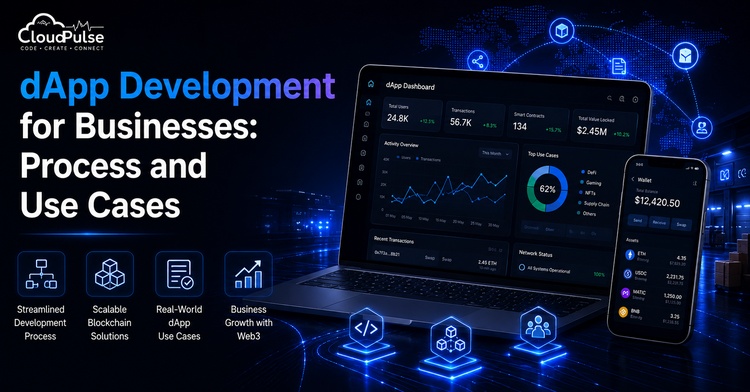
Decentralised application (dApp) development is emerging as a major investment for enterprises aiming to boost transparency, security, automation and user ownership through the use of Web3 technology. Decentralised applications (dApps) can run on top of blockchain using intelligent contracts, removing the need for centralised servers, while offering distributed data management, immutable records and trustless transactions.
Research and Markets in a survey said Decentralised Applications (DApps) are expected to dominate the industry soon enough. In recent years, their applications have also diversified beyond NFT marketplaces and cryptocurrency exchanges. Businesses in the banking, healthcare, supply chain, real estate, gaming, insurance, logistics and digital identity sectors are leveraging decentralised apps to automate processes, eliminate intermediaries, decrease operational costs and boost consumer confidence. Ethereum, Solana, Polygon, Avalanche, BNB Chain and other blockchain platforms offer the architecture required for building enterprise-grade dApps that are scalable and high-performing.
Investing in decentralised app development is not simply about the use of blockchain technology. Digital ecosystems provide organisations transparent transactions, tokenized assets, intelligent contracts that automate business procedures and enhanced user control over their data. With the growing rise of Web3 use, businesses can enjoy new sources of income, enhance operational efficiency and create digital platforms that can withstand the future, especially with the adoption of decentralised applications.
Market size of dApp Development
As the blockchain gains more traction, the interest of businesses in decentralised apps (dApps) increases. Market analysis projects that the global demand for decentralised apps (dApps) will expand from $50.03 billion in 2026 to $103.58 billion by 2030, at a CAGR of around 20%. The growth is being driven by rising enterprise blockchain usage, expanding Web3 ecosystems, new decentralised identity solutions, breakthroughs in decentralised finance (DeFi) and enhanced blockchain scalability.
What is the dApp Development Life Cycle?
A decentralised application (dApp) is an application developed on the blockchain that employs smart contract technology for its backend operations instead of centralised servers. On the front-end it can look like a regular web or mobile app, but underneath it contains decentralised, transparent and tamper-proof functionality. The standard approach to create a decentralised application is:
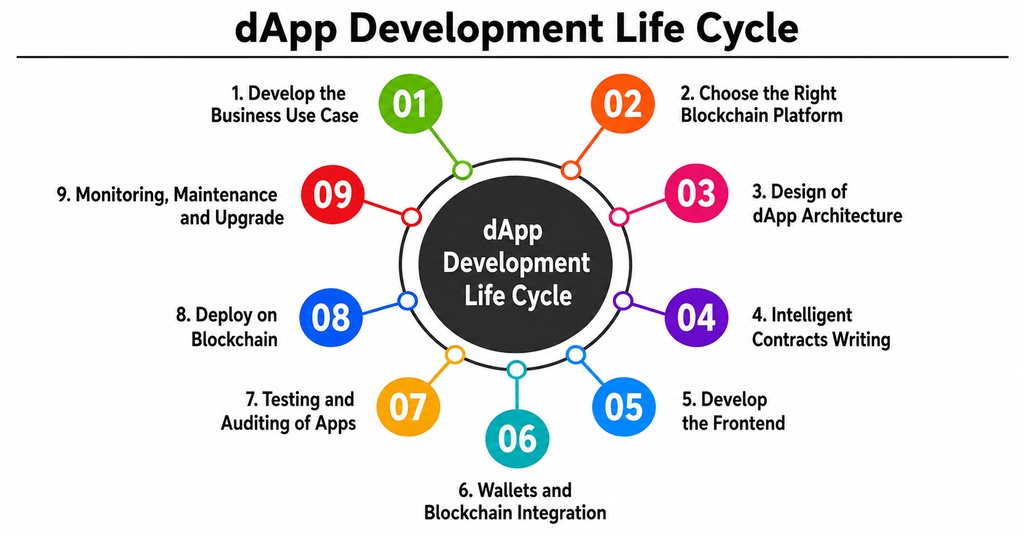
1. Develop the Business Use Case
Before building a decentralised application, it is important to identify a real-world problem that can be solved using blockchain technology. Because businesses also have to decide the aim of the app, the target audience, the functionality needed and if decentralisation delivers benefits such as trust, transparency or asset ownership.
2. Choose the Right Blockchain Platform
In looking for a blockchain network, you should look at scalability, transaction costs, security, ecosystem maturity, and interchangeability. The blockchain(s) used will depend on the project requirements and might include Ethereum, Solana, Polygon, BNB Chain, Avalanche, Arbitrum, Base, Sui, and many others.
3. Design of dApp Architecture
The technical architecture is built by developers. The technical architecture defines the blockchain frontend user interface, the interaction with wallets, the processing of smart contract transactions, and the connectivity of off-chain services (databases, APIs, etc.) to the blockchain.
4. Intelligent Contracts Writing
Intelligent contracts can contain the business logic of the application and can automate transactions without the need for intermediaries. They are meant to be secure and transparent . They are usually written in programming languages like Rust ( Solana , Sui ) , or Solidity ( chains compatible with Ethereum ) .
5. Develop the Frontend
The frontend is responsible for building the user interface, to make the application more user-friendly. Users can register via MetaMask, WalletConnect, Coinbase Wallet, Phantom, or any of the other Web3 wallets supported by the integrations. Just like, Frameworks such as React, Next.js, Vue.js, and Angular are popular choices.
6. Wallets and Blockchain Integration
The software is connected to the blockchain networks through Web3 frameworks and APIs. With wallet integration, users can safely manage their digital possessions, execute transactions and interact with intelligent agreements without revealing any critical information.
7. Testing and Auditing of Apps
Developers test their work very thoroughly before release, to make sure it works as it should, works as expected and is interoperable with different devices and blockchains. Smart contract security can be professionally audited to find flaws and limit the risk of attacks and financial loss.
8. Deploy on Blockchain
On testing, the selected blockchain network is provided with the uploaded smart contract. The front end is hosted on cloud platforms or decentralised storage technologies like IPFS ensuring high availability and censorship resistance.
9. Monitoring, maintenance and upgrade
Decentralised apps (dApps) require constant monitoring, security patches, feature enhancements and performance tweaks after deployment. Hence, Many firms are now implementing upgradeable governance systems or intelligent contracts for continued compliance and security, regardless of future possibilities.
Major Benefits of dApp Development in the Web3 Era
Decentralised apps, or dApps, are defined by the lack of a controlling authority but their benefit goes far beyond the elimination of middlemen. Modern organisations are using decentralised applications (dApps) to make their operations more transparent, efficient and profitable. Therefore, Organisations can gain a lot from decentralised app development in the following ways:
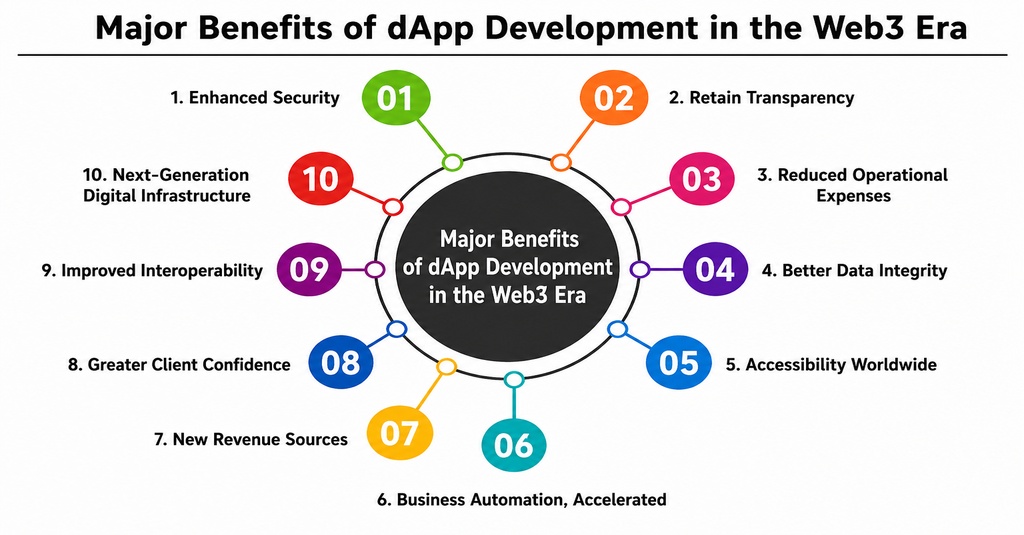
1. Enhanced Security
Decentralised applications leverage blockchain technology and cryptography to protect user data and financial transactions. Hence, The distributed architecture of the records makes them considerably more resistant to hacking, unauthorised alterations and single points of failure than centralised systems.
2. Retain Transparency
A public blockchain allows for every transaction to be verified to create an immutable audit trail. Transparency helps reduce the risk of fraud and conflicts, and increases trust, which is good for regulators, customers, investors and partners.
3. Reduced Operational Expenses
Digital applications or dApps are intelligent contracts which automate commercial processes, removing the need for human labour and middlemen. It reduces administrative costs, it reduces errors, it gets transactions through faster.
4. Better Data Integrity
In the context of data integrity, Data on a blockchain is immutable, i.e. it cannot be changed without the approval of all of the nodes on the network. You can be sure that digital identification, healthcare, supply chain and financial enterprises can always count on their records being correct and unalterable.
5. Accessibility Worldwide
Decentralised applications provide users from all over the world access to their data without the need for a centralised infrastructure. Businesses may now sell to customers all over the world, do cross border transactions and access global marketplaces.
6. Business Automation, Accelerated
Smart agreements are business rules that automatically implement themselves when certain criteria are met.Thus, It cuts red tape, speeds up approvals and makes financial settlements, asset transfers and contract agreements easier.
7. New revenue sources
Therefore, Enterprises can investigate new sources of income such as digital memberships, staking mechanisms, tokenized assets, NFTs, decentralised finance (DeFi) services, transaction fees and marketplaces powered by blockchain.
8. Greater client confidence
Blockchain technology is secure and transparent which increases the faith of users on it. Ownership and transactions are visible to customers, which helps them feel more connected to companies over the long term.
9. Improved Interoperability
Many of the new dApps enable users to connect to multiple blockchain networks, decentralised exchanges, wallets and Web3 protocols. This interoperability allows businesses to depend on their ecosystem and deliver seamless cross-platform experiences.
10. Next-Generation Digital Infrastructure
In the addition of, Web3 adoption, dApps present an ideal opportunity for companies to leverage emerging technologies such as tokenization, decentralised identities, AI-powered blockchain applications, and metaverse ecosystems. Invest in decentralised app development today and prepare for scalable innovation tomorrow.
Cost Aspects of dApp Development (Primary components affecting the budget)
The cost of developing a full-fledged, enterprise-grade platform including DeFi protocols, NFT marketplaces, DAO governance, cross-chain interoperability, AI capabilities and high transaction. Moreover, this is significantly higher than that of an entry-level dApp with basic wallet connectivity and token transfers. Over time, corporations will have to pay for things like smart contract audits, updates to infrastructure, maintenance, compliance and checks. Understanding the cost drivers helps organisations to better manage their finances and construct a secure, scalable and future-proof decentralised application.
| Cost Factor | Development Cost Impact |
| Project Complexity | Development adds time and money with complex features like Staking, DeFi, NFTs, DAO governance, and Cross-chain support. |
| Blockchain Platform | The entire development cost might differ by the tools and deployment costs of different blockchains such as Ethereum, Polygon, Solana, BNB Chain, Avalanche, Base and more. |
| Smart Contract Development | Optimising contracts, automating complex business logic and applying tokenomics needs experienced blockchain developers and further testing. |
| UI/UX Design | Designing and building the front end gets more costly with responsive design, animations, dashboards, custom user interfaces and seamless Web3 experiences. |
| Wallet & Third-Party Integrations | Integration with payment gateways, analytics platforms, MetaMask, Phantom, WalletConnect, IPFS, and Chainlink makes the development process more involved. |
| Security Audits & Testing | Protect your online assets and avoid vulnerabilities with professional audits of intelligent contracts, penetration testing and quality assurance. |
| Scalability Requirements | To accommodate large user bases and high transaction volumes, improved infrastructure, optimised intelligent contracts, and Layer 2 solutions may be required. |
| Compliance & Regulatory Features | Development of regulated organisations is more challenging due to compliance aspects such as Know Your Customer (KYC), Anti-Money Laundering (AML), General Data Protection Regulation (GDPR) and identity verification. |
| Development Team Expertise | Using experienced blockchain developers, UI/UX designers, QA engineers and DevOps professionals usually results in higher, but more reliable development charges. |
| Maintenance & Upgrades | All costs of ownership post launch includes continual monitoring, upgrades of the blockchain, security patches, bug fixes and feature enhancements. |
Industries dApp applications: Various revenue-oriented business strategies for the organisation
Decentralised applications (dApps) are revolutionising many sectors with the help of blockchain technology by enabling trustless transactions, boosting transparency and getting rid of intermediaries. Decentralised apps (dApps) are enabling businesses such as banking, healthcare, gaming and real estate to build new digital ecosystems and unlock long-term benefits. Depending on the app’s purpose, audience, and blockchain technology, a decentralised application (dApp) might employ different revenue models such subscriptions, transaction fees, token economies, NFT sales, and premium services.
| Industry | Popular dApp Use Cases | Common Revenue Models |
| Finance (DeFi) | Lending and borrowing, yield farming, staking, decentralised exchanges (DEXs) | Transaction costs, interest on loans, staking charges, liquidity pool fees, and the value of governance tokens |
| Healthcare | Clinical trial management, patient records, and pharmaceutical supply chain | Monthly payment, software as a service, corporate connectivity, and data validation expenses |
| Real Estate | Handling mortgages, rental marketplaces, digital ownership transfers and property tokenization Fees related to asset management | platform subscription fees, transaction commissions and token issuance |
| Supply Chain & Logistics | Warehouse management, product tracking, cross-border logistics | Transaction-based pricing, API access, enterprise license, verification fees |
| Gaming & Metaverse | P2E games, non-fungible token marketplaces, ownership of virtual land and exchanges of digital currency advertising revenue | premium memberships, in-game purchases, marketplace commissions, NFT sales |
| Retail & E-commerce | Decentralised markets, blockchain-based loyalty programmes and the capacity to check the integrity of products | Marketplace fees, seller memberships, transaction prices and premium merchant services |
| Healthcare Insurance | Decentralized policy management, claims automation and fraud detection | Premiums for policy administration, business memberships and claims processing |
Important Revenue Models in dApp Development
| Revenue Model | How It Works |
| Transaction Fees | It is the profit earned from each transaction made on the platform, which might be a percentage or a fixed amount. |
| Token Sales | Issue utility or governance tokens to raise capital when launching or expanding the ecosystem. |
| Subscription Plans | You can provide subscriptions for premium products, analytics, APIs, or business dashboards on a monthly or yearly basis. |
| NFT Minting & Marketplace Fees | Earn a commission from trades on the secondary market by minting NFTs. |
| Staking & Validator Rewards | Earn benefits by running validator nodes or user-provided staking infrastructure. |
| Advertising & Sponsorships | Monetize user visits with sponsored content, blockchain-native adverts, or featured listings. |
| Enterprise Licensing | License blockchain infrastructure or white label decentralised application solutions to enterprises and earn a regular income. |
| API & SDK Access | Purchase access to premium application programming interfaces (APIs), blockchain integrations, and developer tools. |
Essential Technologies Behind Successful dApp Development
Building a decentralised application (dApp) involves utilising a blend of blockchain infrastructure, smart contract technology, decentralised storage, and Web3 technologies to provide safe, transparent, and scalable digital solutions. Traditional applications run on centralised servers, but dApps use distributed technologies which allow for trustless interactions, better security, and greater user control over data and digital resources.
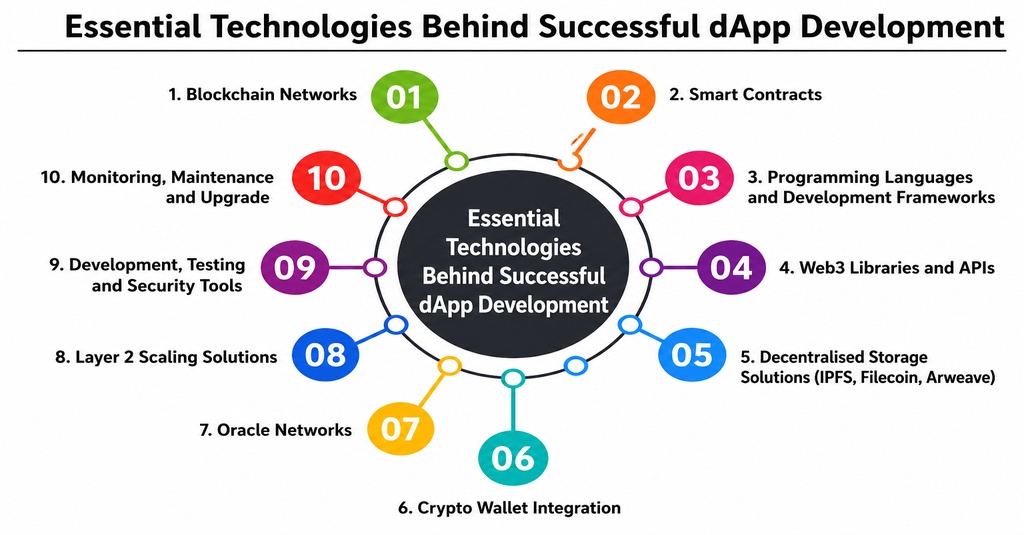
Blockchain Networks
These are the backbone of any dApp. Infrastructure needed to process transactions, maintain immutable records and run intelligent contracts are provided by decentralised platforms like Ethereum, Solana, Polygon, Avalanche, BNB Chain and Arbitrum. The choice of blockchain is dependent on considerations including scalability, transaction fees, security and ecosystem support.
Smart Contracts
Standard are the building blocks of dApps. These self-executing programmes automate the execution of preset business processes without the need for intermediaries . Intelligent contracts execute tasks including as payments, token transfers, staking, governance, identity verification, and automated workflows, increasing transparency and decreasing operating expenses.
Programming Languages and Development Frameworks
User interface and blockchain logic are developed using Programming Languages and Development Frameworks. Solidity is the most used language for Ethereum compliant blockchains, whereas Rust is usually used for Solana development. On the frontend, developers employ JavaScript, TypeScript, React and Next.js to build responsive and intuitive user interfaces that connect with blockchain networks.
Web3 Libraries and APIs
These are enable the frontend application to talk to blockchain infrastructure. Libraries like Ethers.js, Web3.js, Wagmi, and WalletConnect let users to link their crypto wallets, sign transactions, access data from the blockchain, and safely interact with intelligent contracts, leading to a seamless decentralised user experience.
Decentralised Storage Solutions (IPFS, Filecoin, Arweave)
These are used to store documents, media files, NFT metadata and other big datasets outside the blockchain. This technique lowers on-chain storage costs and ensures that data is dispersed, tamper-proof, and available forever.
Crypto wallet integration
Another key technology in dApp development is the integration of crypto wallets. MetaMask, Trust Wallet, Coinbase Wallet and Phantom are among of the wallets that enable users to authenticate securely, manage digital currencies and authorise blockchain transactions without revealing their private keys, thereby giving both convenience and high safety.
Oracle Networks
These networks are integrate the blockchain to other external systems by feeding intelligent contracts with data from the real world – for example prices of cryptocurrencies, weather, sports outcomes, financial market data, and IoT sensor inputs. With Chainlink, Pyth and other services, dApps may execute complicated data-driven business logic with trusted off-chain data.
Layer 2 Scaling Solutions
It improve the performance of blockchain applications by lowering transaction fees and boosting the processing speed. They also allow building scalable dApps that can serve thousands of users without sacrificing security or decentralisation, using technologies like Polygon, Arbitrum, Optimism, and zkSync.
The development, testing and security tools
These tools are as vital as the delivery of enterprise-grade decentralised apps. Tools like Hardhat, Foundry, Truffle and Remix make developing intelligent contracts easier, while automated testing, vulnerability scanning and professional security audits assist spot possible dangers before they are deployed, giving the application the best chance of being both secure and reliable.
Conclusion
Web3 is changing the way businesses construct trusted, scalable and decentralised digital solutions with the introduction of decentralised application (dApp) development. Blockchain technology, smart contract technology, and decentralised infrastructure enable organisations to automate operations, eliminate middlemen, increase data quality and develop new business models. dApps are helping businesses in a range of areas, including healthcare, gaming, real estate, finance and supply chain management, to create better digital experiences.
The first step in creating a fully functional decentralised application is to choose a blockchain platform. Organisations need to focus on smart contract security, long-term compliance and scalability, and intuitive user experience. Future-proof decentralised apps that encourage creativity, provide recurring sources of income, and give them a competitive edge are what businesses may launch in the ever-expanding Web3 space to thrive.
FAQs
Que 1: What is dApp?
Answer 1: Decentralised applications (dApps) are a new type of software that run on the blockchain, using smart contract technology as opposed to centralised servers. This means more user agency, safety and visibility.
Que 2: What is the ideal blockchain for dApp development?
Answer 2: The appropriate blockchain for your project will depend on what your project requires. Ethereum, Base, Solana, Avalanche, BNB Chain and Polygon are among of the most popular solutions in terms of scalability, security and ecosystem support.
Que 3: How long does it take to build a dApp?
Answer 3: Generally, launching a dApp takes 2-4 months, whereas a major enterprise-grade dApp with many features could take 6-12 months or more.
Que 4: Which sectors can profit the most from dApp development?
Answer 4: Some of the industries that use decentralised apps the most are financial services, healthcare, education, supply chain management, gambling, retail, real estate, banking and logistics.
Q5: What affects the cost of dApp development?
Answer 5: The major cost drivers are: project complexity, blockchain platform, smart contract development, user interface and experience (UI/UX) design, wallet integration, security audits, scalability requirements, compliance features, and continuous maintenance.