In the global financial market, the cryptocurrency market has emerged as a larger investment segment. By using several secure and advanced mobile applications, millions of customers are interested in buying, selling, and storing digital assets for the future. Therefore, CoinSwitch Kuber is a simple cryptocurrency trading app that offers quick transactions, asset tracking, security, and user-friendly interactions. Investments in crypto trading applications are regularly increasing at the global level by businesses and fintech startups to capitalise on the growing trading market.
If trying to introduce and expand digital offerings to customers, then you can enter the blockchain industry and start a startup to attract a tech-savvy customer base and unlock new revenue streams. CoinSwitch Kuber is a crypto trading app that includes some qualities such as development steps, technology stack, safety aspects, cost estimation, and future trading trends, which assist in explaining everything to customers who want to know about crypto trading.
Market Overview About Crypto Trading App Development
Digital assets are more accessible to retail and institutional organisations, which is driving rapid growth in the cryptocurrency sector. Several applications have shown and transformed for clients how they can invest, how easy it is to transfer value, and how they can interact with financial systems such as Bitcoin, Ethereum, Solana, and thousands of other cryptocurrency companies.
A few factors that are necessary to increasing uses for crypto trading applications.
- Increasing blockchain technology adoption
- Enhancing investments in cryptocurrency worldwide
- Decentralised finance (DeFi) interest level is increasing
- Digital payments platform expansion
- In many regions, having better regulatory clearance
- Smartphone and internet penetration
With the help of launching crypto exchanges and trading platforms, business firms can determine opportunities that provide safety and security and a convenient and quality experience for customers. Modern crypto trading applications include platform management, staking, recurring investments, educational resources, market insights, and advanced trading techniques that enable users to buy and sell assets.
What is a Crypto Trading App?
A crypto trading app is a digital platform that allows people to buy, sell, exchange, and trade their cryptocurrencies from their mobile devices or browsers. These applications provide their users access to the crypto market and help them make transactions online as well as store their digital assets securely.
Unlike trading stock apps, crypto trading apps work round the clock and offer users the opportunity to make purchases or sell their crypto assets at any given time.
A typical crypto trading platform today offers the following features:
- Crypto buying/selling,
- Wallets,
- Market prices,
- Portfolio management,
- Secure payment methods,
- KYC (Know Your Customer),
- Transaction history,
- Trading analytics,
- Price alerts,
- Multi-currency support, etc.
CoinSwitch Kuber aggregates crypto exchanges, which allows investors to make more informed decisions about their investments. This application is effortless to use and provides all necessary functions to experienced investors.
Investment in Crypto Trading App Development and Why?
The booming market for cryptocurrencies creates business opportunities for satisfying clients’ needs. Instead of providing traditional financial services, companies should consider developing crypto trading platforms to diversify their product portfolio and benefit from rampant speculation. Apart from substantial profits from trading, crypto exchanges offer such advantages as the ability to attract an expanding customer base, generate revenues from multiple sources, ensure high engagement, and provide global coverage and a deep competitive advantage.
1. Multiple Revenue Streams
- Cost of trading
- Charges for deposits and withdrawals
- New token listing charges
- Subscription to premium
- Trading cost of margin
- Cost of API access
- Partnership advertising
2. High Number of Customer Engagement
Unlike other financial apps, crypto traders actively monitor the fluctuations of the market during the day, which leads to increased engagement with the app.
3. Market Reach Worldwide
Cryptocurrency exchange is not tied to any country, and transactions can be made in many currencies.
4. Competitive Benefits
The companies that position themselves as progressive and adopt new technologies become market leaders and attract customers.
How Does a Crypto Trading App Like CoinSwitch Kuber Work?
Although the user interface is simple, a crypto trading application involves several underlying technologies that work together to provide an easy-to-use experience.
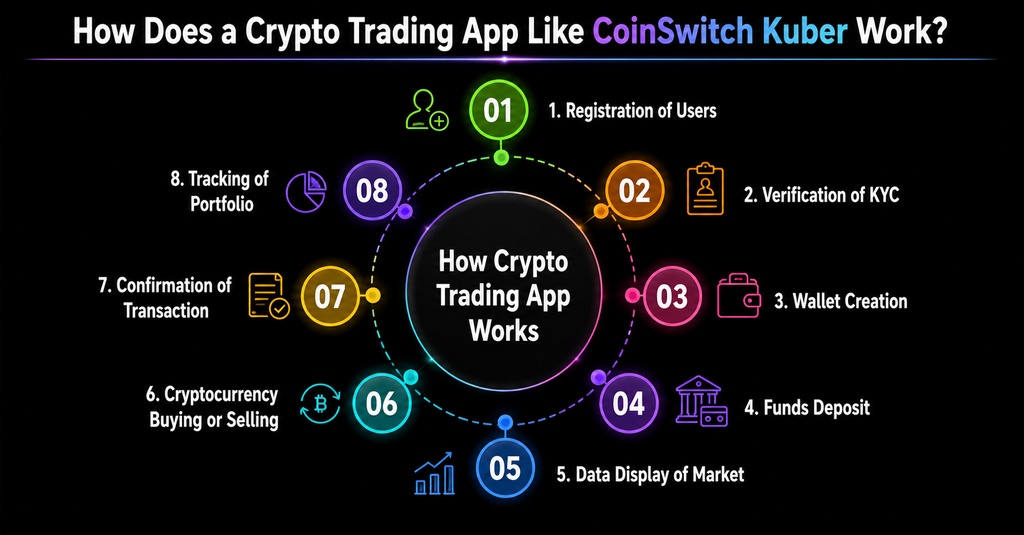
Step 1: Registration of users
Users are required to register by providing their email or phone number. In addition, multi-factor authentication secures the account and ensures only the rightful owner can gain access to the system.
Step 2: Verification of KYC
In addition, users are required to submit government-issued identification documents and take a selfie for verification purposes. The KYC procedure is automated and verifies the information before granting access to the application.
Step 3: Wallet creation
The cryptocurrency platform creates safe and secure cryptocurrency wallets after the verification is complete with the existing wallets, so that users can store their digital assets and manage them.
Step 4: Funds deposit
- UPI
- Bank transaction
- Credit and Debit cards
- Net banking
- Supported digital wallets
- Cryptocurrency deposits
Step 5: Data Display of Market
The application constantly pulls in cryptocurrency data such as price, market capitalisation, volume, and price chart from a variety of sources such as crypto exchanges or liquidity providers.
Step 6: Cryptocurrency buying or selling
The user then submits a buy/sell order, which is processed and matched either internally or sent to external liquidity providers based on the settings of the application.
Step 7: Confirmation of transaction
Once processed, the balance is updated and stored for later withdrawal, as well as the associated transaction being stored for later review.
Step 8: Tracking of portfolio
The user can then track his/her investment, profit and loss, transactions, and portfolio within the application.
Types of Crypto Trading Apps
On the basis of future targets, target customers, and the budget of investment, business firms can choose different types of development models to achieve their goals.
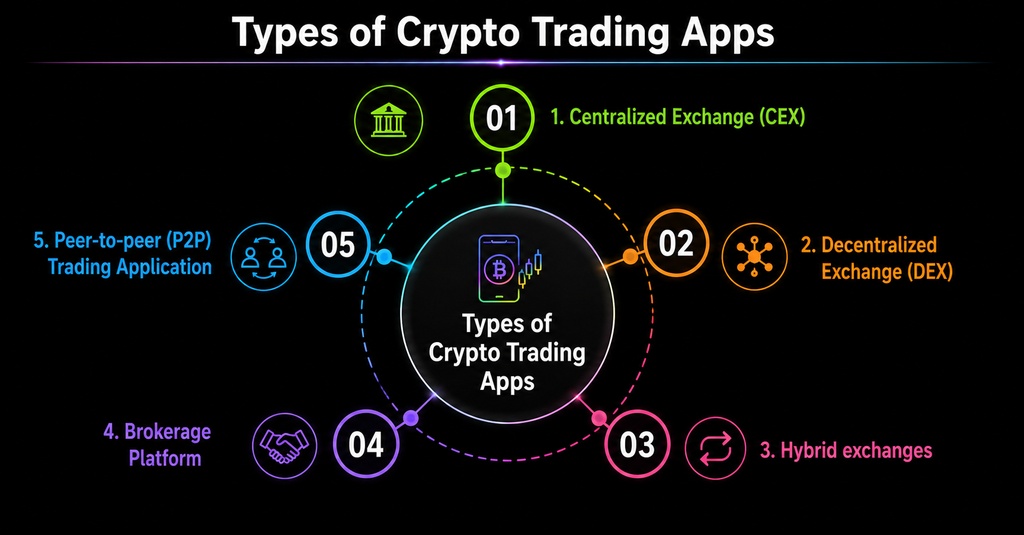
1. Centralised Exchange (CEX)
Centralised exchange apps are run by an entity that manages users’ accounts, transactions, liquidity, and security. Such platforms usually offer an intuitive-to-use interface and attract novice and high-volume traders who seek convenience, rapid order processing, support, and various payment options.
2. Decentralized Exchange (DEX)
These apps enable users to engage in direct peer-to-peer trading and give full control of the crypto assets to the holders. Decentralised exchanges promote privacy, transparency, and security, which has made them popular in the Web3 space.
3. Hybrid exchanges
Hybrid exchanges provide the best of two worlds: they ensure the speed and convenience of centralized platforms while delivering the security and control of decentralized exchanges. The concept is becoming popular among businesses that want to attract crypto-savvy users.
4. Brokerage Platform
Brokerage crypto trading apps allow investors to buy and sell digital assets from/to the broker at a specified price. The advantage of such platforms is that they eliminate the need to deal with order books and provide an easy-to-use interface for crypto newcomers.
5. Peer-to-peer (P2P) Trading Application
Peer-to-peer trading apps enable crypto holders to negotiate directly with each other. The service providers in this space do not control crypto transactions; instead, they offer escrow custody services to ensure that both parties receive what they are entitled to. P2P exchanges are popular in emerging markets because they enable local trading in a preferred currency.
Crypto Trading App Development Timeline: How Long Does It Take?
The timeline for building a crypto trading app like CoinSwitch Kuber depends on the app complexity and features, level of security, regulatory compliance, and third-party service integrations to be supported within the application. Typically, the development of a crypto trading app takes anywhere between 3 and 12 months. A crypto trading platform with minimum functionality requires around 3-5 months to build, while an advanced crypto trading app with all the options and services offered by crypto exchanges may take up to 12+ months to develop. The table below provides an overview of the crypto trading app development timeline.

| Development Stage | Duration |
| Requirement analysis and planning | 2-3 weeks |
| UI/UX prototyping and design | 3-4 weeks |
| Front and back-end development | 8-12 weeks |
| Crypto blockchain and wallet development | 3-5 weeks |
| APIs development and integration | 2-4 weeks |
| Security implementation and penetration testing | 3-5 weeks |
| QA testing, debugging, and optimization | 2-4 weeks |
| Deployment and launch | 1-2 weeks |
| Total estimated duration | 3-12+ months |
In conclusion, it takes about 3 to 12 months to develop a crypto trading app like CoinSwitch Kuber. You can reduce the development timeline by partnering with a reliable blockchain development company that has proven expertise in developing high-performance crypto trading platforms and blockchain applications.
Factors That Influence Crypto Trading App Development Cost
The price of crypto trading platforms’ development varies depending on numerous factors related to technical and business requirements. Some of them are connected to the app’s design and features, while others are related to security, technical support, regulations, and others. The fewer functions your platform has, the cheaper its development will be. However, if you plan to build an enterprise-level app for crypto trading, you should add the expenses for advanced trading tools, artificial intelligence technologies, and enhanced security features. You should also consider other crypto exchange costs, which can help you determine the app’s development budget and prioritise its features.
| Cost Factor | Impact on Cost |
| Application complexity | It is cheaper to build a simple crypto app, while advanced trading features and functionality require more effort and money. |
| Design | Custom design and intuitive UI/UX make your product stand out from the rest, but they take longer to develop. |
| Supported platforms | Building software for iOS, Android, and web applications requires a bigger budget than developing it for only one platform. |
| Blockchain | Crypto apps are different from conventional ones in that they must also support blockchains, wallets, tokens, smart contracts, and decentralized finance (DeFi). |
| Security | Advanced safety solutions, such as multifactor authentication, cold wallet support, anti-fraud systems, and regular external audits, increase development costs. |
| Third-party services | Payment systems, KYC, liquidity providers, market data, and AML tools must all be integrated into the app, requiring more time and effort. |
| Regulatory Compliance | KYC, AML, GDPR, and other financial regulations require additional development and legal expertise. |
| Scalability and performance | The architecture of applications for thousands of concurrent users and high-performance trading requires more time and money to develop. |
| Development team and location | Experienced professionals working on a crypto app’s development cost much more than unskilled ones. Besides, remote workers and local employees may have significantly different hourly rates. |
| Maintenance and updates | Software maintenance, regular updates, security fixes, performance upgrades, and technical support add to the cost of developing crypto apps. |
Future Trends Shaping Crypto Trading App Development Essay
The future of crypto trading app development is determined by technological advances in blockchain innovation, artificial intelligence and machine learning, decentralized finance (DeFi), and regulatory changes. Businesses must keep their crypto trading platforms updated if they want to fulfill the demand for faster and more sophisticated digital financial services. Implementing modern technologies will also provide an additional impetus for growth and help maintain a competitive advantage in the dynamic crypto space.
Developers worldwide are adopting artificial intelligence and blockchain technology to provide their clients with cutting-edge solutions for managing and tracking cryptocurrencies. The latest innovations enable businesses to enhance performance, attract more users, and meet the rising demand for comprehensive crypto services.
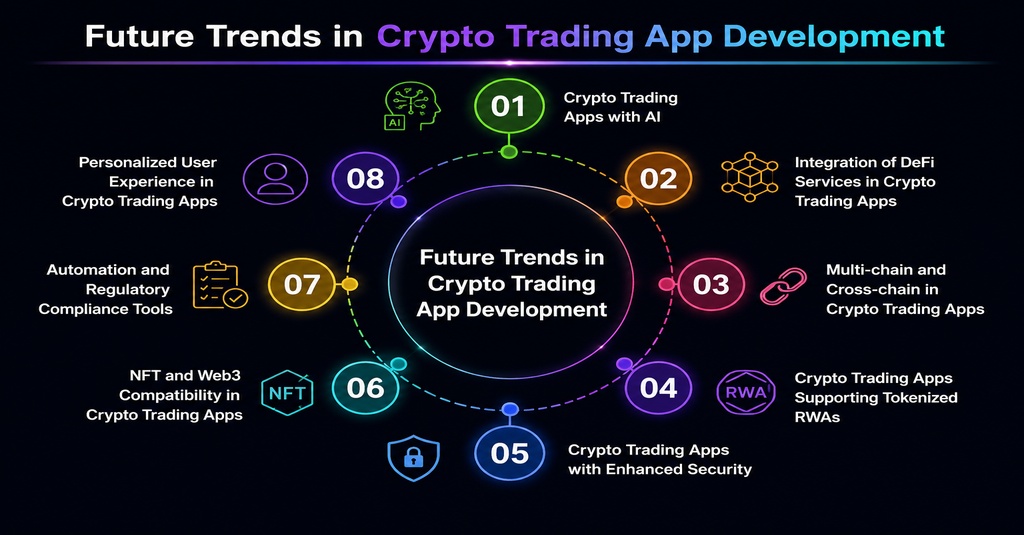
1. Crypto Trading Apps with AI
Using artificial intelligence in crypto trading apps enables businesses to offer intelligent trading instruments, automated trading strategies, and advanced predictions and analytics. AI can also assist customers by providing them with investment recommendations, responding to queries in real-time, and offering other digital services.
2. Integration of DeFi Services in Crypto Trading Apps
Decentralized Finance (DeFi) is a fast-evolving blockchain-based financial system that enables users to engage in investment activities and access a wide range of financial services, including staking and lending, with minimal effort. More crypto trading platforms are set to integrate DeFi services in the future, as they offer users increased yield, convenience, and a diverse selection of financial products.
3. Multi-chain and Cross-chain in Crypto Trading Apps
Multi-chain and cross-chain capabilities are critical to the future of crypto trading apps development because they enable businesses to position themselves as flexible and user-friendly. In the future, crypto trading apps will offer their clients the ability to trade and store assets on different blockchains.
4. Crypto Trading Apps Supporting Tokenized RWAs
Projected trends in crypto trading app development include the creation of apps that support tokenized real-world assets (RWAs). In the future, businesses will enable their clients to invest in a broader range of RWAs, including carbon credits, stocks, bonds, and real estate, in addition to cryptocurrencies. This function will enable crypto trading app owners to provide their clients access to an extended number of investment opportunities.
5. Crypto Trading Apps with Enhanced Security
Crypto trading platforms will prioritize enhanced data security and use advanced safety measures in the future. Personal biometrics, AI-powered fraud detection, and cold wallet storage systems will become more widespread among crypto trading apps. Furthermore, businesses will embrace multifactor authentication and other cutting-edge technologies to ensure that only authorised personnel can access sensitive information.
6. NFT and Web3 Compatibility in Crypto Trading Apps
In the future, crypto trading platforms will incorporate NFT marketplaces and Web3 technologies. Doing so will enable them to attract a more significant number of traders and offer a variety of digital services. Additionally, compatibility with NFTs and Web3 will help crypto trading apps provide their users with increased security and flexibility when accessing digital assets.
7. Automation and Regulatory Compliance Tools
Several countries are developing regulatory frameworks to establish guidelines for cryptocurrency-related trading activities. Crypto trading apps will continue to adopt automated compliance tools to ensure they operate within the bounds of the law. These platforms will also use artificial intelligence and other technologies to track and report transactions, conduct KYC and AML checks, and adhere to all relevant regulations.
8. Personalised User Experience in Crypto Trading Apps
Crypto trading app developers will implement technologies that allow them to create engaging and unique user experiences for their clients. For instance, they will use data analytics to gain insight into user behaviour and then apply their findings to enhance the app’s performance. Furthermore, users will benefit from improved user interfaces, intuitive personal experiences, and valuable suggestions offered by trading apps.

Conclusion
Crypto trading app development has helped to grow the adoption and use of cryptocurrencies and blockchain techniques that are beneficial for providing opportunities for organisations to invest. Proper planning, safety and security, regulatory compliance, and scalable stack techniques are essential for developing a crypto trading app like CoinSwitch Kuber for providing a seamless trading experience. A few features played an important role in achieving success on the platform, like customer registration, KYC verification, wallet integration, real-time market information, and smart or latest trading features. Meeting market demands and supplying long-term value for clients and investors requires forming a partnership with an experienced blockchain development organisation that assists in developing a safe and secure, quality-rich, and future-ready crypto trading application.
Frequently Asked Questions (FAQs)
Que 1: What is the cost of developing a crypto trading app like CoinSwitch Kuber?
Answer 1: Crypto trading app development cost typically ranges from $40,000 to $250,000+, that is all depends upon the features of the app, safety, and complexity.
Que 2: How much time to take for building application of crypto trading application?
Answer 2: A crypto trading application usually takes 3 to 12 months for development; that depends upon the scope of the project and functions.
Que 3: What kind of features should a crypto trading app have?
Answer 3: A few features that should be included in a crypto trading application are customer registration, KYC verification, a crypto wallet, real-time market data, safe and secure payment, portfolio tracking, and smart security.
Que 4: Give some names of technologies that can be used to develop a crypto trading app?
Answer 4: React Native, Flutter, Node.js, Python, Solidity, Ethereum, Polygon, AWS, and blockchain APIs.
Que 5: Why do business firms have to invest in crypto trading app development?
Answer 5: They assist to generate revenue streams, attract a large number of users globally, increase client engagement, and enhance cryptocurrency market capitalization.