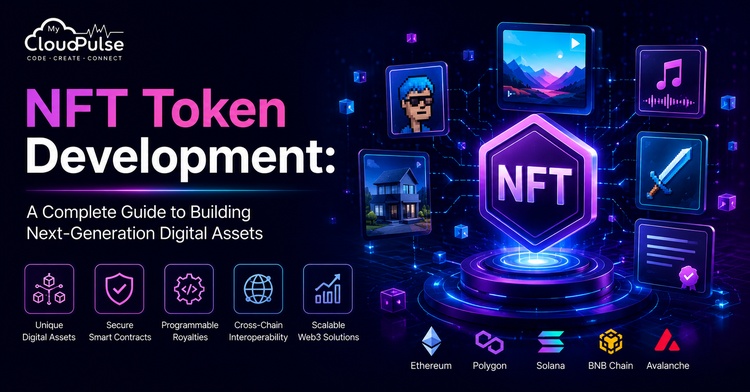
Non-Fungible Tokens (NFTs) are now much more than just digital collectibles or works of art. In 2026, NFTs are facilitating authentication of high-end items, digital asset tokenization, gaming ecosystems, virtual real estate, event tickets, healthcare records, business applications, and intellectual property rights. These features are propelling innovation across a variety of industries. To construct decentralised ecosystems, increase customer engagement, generate distinctive digital assets, and tap into new revenue sources, businesses are investing more and more in NFT token development as Web3 use grows and blockchain technology matures.
Token development for NFTs include creating, testing, and releasing one-of-a-kind blockchain-based tokens that stand in for physical or virtual assets. Each NFT token has its own distinct identity and cannot be swapped for another one in a one-to-one fashion, unlike fungible cryptocurrencies like Bitcoin or Ethereum. Advanced features like programmable royalties, metadata powered by AI, cross-chain interoperability, token-bound accounts, and smart contracts that are suitable for compliance are all part of modern NFT development.
Creating one-of-a-kind NFT tokens is just the beginning of what goes into modern NFT token production. In order to facilitate automation, compliance, and practical use, modern NFT solutions make use of AI-powered metadata, dNFTs, token-bound accounts, cross-chain interoperability, programmable royalties, DID, and smart contracts. Thanks to these advancements, companies can construct NFT ecosystems that can grow with their needs, increasing value over time while improving safety, proving ownership, and involving users.
The Future of the NFT Industry: Market Trends, Growth & Opportunities (2026–2030)
The NFT sector is maturing, moving away from speculative trading and towards practical applications and widespread use by businesses. Web3 economies are predicted to be led by NFTs between 2026 and 2030. These currencies will provide decentralised identities, tokenized real-world assets (RWAs), digital commerce, brand engagement, gaming ecosystems, AI-generated IP, and verifiable digital ownership. Companies in the banking, healthcare, real estate, entertainment, sports, educational, and retail sectors are incorporating NFT technology into their digital transformation plans at a rapid pace due to the improving blockchain infrastructure and the increasingly clear rules.
A major factor propelling expansion is the mixing of NFTs with cutting-edge innovations like AI, the metaverse, decentralised banking, and the Internet of Things (IoT). NFTs are becoming more interactive, lucrative, and functional with the introduction of AI-powered dNFTs, token-bound accounts (ERC-6551), programmable royalties, and cross-chain interoperability. Thanks to these advancements, companies can now automate digital ownership, construct scalable Web3 ecosystems, and provide customers with more tailored experiences.
NFT Market Statistics (2026–2030)
- The global NFT market was valued at USD 16.02 billion in 2025 and is projected to reach USD 18.71 billion in 2026, growing to USD 102.59 billion by 2034 at a CAGR of 23.7% during the forecast period (2026–2034).
- Grand View Research estimates the NFT market will grow from USD 63.5 billion in 2026 to USD 211.7 billion by 2030, representing a 34.5% CAGR between 2024 and 2030.
- North America accounted for 34.02% of the global NFT market in 2025, making it the largest regional market due to strong blockchain adoption, Web3 investments, and enterprise use cases.
- Ethereum remains the leading blockchain platform for NFT development, while ecosystems such as Solana, Polygon, and BNB Smart Chain continue gaining adoption because of lower transaction costs and faster processing.
- Gaming & Metaverse, Real-World Asset (RWA) Tokenization, Enterprise Applications, and Digital Collectibles are among the fastest-growing NFT application segments, reflecting the industry’s shift from speculation to utility-driven adoption.
- India’s NFT market is projected to reach approximately USD 0.82 billion in 2026, highlighting increasing blockchain adoption and expanding opportunities for Web3 startups and digital creators.
- According to Grand View Research, India’s NFT market generated approximately USD 1.03 billion in revenue in 2023 and is forecast to reach USD 9.25 billion by 2030, growing at a 36.9% CAGR from 2024 to 2030.
What Is NFT Token Development? Understanding How NFTs Work in the Modern Web3 Ecosystem
The creation of one-of-a-kind digital assets that stand in for ownership, authenticity, and provenance of digital or real goods is known as NFT development, or non-fungible token development. Each NFT is one-of-a-kind and contains unique metadata that cannot be reproduced or traded one-for-one, in contrast to fungible and equally valuable cryptocurrencies like Bitcoin or Ethereum. Because of their singularity, NFTs are well-suited to represent digital assets including music, artwork, gaming products, venue tickets, intellectual property, digital identities, and tokenized real-world assets (RWAs).
Ethereum, Polygon, Solana, BNB Smart Chain, Avalanche, and Base are just a few of the blockchain networks that fuel NFTs. A number of programmable aspects of NFTs, including ownership, transfer regulations, metadata, and royalties, are defined by these smart contracts. The generation and permanent recording of a unique token ID during NFT minting guarantees transparency, security, and ownership that cannot be tampered with. An immutable public ledger is created when every transaction, whether it’s purchasing, selling, minting, or transferring, is validated by the blockchain network.
In 2026, the development of NFT tokens has progressed much beyond digital collectibles. A number of businesses are finding new uses for NFTs, including loyalty and membership programmes, healthcare record security, real estate tokenization, decentralised identity (DID), IP protection, blockchain gaming, and the creation of immersive metaverse experiences. The development of advanced features like programmable royalties, account abstraction, cross-chain interoperability, token-bound accounts (ERC-6551), AI-powered metadata, and dynamic NFTs (dNFTs) is enhancing the intelligence, interactivity, and utility-driven nature of NFTs.
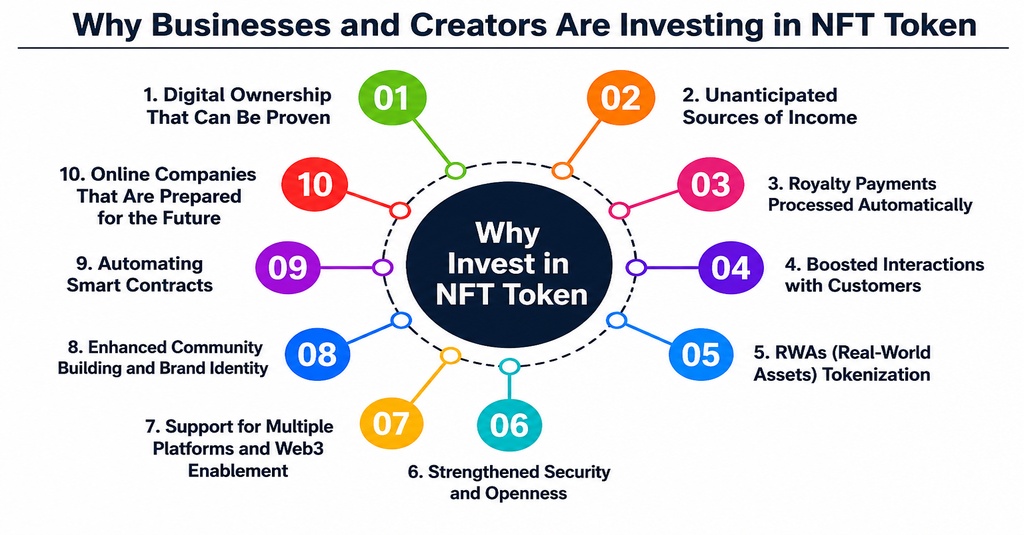
Why Businesses and Creators Are Investing in NFT Token
Businesses, startups, innovators, and enterprises are increasingly seeing NFT token creation as a strategic investment in order to take advantage of the expanding Web3 ecosystem. In addition to digital collectibles, NFTs allow businesses to tokenize physical and virtual assets, build stronger relationships with customers, generate more income, and verify ownership. Companies in many different sectors are finding new ways to innovate with the support of NFT solutions as blockchain technology develops further. These sectors include gaming, entertainment, real estate, healthcare, retail, finance, education, and luxury goods.
1. Digital Ownership That Can Be Proven
Non-fungible tokens (NFTs) offer blockchain-based, unchangeable evidence of ownership. This permits safe ownership transfers of both digital and physical assets while also guaranteeing their authenticity and preventing their duplicate.
2. Unanticipated Sources of Income
The selling of NFTs, subscription memberships, royalty payments, premium content, and tokenized experiences are all ways that businesses and creators can make money off of digital assets.
3. Royalty Payments Processed Automatically
Smart contracts guarantee artists receive royalties on every resale of an NFT, eliminating the need for middlemen and guaranteeing a steady stream of income.
4. Boosted Interactions with Customers
For brands, NFTs are a way to boost consumer retention and engagement through exclusive memberships, VIP access, loyalty incentives, limited-edition collectibles, and customised experiences.
5. RWAs (Real-World Assets) Tokenization
Real estate, high-end items, intellectual property, event tickets, certificates, and other tangible assets can all be represented by NFTs, which provide digital management, verification, and trading.
6. Strengthened Security and Openness
The immutable record of all NFT transactions on the blockchain decreases the possibility of fraud and increases confidence in the system.
7. Support for Multiple Platforms and Web3 Enablement
To expand their customer base and make their assets more portable, modern NFTs can operate on many blockchain networks, markets, games, and metaverse platforms.
8. Enhanced Community Building and Brand Identity
With the help of NFT collections, companies can build exclusive online communities where members enjoy perks like early access to products, voting privileges, prizes, and special brand experiences.
9. Automating Smart Contracts
By eliminating the need for human intervention and lowering operational expenses, NFT smart contracts streamline a variety of business activities, including ownership transfers, royalty distribution, licensing agreements, and access permissions.
10. Online Companies That Are Prepared for the Future
Businesses can stay competitive in the digital economy by developing scalable, innovative solutions with NFT tokens. This is especially important since AI, Web3, decentralised identity (DID), blockchain gaming, and the metaverse all undergo continuous evolution.
Popular Types of NFTs: Choosing the Right NFT for Your Business
Digital art and antiques are no longer the only uses for NFTs. Tokenizing digital and physical assets, improving consumer engagement, and building unique Web3 experiences are all within their capabilities in 2026, and they assist a broad variety of industries. Your business goals, target audience, and use case will determine the type of NFT that is best for you. The following are examples of the most widely used NFTs that will have an impact on digital ownership in the future.
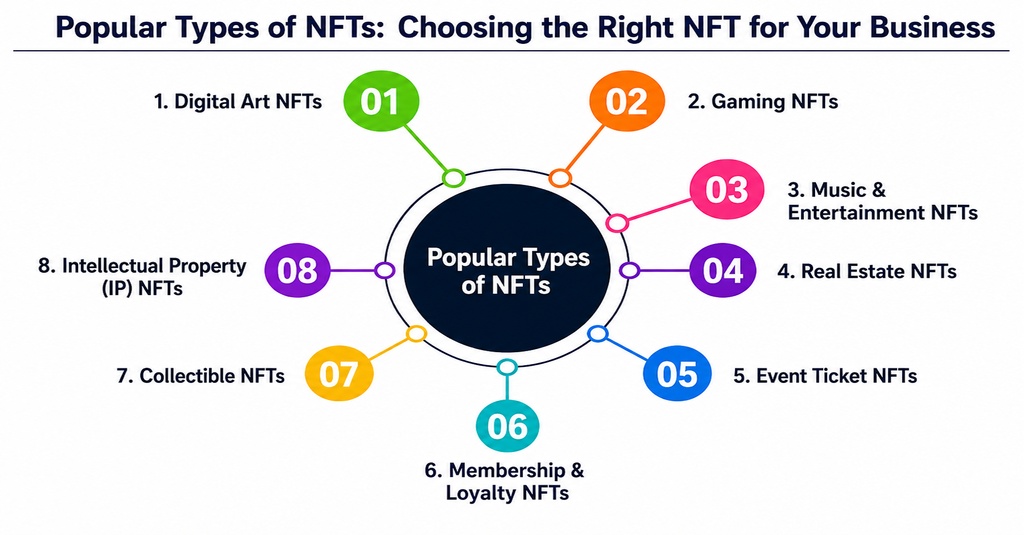
1. NFTs for Digital Art
Digital Art NFTs stand for one-of-a-kind digital works made by designers, artists, or AI systems. When the artwork is resold, they offer proof of ownership, authenticity, and royalties. This platform is ideal for artists, galleries, makers, online art markets, and AI-powered artworks.
2. Using NFTs for Gaming
Virtual goods, in-game characters, weapons, avatars, skins, collectibles, and other assets can be owned, traded, or utilised across gaming ecosystems that are compatible with gaming NFTs. Ideal for: Crypto games, GameFi systems, metaverse initiatives, and game development companies.
3. NFTs in the M&E industry
Albums, songs, movies, backstage passes, and unique experiences can be tokenized with these NFTs, and content creators, filmmakers, and artists can receive automated royalties using smart contracts. Ideal for: Artists, producers, directors, record labels, streaming services, and media companies.
4. Real Estate NFTs
To facilitate property transactions and broaden investment opportunities, real estate NFTs digitally reflect ownership or fractional ownership of physical, virtual, or commercial properties. The ideal users for this technology are virtual land marketplaces, real estate investment platforms, and real estate companies.
5. NFTs for Event Tickets
Secure and tamper-proof access to events like concerts, sports, conferences, and festivals is made possible using NFT-based tickets, which also help to reduce instances of fraud and ticket scalping. Conference sites, event planners, sports clubs, and entertainment businesses will benefit the most from this.
6. NFTs for Membership and Loyalty
Membership NFTs allow businesses to enhance client engagement through the provision of special advantages, discounts, rewards programmes, premium content, and community memberships. Companies in the luxury goods industry, online communities, subscription services, and brands all benefit the most.
7. Investable NFTs
Digital trading cards, sports memorabilia, comic books, rare collectibles, and limited-edition digital objects garner value according to demand and rarity make up collectable NFTs. Sports teams, auction houses for rare items, and entertainment companies benefit the most.
8. NFTs related to intellectual property (IP)
IP NFTs streamline the licensing and ownership verification processes by tokenizing intellectual property such as patents, trademarks, copyrights, digital licenses, and creative works. Those working in the fields of publishing, law, and technology will benefit the most from this.
Essential NFT Token Standards for Building Secure and Scalable NFT Projects
NFT token standards define the rules and technical specifications that determine how NFTs are created, transferred, managed, and interact with blockchain networks. These standards ensure compatibility between wallets, marketplaces, decentralized applications (dApps), and smart contracts, making NFT ecosystems secure, interoperable, and scalable. Choosing the right token standard is one of the most important decisions in NFT token development, as it directly impacts functionality, transaction costs, and future scalability.
Below are the most widely used NFT token standards in 2026.
1. ERC-721
ERC-721 is the original and most widely adopted NFT standard on Ethereum. Each token is unique and has its own identifier, making it ideal for assets that require individual ownership and authenticity.
Best for:
- Digital art
- Collectibles
- Virtual real estate
- Music NFTs
- Identity NFTs
Key Features:
- One-of-a-kind digital assets
- Secure ownership verification
- Broad marketplace compatibility
- Supported by major wallets and NFT platforms
2. ERC-1155
ERC-1155 is a multi-token standard that allows developers to create both fungible and non-fungible tokens within a single smart contract. It significantly reduces gas fees and improves transaction efficiency.
Best for:
- Blockchain gaming
- Metaverse assets
- Digital collectibles
- Loyalty and reward programs
Key Features:
- Supports multiple token types
- Lower transaction costs
- Batch minting and transfers
- Improved scalability
3. ERC-6551 (Token-Bound Accounts)
ERC-6551 introduces token-bound accounts, enabling NFTs to own wallets, digital assets, and other NFTs. This creates intelligent NFTs capable of interacting with decentralized applications independently.
Best for:
- AI-powered NFTs
- Gaming characters
- Digital identities
- Metaverse ecosystems
Key Features:
- NFTs can own assets
- Enhanced interoperability
- Dynamic asset management
- Advanced Web3 functionality
4. ERC-4907
ERC-4907 adds rental functionality to NFTs by separating ownership rights from usage rights. Owners can rent NFTs without transferring permanent ownership.
Best for:
- NFT rentals
- Gaming assets
- Virtual land
- Digital memberships
Key Features:
- Time-based access
- Rental support
- Automatic expiration
- Improved asset utilization
5. ERC-2981
ERC-2981 standardizes royalty payments, allowing creators to automatically receive royalties whenever their NFTs are resold across compatible marketplaces.
Best for:
- Artists
- Musicians
- Content creators
- Digital collectibles
Key Features:
- Automated royalty distribution
- Marketplace compatibility
- Creator-friendly monetization
- Smart contract integration
6. BEP-721
BEP-721 is the NFT standard on BNB Smart Chain and is compatible with Ethereum’s ERC-721. It offers faster transactions and lower gas fees while maintaining NFT uniqueness.
Best for:
- Cost-effective NFT marketplaces
- Gaming platforms
- Collectibles
- Enterprise NFT projects
Key Features:
- Low transaction fees
- Fast confirmation times
- EVM compatibility
- Strong ecosystem support
7. SPL Token Standard (Solana NFTs)
The SPL Token Standard powers NFTs on the Solana blockchain, offering extremely fast transactions and minimal fees, making it suitable for high-volume NFT applications.
Best for:
- Blockchain gaming
- NFT marketplaces
- Creator platforms
- High-performance Web3 applications
Key Features:
- High throughput
- Very low transaction costs
- Fast minting
- Scalable infrastructure
8. FA2 (Tezos NFT Standard)
FA2 is Tezos’ flexible token standard that supports fungible, non-fungible, and hybrid tokens through a single smart contract while maintaining energy efficiency.
Best for:
- Sustainable NFT projects
- Digital art
- Enterprise blockchain applications
Key Features:
- Energy-efficient blockchain
- Flexible token management
- Lower minting costs
- Eco-friendly infrastructure
Step-by-Step NFT Token Development Process for Building a Successful NFT Project
Developing an NFT token involves much more than simply minting a digital asset. A successful NFT project requires careful planning, selecting the right blockchain, developing smart contracts, creating metadata, ensuring security, and launching on a trusted marketplace. Below is a step-by-step overview of the NFT token development process in 2026.
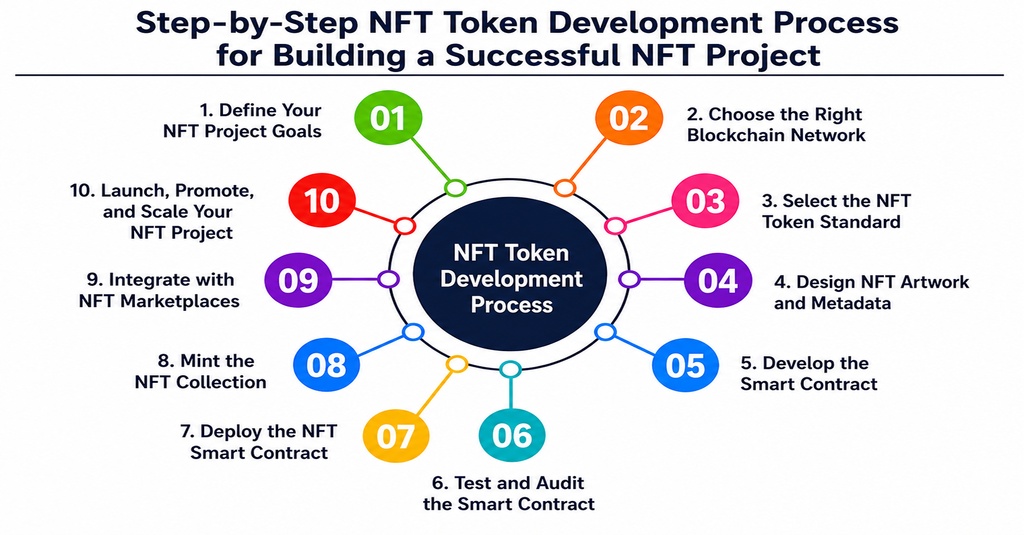
1. Define Your NFT Project Goals
The first step is identifying the purpose of your NFT collection or platform. Determine:
- Business objectives
- Target audience
- NFT use case (art, gaming, music, real estate, collectibles, memberships, ticketing, etc.)
- Revenue model
- Utility and long-term roadmap
Having a clear strategy ensures the NFT project aligns with your business goals and market demand.
2. Choose the Right Blockchain Network
Selecting the appropriate blockchain affects transaction costs, scalability, speed, security, and marketplace compatibility.
Popular blockchain options include:
- Ethereum
- Polygon
- Solana
- BNB Chain
- Avalanche
- Base
- Immutable
Each blockchain offers different advantages depending on your budget and project requirements.
3. Select the NFT Token Standard
Choose a token standard based on your NFT functionality.
Common NFT standards include:
- ERC-721 – Unique NFTs
- ERC-1155 – Multi-token standard for gaming and collections
- BEP-721 – NFTs on BNB Chain
- SPL Tokens – Solana NFTs
- FA2 – Tezos NFTs
The token standard determines how NFTs are created, transferred, and managed.
4. Design NFT Artwork and Metadata
Create high-quality digital assets such as:
- Images
- Videos
- Music
- 3D models
- Digital documents
Prepare metadata including:
- NFT name
- Description
- Creator information
- Traits and rarity
- Collection details
- Royalty percentage
Metadata is typically stored on decentralized storage solutions like IPFS or Arweave.
5. Develop the Smart Contract
Develop a secure smart contract that powers the NFT collection.
The smart contract includes:
- NFT minting logic
- Ownership tracking
- Royalty distribution
- Transfer functionality
- Burning capability (optional)
- Access permissions
- Supply management
Well-written smart contracts ensure transparency, automation, and trust.
6. Test and Audit the Smart Contract
Before deployment, thoroughly test the contract on a blockchain testnet.
Testing includes:
- Minting NFTs
- Buying and selling
- Transfers
- Royalty payments
- Security validation
- Gas optimization
Professional smart contract audits help identify vulnerabilities and reduce security risks.
7. Deploy the NFT Smart Contract
Once testing is complete, deploy the smart contract to the selected blockchain’s mainnet.
Deployment involves:
- Configuring network parameters
- Paying deployment gas fees
- Verifying contract code
- Generating the contract address
This creates the live NFT collection on the blockchain.
8. Mint the NFT Collection
Minting converts your digital assets into blockchain-based NFTs.
Minting methods include:
- Fixed collection minting
- Lazy minting
- Batch minting
- Dynamic NFT minting
Each NFT receives a unique token ID and ownership record.
9. Integrate with NFT Marketplaces
Connect the NFT collection with popular marketplaces to enable buying, selling, and trading.
Common integrations include:
- OpenSea
- Magic Eden
- Blur
- Rarible
- OKX NFT Marketplace
Marketplace integration increases visibility and liquidity for your NFT project.
10. Launch, Promote, and Scale Your NFT Project
After launch, focus on growing your community and increasing adoption.
Successful NFT marketing strategies include:
- Community building on Discord and Telegram
- Social media marketing
- Influencer partnerships
- NFT whitelist campaigns
- Airdrops and giveaways
- Utility expansion
- Brand collaborations
Continuous updates, roadmap execution, and community engagement help maintain long-term project value
Common NFT Token Development Challenges and Proven Strategies to Overcome Them
While NFTs continue to transform industries such as digital art, gaming, real estate, entertainment, and the metaverse, developing a successful NFT project comes with technical, legal, and market-related challenges. Understanding these risks early and implementing effective solutions can improve security, user trust, and long-term sustainability.
1. Smart Contract Security Risks
Challenge:
Poorly written smart contracts can contain vulnerabilities that hackers exploit, leading to unauthorized minting, asset theft, or financial losses.
Solution:
- Follow secure coding standards.
- Conduct multiple rounds of testing.
- Perform third-party smart contract security audits.
- Implement bug bounty programs for ongoing security improvements.
2. High Blockchain Transaction Fees
Challenge:
Minting and transferring NFTs on some blockchain networks can result in high gas fees, discouraging users and reducing adoption.
Solution:
- Choose cost-efficient blockchains like Polygon, Base, or Solana.
- Optimize smart contract code to reduce gas consumption.
- Consider lazy minting to delay minting costs until purchase.
3. Scalability and Network Congestion
Challenge:
Popular blockchain networks can become congested during high-demand periods, causing slow transactions and increased fees.
Solution:
- Deploy on scalable Layer-2 networks.
- Use high-throughput blockchain platforms.
- Optimize backend infrastructure for handling increased traffic.
4. Intellectual Property and Copyright Issues
Challenge:
Unauthorized use of artwork, music, or digital content can lead to copyright disputes and legal complications.
Solution:
- Verify ownership of all digital assets before minting.
- Obtain proper licensing agreements.
- Include clear copyright and usage terms for NFT holders.
5. Regulatory and Compliance Uncertainty
Challenge:
NFT regulations continue to evolve across different countries, creating uncertainty regarding taxation, consumer protection, and digital asset compliance.
Solution:
- Stay updated with regional regulations.
- Work with legal and compliance experts.
- Implement KYC/AML processes where required.
- Design your NFT ecosystem to meet applicable legal standards.
6. Poor User Experience
Challenge:
Complex wallet setup, confusing interfaces, and difficult purchasing processes can discourage mainstream users.
Solution:
- Create intuitive user interfaces.
- Support multiple wallet options.
- Simplify onboarding with guided registration and tutorials.
- Offer seamless payment options, including fiat where possible.
7. Metadata Storage Risks
Challenge:
Storing NFT metadata on centralized servers increases the risk of broken links, data loss, or manipulation.
Solution:
- Use decentralized storage solutions such as IPFS or Arweave.
- Maintain redundant backups of metadata.
- Ensure metadata integrity through immutable storage practices.
8. Low Market Demand and Community Engagement
Challenge:
Even technically strong NFT projects may struggle if they fail to attract buyers or build an active community.
Solution:
- Develop a clear utility beyond digital ownership.
- Build engaged communities through Discord, Telegram, and social media.
- Offer exclusive benefits, memberships, staking, or rewards for NFT holders.
- Execute consistent marketing and partnership campaigns.
9. Marketplace Compatibility Issues
Challenge:
NFTs may not function properly across different wallets, marketplaces, or blockchain ecosystems due to incompatible standards.
Solution:
- Use widely accepted NFT token standards such as ERC-721 or ERC-1155.
- Test compatibility with major marketplaces and wallets before launch.
- Follow blockchain interoperability best practices.
10. Long-Term Project Sustainability
Challenge:
Many NFT projects lose momentum after launch because they lack continuous development and community support.
Solution:
- Publish a realistic long-term roadmap.
- Deliver regular feature updates and new utilities.
- Engage with the community through events, governance, and rewards.
- Continuously improve the platform based on user feedback.
Conclusion
NFT token development has become a cornerstone of the Web3 economy, enabling businesses to create secure, transparent, and utility-driven digital assets that extend far beyond collectibles. As highlighted throughout this guide, NFTs are transforming industries including gaming, real estate, finance, healthcare, entertainment, retail, education, and intellectual property management by providing verifiable ownership, automated transactions, and decentralized asset management.
Building a successful NFT project requires a strategic approach that begins with defining clear business objectives and selecting the right blockchain network and token standard. From designing digital assets and metadata to developing secure smart contracts, conducting comprehensive audits, and integrating with leading NFT marketplaces, every stage of the development process plays a critical role in ensuring scalability, security, and long-term success. Choosing the appropriate technologies and following industry best practices helps businesses reduce development risks while delivering a seamless user experience.
The report also highlights that the future of NFTs lies in utility rather than speculation. Emerging innovations such as dynamic NFTs (dNFTs), AI-powered metadata, token-bound accounts (ERC-6551), programmable royalties, decentralized identity (DID), cross-chain interoperability, and real-world asset (RWA) tokenization are expanding NFT capabilities and opening new business opportunities. These advancements enable organizations to build intelligent, interactive, and interoperable digital ecosystems that generate lasting value for both businesses and users.
Frequently Asked Questions (FAQs)
Que 1: What is NFT token development?
Answer 1: NFT token development is the process of creating unique blockchain-based digital assets that represent ownership of digital or physical items.
Que 2: Which blockchain is best for NFT development?
Answer 2: Ethereum, Polygon, Solana, BNB Chain, and Base are among the most popular choices, depending on your project’s budget and scalability needs.
Que 3: How much does NFT token development cost?
Answer 3: The cost varies based on features, blockchain network, smart contract complexity, and marketplace integration, typically ranging from a few thousand to several hundred thousand dollars.
Que 4: Which NFT token standard should I choose?
Answer 4: ERC-721 is ideal for unique NFTs, while ERC-1155 is better for gaming and multi-token projects that require lower transaction costs.
Que 5: Why should businesses invest in NFT token development?
Answer 5: NFTs enable businesses to create digital ownership, generate new revenue streams, automate royalties, improve customer engagement, and support innovative Web3 business models.