Vehicles, drivers, shipments, routes, paperwork, clients, money, and delivery dates are all aspects of daily operations for transportation companies. When these activities rely on spreadsheets, phone calls, paper records, and disconnected applications, teams may face problems like delayed dispatching, incorrect cargo information, empty vehicle capacity, inefficient routes, and limited operational visibility.
Logistics software development solves these issues by providing a unified system for transportation operations management. Enterprise supply chains, intracity deliveries, freight operations, cargo marketplaces, third-party logistics, and last-mile distribution are all features that the programme can provide.
A good solution will do more than just show where cars are located on a map. It needs dependable procedures that link administrators, customers, financial teams, drivers, carriers, dispatchers, and shippers.
Logistics Software Market Statistics
With a projected increase of 7.8 percent from 2025 to 2026, the worldwide logistics software industry will go from a value of about $16.32 billion to $17.60 billion. From 2026 to 2035, it is anticipated to reach around USD 34.68 billion, growing at a CAGR of around 7.83%.
According to one projection, the market would expand from $18.70B in 2025 to $21.30B in 2026, a rise of around 13.9%, and then reach $44.84B in 2034, a growth rate of 9.8 per cent. Different reports include different components, such as transportation-management software, planning, freight visibility, analytics, and related services, which causes estimates to vary.
| Market | 2025 | 2026 | Long-Term Forecast |
| Logistics software | USD 16.32B | USD 17.60B | USD 34.68B by 2035 |
| Transportation management systems | USD 18.70B | USD 21.30B | USD 44.84B by 2034 |
What Is Logistics and Transportation Management Software?
Logistics and transportation management software is a digital system that helps businesses plan, coordinate, execute, and monitor the movement of goods.
The platform can handle tasks such as the following:
- Making the shipment
- Obtaining a freight quote
- Picking out a car
- Assigning drivers or carriers
- Organizing routes
- Remote monitoring
- Instructions
- Evidence of shipment
- Invoicing and payment
- The upkeep of the fleet
- Analyses and reporting
This software can serve as a digital marketplace that links shippers with independent carriers, an on-demand vehicle booking application, an enterprise transportation management system, an internal fleet-management system, or some combination of these functions, depending on the business model.
A basic solution can handle local vehicle booking and tracking. A sophisticated platform coordinates thousands of shipments across various warehouses, transportation modes, carriers, nations, currencies, and regulatory frameworks.
How Does Logistics and Transportation Management Software Work
When either a shipper or an employee requests delivery, the transportation workflow starts. Customer information, shipment dimensions, weight, product type, delivery date, necessary vehicle, special handling instructions, and locations for pickup and drop-off are all part of the request.
Next, it determines which modes of transportation are accessible. A logistics marketplace might compare third-party transportation providers, whereas an internal fleet operator might look for its own drivers and cars.
The pricing engine then determines the transportation charge. It might take factors like demand, waiting time, labour, service level, distance, shipment weight, vehicle type, predicted travel time, tolls, fuel expenses, and fuel prices into account.
The despatch engine will then designate a carrier or driver once it receives confirmation. The software takes care of creating the route, communicating with the driver, and tracking the consignment.
The platform receives location data and status events while transportation is underway. Dispatchers can track shipments in real time, and consumers receive updates on when their goods will be picked up, delivered, and in transit.
As a last step, the driver takes delivery confirmation. Closing the journey, calculating costs, creating an invoice, updating the carrier’s earnings, and storing the cargo history for reporting and audits are all tasks that are handled by the platform.
Core Features of Logistics and Transportation Management Software
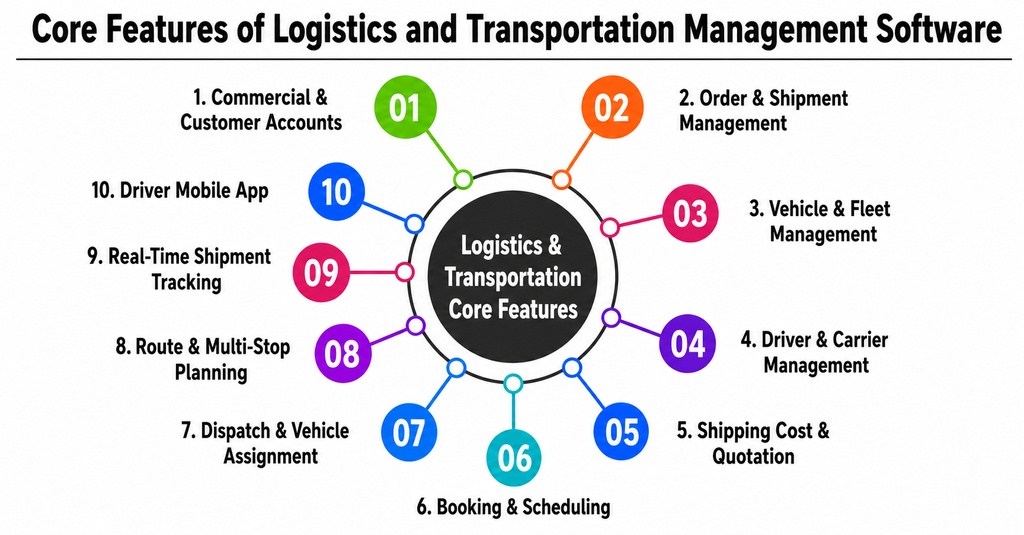
1. Management of Commercial and Customer Accounts
Anyone from sole proprietors to large corporations, transportation companies, and even internal staff should be able to sign up for an account on the platform.
Data such as the firm name, tax identification number, billing and shipping addresses, credit limits, service agreements, preferred routes, authorised personnel, and approval processes may be required for business accounts.
Organisations should be able to manage user accounts by adding or removing users and assigning permissions based on their roles. A different individual may be responsible for creating bookings and another for approving payments or viewing company-wide reports.
2. Order and Shipment Administration
Managing shipments is the backbone of the platform’s operations. The following fields should be filled out by users when creating shipments: pickup and delivery addresses, sender and receiver information, package dimensions and weight, product or consignment type, quantity and declared value, due date for delivery, handling instructions, documents to support the shipment, and transportation mode preference.
There has to be a comprehensive history of shipping statuses and a unique tracking number for every shipment. Additional features that the system should have are the ability to handle repeated shipments, uploads in bulk, duplicate shipments, order cancellations, failed deliveries, returns, rescheduling, and partial deliveries.
3. Management of Vehicles and Fleets
Fleet management systems keep data pertaining to various vehicles, including trucks, vans, bikes, trailers, containers, and specialised vehicles. All vehicles can have their registration numbers, capacities, dimensions, fuel types, insurance, permits, maintenance records, operating regions, and availability shown in their records.
If a vehicle isn’t suitable for the shipment, the platform shouldn’t let you allocate it. It would be inappropriate, for instance, to load a heavy shipment onto a vehicle that isn’t capable of handling it or to assign a refrigerated shipment to a regular vehicle.
4. Transportation and Driver Administration
The driver module should handle details like availability, service areas, ratings, earnings, performance, personal information, documents, and licenses.
Records kept by carriers may contain information regarding the following: operating lanes, insurance, contract prices, service history, payment terms, compliance paperwork, and fleet capacity.
Managers should have the authority to authorise, revoke, or limit carriers and drivers. When important documents like licences, insurance, and permits are about to expire, automated reminders can let them know.
5. Cost and Estimate for Shipping
The price engine determines transportation costs according to company policies. Distance, weight, volume, number of stops, pickup urgency, delivery deadline, toll charges, waiting time, loading assistance, fuel expenses, service region, market demand, and pricing can be determined by various factors.
Companies may need to charge different fees to contracted clients and on-demand users. The quotation module should display the base fare, taxes, tolls, extra services, discounts, and the final anticipated price properly. Customers have more faith in a business, and fewer disagreements arise when prices are clear.
6. Planning and Reserving
Customers should be able to reserve transportation immediately or at their convenience. It is expected that the system will block bookings made outside of the service zone, vehicle capacity, or available operation hours.
The software might also be able to handle repeating schedules for business processes. A store, for instance, might need a car first thing in the morning to transport merchandise from the warehouse to all of their locations.
7. Transportation Scheduling and Assignment
Despatch management links the availability of transportation services to the demand for delivery. Either the dispatcher can manually allocate the vehicle or the software can suggest the best driver and vehicle combination.
Pickup location, vehicle capacity, driver availability, route, shipment priority, delivery date, service zone, driver hours, cost estimate, and past performance are all factors that the assignment engine can take into account. When operational conditions change, a vehicle breaks down, or a driver cancels, the platform should also allow for reassignment.
8. Coordinating Delivery Stops and Routes
The optimal sequence for pickups and deliveries is determined using route-planning software. Distance, delivery windows, vehicle capacity, traffic, priority, and driver working limitations are some of the factors that an advanced platform can optimise over multiple stops, in contrast to a basic system that may only compute a route between two points.
Retail distribution, grocery supply, warehouse replenishment, courier services, and last-mile delivery are some of the most common uses for multi-stop support. If dispatchers have local knowledge or customer requirements that make a different sequence more practical, they should still be able to review or modify the proposed route.
9. Track your shipments in real time.
Tracking lets everyone, from customers to dispatchers to administrators and support staff, see where things stand. The driver application can set specified intervals to transmit location updates. The web dashboard then shows the vehicle’s location, route, stops made, next stop, and expected time of arrival.
When a vehicle enters or exits a pickup, warehouse, checkpoint, or delivery location, geofencing can immediately update the shipment. With the rise of on-demand transportation services, customers now expect real-time vehicle tracking and automatic notifications.
10. Driver Mobile Application
A dependable and straightforward-to-use mobile interface is necessary for drivers. You should be able to create new trip requests, accept or reject them, navigate to pickup and drop-off locations, find customer contact information, get shipment instructions, upload documents, get status updates, see a summary of your profits, see your payment history, report issues, and access support through the app.
Given that drivers may engage with the interface in a time-sensitive manner, it is advisable to employ big controls and eliminate superfluous steps. When drivers are working in places with spotty internet service, offline support is invaluable. Local storage of statuses and documents enables synchronisation once the connection is restored.
Advanced Features of Transportation Management Software
1. Carrier and Vehicle Matching Enabled by AI
Before making a recommendation for a carrier or vehicle, AI can assess factors such as availability, cost, location, capacity, route compatibility, and delivery risk.
Intelligent matching can take into account how the assignment would impact future trips, in contrast to simple nearest-driver allocation. If a neighbouring vehicle is already booked for another high-priority shipment, allocating it to this one may not be the most efficient use of its time. In certain cases, human dispatchers may need to review or even override the advice.
2. Predictive Estimated Arrival Times
Traditional ETA calculations depend mainly on distance and current traffic. Predictive models may also analyse historical travel times, loading duration, driver behaviour, vehicle type, weather, delivery-location delays, warehouse congestion, and time.
The system can continuously recalculate the expected arrival time and notify stakeholders before a delay becomes critical.
3. Projection of Anticipated Departure Times
Distance and current traffic conditions are the primary factors in traditional ETA calculations. In addition to past journey timings and loading durations, predictive models may also take into account driver behaviour, vehicle type, weather, delivery-location delays, warehouse congestion, time of day, and delivery locations.
Before a delay becomes critical, the system can warn stakeholders and continuously recalculate the projected arrival time.
4. Smart Exception Handling
No cargo should necessitate the manual monitoring of transportation crews. An exception-management engine will catch unusual events like a prolonged idle vehicle, route deviation, missed pickup, unexpected stop, expired document, high-temperature alarm, failed payment, or inaccessible customer.
Based on its severity classification, the platform can then advise the appropriate employee and send them a notification.
5. Adjustable Costs
Dynamic pricing adjusts transportation rates based on the current operating conditions. The system takes into account factors such as supply and demand, fuel prices, distance, traffic, weather, and the difficulty of the route.
Nonetheless, companies must monitor their prices and provide their clients with an itemised bill. Lost faith can result from mysterious price shifts.
6. Load and Capacity Optimisation
Capacity optimisation helps businesses use their available vehicle space more efficiently. The software may combine compatible shipments according to weight, volume, destination, route, handling requirements, and delivery windows.
This reduces partially empty trips and improves revenue per vehicle. Nevertheless, the system must avoid combining products that require different temperatures, security conditions, or regulatory handling.
7. Ensuring Efficient Use of Resources
Businesses can better use their available vehicle space through capacity optimisation. Weight, volume, destination, route, handling needs, and delivery windows are some of the factors that the software takes into account when combining compatible shipments.
As a result, the system achieves fewer trips with empty seats and higher revenue per vehicle. However, the system should not mix products that have various temperature, security, or regulatory handling requirements.
8. Forecasting Upkeep
To determine which vehicles in their fleet may need repairs, fleet managers might review data such as mileage, engine specs, fuel economy, problem codes, and maintenance records. Before a malfunction interrupts an ongoing shipment, the system may suggest maintenance.
When telematics devices integrate with the software and receive accurate vehicle data, they make predictive maintenance most effective.
9. Connectivity between the Internet of Things and Telematics
There is more data that IoT devices can provide than just their GPS coordinates. Sensors can monitor temperature, humidity, gasoline level, speed, hard braking, engine condition, cargo movement, and open doors.
Shipments of perishable goods, such as food, chemicals, electronics, and pharmaceuticals, benefit greatly from these capabilities.
10. Preventing Fraud and Other Risks
Bookings that don’t add up, drivers that act suspiciously, manipulated routes, fraudulent proof of delivery, and strange payments are all things that fraud detection software can spot.
Before completing a transaction, the software can assign a risk score and necessitate extra verification.
11. Tower for Logistics Control
With the help of a control tower, transportation operations can be monitored from a central location, regardless of the warehouse, carrier, or mode of transportation. The control tower highlights trends in performance, costs, risks, capacity shortages, active shipments, and delays.
For managers to make quicker decisions, the control tower gathers and analyses data from various sources rather than replacing operational systems.
12. Tracking Emissions and Sustainability
More and more, companies are interested in tracking metrics like fuel efficiency, empty mileage, route effectiveness, and projected carbon emissions. The software might suggest route consolidation, improved vehicle utilisation, or vehicles with reduced emissions after comparing various transport options.
Emissions calculations should clearly state the methodology and data used.
Unique Selling Proposition of Transportation and Logistics Apps
Having complete oversight and management of all transportation-related processes from a single interface is the key differentiator.
Without a unified system, users rely on various apps or manual processes for booking, despatch, tracking, paperwork, payments, and reporting.
With a unified logistics platform, all authorised users can access accurate, up-to-date data. Customers can see where their shipments are, drivers can follow detailed instructions, dispatchers can handle exceptions, and managers can see how much it costs and how well it’s working.
The programme also generates a reliable operational history. Businesses can leverage this data to enhance routes, negotiate contracts with carriers, pinpoint lanes that aren’t performing up to par, and anticipate transportation needs in the future.
Unique Attribute: Dispatch Engine with Constraint Awareness
A freight-matching and despatch engine that takes constraints into account is the most useful feature. The closest vehicle is chosen via a basic allocation system, which considers the whole operational environment by means of a constraint-aware engine.
It could look at:
- Sort and capacity of the vehicle
- Dimensions for shipment
- Tips for drivers
- Available times for pickup
- The due date for delivery
- Directions on the route
- Permits called for
- Conditions involving temperature
- Current weight of the vehicle
- Putting the customer first
- Accuracy of the carrier
- Cost estimate for the journey
After weighing service quality, cost, operational risk, and vehicle utilisation, the engine then suggests the assignment that strikes the optimal balance.
Common Types of Logistics Software
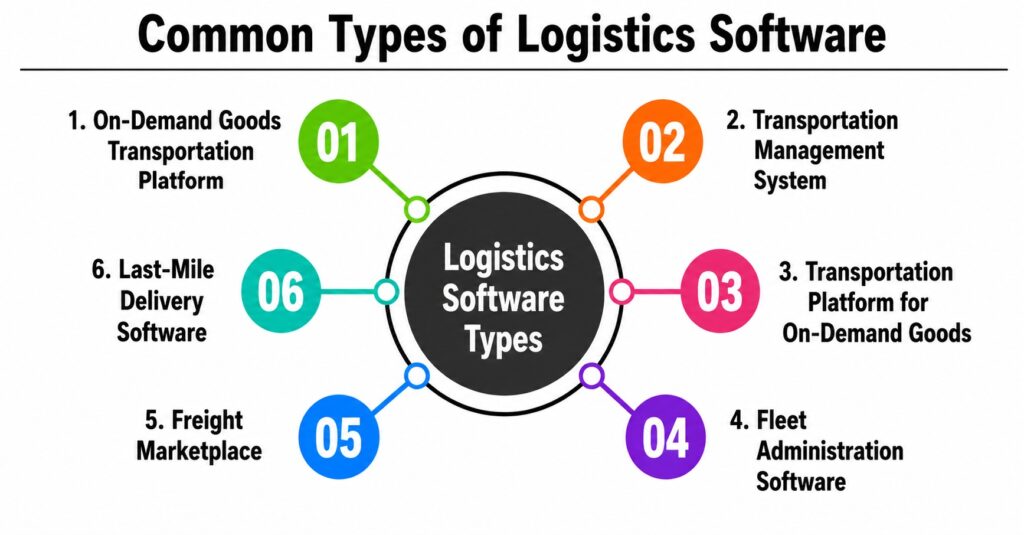
1. On-Demand Goods Transportation Platform
This model allows individuals and businesses to book bikes, vans, mini trucks, or larger commercial vehicles. It is suitable for local deliveries, business stock movement, furniture transport, and small cargo.
2. Transportation management systems
Transportation management systems (TMSs) help businesses organise their transport across various locations, carriers, and shipment types. Freight planning, carrier selection, route optimisation, tracking, auditing, and reporting are some of the usual services it offers.
3. Software for Fleet Administration
All eyes are on the company’s drivers and vehicles when it comes to fleet software. It manages vehicle locations, utilisation, fuel, documentation, driver conduct, and operational costs.
4. Online Market for Freight
A freight marketplace connects shippers and transport corporations or independent carriers. Posting loads, negotiating prices, verifying carriers, booking, tracking, paying, and rating all happen on the site.
5. Delivery Software for the Final Mile
Distribution centres, warehouses, and retail outlets all work together through last-mile delivery systems. In many cases, they facilitate failed-delivery management, customer alerts, proof of delivery, delivery time windows, and route optimisation.
Logistics Software Development Process
1. Provide an Overview of Business and Its Operations
The first step is to identify what the programme is responsible for managing. The company has to figure out who they’re selling to, where they’re shipping to, what kinds of vehicles they have, how they’ll pay for them, how they’ll comply, and how much money they’ll make.
Enterprise transportation systems that operate across borders have different architectural needs than platforms that facilitate the booking of local vehicles.
2. User Responsibilities and Document Needs
Teams in charge of shipping, dispatching, drivers, carriers, warehouse operations, accounting, customer service, and administration should establish standards. Prioritise features that are necessary for the MVP and those that can be added later.
A seasoned logistics software development business should question unneeded features instead of trying to implement every idea in the initial release.
3. Create a Personalised Interface
Interface standards, wireframes, prototypes, and user journeys are all products of the design process. Every user needs a unique experience. Dispatchers need extensive real-time data, drivers need quick operational controls, and customers need simple booking and tracking.
Regardless of the number of active shipments, the maps, tables, status indicators, warnings, and actions should all be easily comprehensible.
4. Create the Building Plans
Integrations with third parties, real-time data, notifications, payments, documents, and analytics are all essential components of any effective design.
Web and mobile frontend apps, backend app services, document and relational databases, caching, message queues, cloud object storage, notification providers, analytics tools, monitoring, and logging are all components of a scalable system. The architecture should partition the main modules so that changes to the platform as a whole do not disrupt other services.
5. Build the Foundational Units
In a typical development cycle, the team creates features for managing shipments, pricing, booking, dispatching, driver tools, tracking, payments, reporting, and administration.
Before configuring typical transportation procedures, businesses looking to design custom logistics software should tailor only the operations that generate real competitive advantage.
6. Incorporate Third-Party Apps
A few examples of popular integrations are GPS, payment processors, email and SMS providers, enterprise resource planning (ERP) software, accounting and warehousing systems, fuel cards, telematics devices, tax systems, identity verification, and customer support platforms.
Authentication, handling errors, retries, monitoring, and data ownership rules should all be part of any integration.
7. Evaluate the System
All aspects of the product, including its features, usability, security, speed, pricing, route calculations, permissions, notifications, and device compatibility, should be thoroughly tested.
Team members should also practise handling unexpected scenarios, such as drivers cancelling last-minute trips, vehicles breaking down, duplicate payments, spotty internet, wrong GPS coordinates, unavailable customers, partial deliveries, driver documents that have expired, routes that have been closed, and oversized shipments.
As part of their professional software development services, transportation companies should conduct user-acceptance testing with actual drivers, dispatchers, and operations staff.
8. Set Up a Pilot System
For the initial launch, businesses should consider city, region, customer group, or fleet limitations. Businesses often conduct pilot programmes to gauge booking completeness, driver acceptability, vehicle utilisation, delivery time, support requests, payment accuracy, and system stability.
It is recommended to gather operational feedback before introducing additional regions or complex features.
9. Optimise and Scale
The business will be able to increase automation, capacity, locations, integrations, and transportation options following the pilot.
For logistics software development to be reliable, it needs post-launch support in the form of monitoring, maintenance, security patches, performance enhancements, and new features.
10. Suggested Technology Stack
Backend services can use Python, Go, Node.js, or Java. Structured operations, PostgreSQL or MySQL, manage all records, while Redis supports caching and rapid, transient data.
You can find shipments, customers, or addresses fast with the use of search engines. Message queues are capable of handling asynchronous workflows, notifications, and tracking events.
When you choose the final technology stack, consider several factors, including anticipated traffic, development-team expertise, security requirements, integration demands, hosting preferences, and long-term maintenance.
Team Required for Logistics Software Development
Expertise in both technology and logistics is typically necessary for a professional project.
The product owner defines a company’s objectives and aims. The project manager manages time, communication, hazards, and the project’s scope.
The business analyst records users’ needs, transportation procedures, and any operational quirks.
The logistics domain expert verifies that the platform accurately represents actual dispatching, fleet, carrier, warehouse, and compliance needs. Interaction designers create user interfaces for administrators, drivers, dispatchers, and customers.
Mobile and web developers create the user interfaces and functionality of applications. Service providers in the backend build the system’s shipment, pricing, assignment, tracking, payment, and reporting features. In terms of data, applications, integration, security, and scalability, the solution architect designs the big picture.
Quality assurance engineers test functionality, speed, workflows, devices, and permissions. A DevOps engineer is responsible for overseeing the reliability, backups, monitoring, and environments in the cloud.
For sophisticated analytics, anomaly detection, predictive ETA, intelligent despatch, and forecasting, data or AI experts must be involved. Issue response, integrations, sensitive data, authorisation, encryption, and authentication are all examined by a security expert.
Even though smaller projects may involve multiple people and tasks, everyone involved should clearly understand who is responsible for what in terms of design, logistics, quality, and safety.
Key Development Challenges
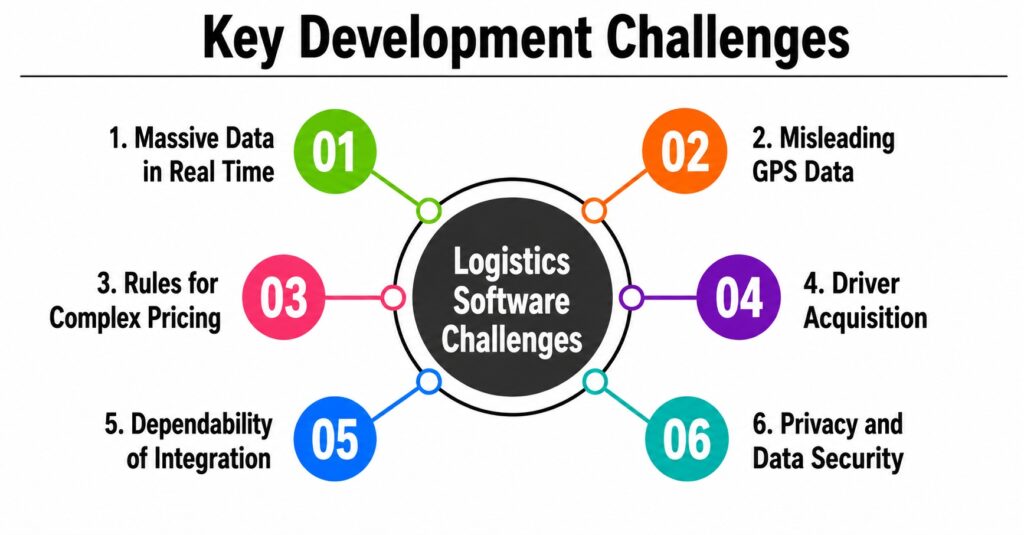
1. Massive Data in Real Time
Tracking thousands of moving automobiles produces a lot of location events. The system must process this data without causing unnecessary delays in user interfaces or increasing infrastructure costs.
2. Misleading GPS Data
Device settings, weak signals, tunnels, tall buildings, and battery-saving modes can all impact location data. When real-time data isn’t available, the programme should highlight the most recent reliable update and flag any implausible jumps.
3. Rules for Complex Pricing
Several factors can affect transportation expenses, including distance, vehicle capacity, weight, tolls, waiting time, labour, fuel, taxes, and contractual rates. It is important that rules can be adjusted and tested extensively.
4. Driver Acquisition
Software that requires excessive data entry or provides vague instructions may face resistance from drivers. Navigation, trip details, earnings transparency, and support are all practical features that the driver app should offer while minimising the number of steps.
5. Dependability of Integration
For a limited time, you might not be able to use an external provider for telematics, ERP, maps, or payments. Platform features should include error recording, safe retrying, and transaction duplication prevention.
6. Privacy and Data Security
Data stored in logistics systems includes names, addresses, shipments, drivers’ paperwork, and financial transactions. It is important to encrypt and audit sensitive information and to follow role-based permissions for access.
Monetization Methods
1. SaaS Membership
Companies can pay on a monthly or yearly basis to access the site. User, vehicle, shipping, branch, storage, and feature-specific plans may vary.
Flat Rate for Each Trip or Shipment
Every finished booking or shipment incurs a predetermined fee from the platform. With this model, the platform directly links customer activity to its revenue.
2. Model for Commissions
A freight marketplace can take a share of the money that carriers receive. The commission may change depending on the type of shipment, the distance, the carrier agreement, and the level of service.
3. Pricing in Relation to Use
Data storage, route computations, communications, documents, API calls, and tracking events are all potential sources of charges.
4. Business licences
Annual licensing is an option for large organisations that covers defined capacity, implementation, support, integrations, and service commitments.
5. Exclusive Modules
There are potential add-on modules for advanced route optimisation, artificial intelligence dispatching, analytics, telematics, financial automation, and compliance tools.
6. Custom Software Development
Transport companies can license the technology to run the platform under their brand. Setup fees, customisation fees, subscription fees, and transaction fees are all potential sources of revenue.
Conclusion
Building software for transportation and logistics management calls for an in-depth familiarity with both digital and physical processes.
To effectively handle real-life issues like traffic, breakdowns, delays, and insufficient information, the platform must manage shippers, cars, drivers, routes, paperwork, payments, and customer expectations.
A well-defined operating model and prioritised requirements are the foundation of logistics software development. Before anything else, the company needs to establish its core competencies in shipment, despatch, tracking, payment, and reporting. Measurable operational needs then help to introduce advanced services such as AI matching, forecasting arrival times, capacity optimisation, telematics, and automated exception management.
Platforms with the most features do not necessarily offer the best answer. It is the one that allows teams to react to issues before they impact customers, increases transportation visibility, reduces manual labour, and makes effective use of fleet capacity.
Frequently Asked Questions
Que: 1. How long does it typically take to develop logistics software?
Answer: Depending on the features, connectors, and workflows of the logistics MVP, its development time could range from four to six months. An enterprise platform with advanced analytics, multi-regional operations, complex telematics, finance, and despatch may necessitate a more drawn-out, phased development strategy.
Que 2: What are the essential features of transportation management software?
Answer: Inventory management, booking, pricing, despatch, route planning, real-time tracking, notifications, payment, reporting, administrative controls, and proof of delivery are some of the main features.
Que 3: How is logistics software different from fleet-management software?
Answer: Typically, owned cars, drivers, maintenance, fuel, and utilisation are the primary components of fleet-management software. Logistics software encompasses all aspects of transportation, including clients, shipments, carriers, routes, paperwork, invoicing, and delivery efficiency.
Que 4: Can logistics software support both an internal fleet and external carriers?
Answer: Yes. When a suitable business vehicle is not available, a hybrid platform can assign a qualified external carrier after searching internal fleet capacity. Each model requires its own set of configuration settings for pricing, contracts, settlements, and permissions.