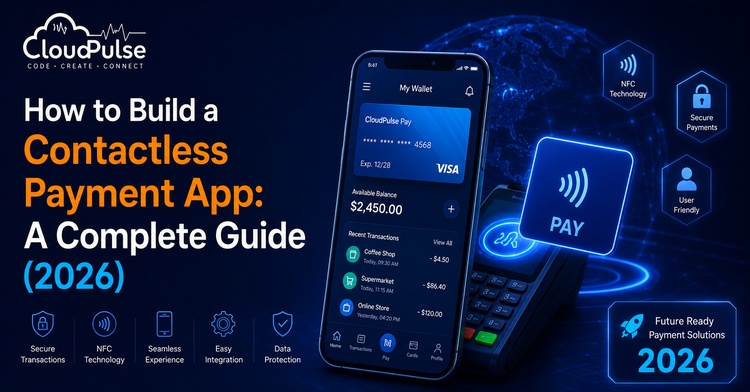
The global payments landscape has undergone a significant transformation over the last decade, with contactless payments becoming the preferred transaction method for consumers and businesses alike. Driven by the widespread adoption of smartphones, wearable devices, Near Field Communication (NFC) technology, and digital wallets, contactless payment applications have revolutionized how people make purchases. Instead of relying on cash or inserting physical cards into payment terminals, users can now complete transactions with a simple tap of their smartphone, smartwatch, or contactless payment card.
The growing demand for speed, convenience, and security has encouraged businesses across industries including retail, healthcare, hospitality, transportation, banking, and eCommerce to invest in contactless payment solutions. Consumers increasingly expect frictionless payment experiences, making contactless payment apps a strategic necessity rather than an optional feature.
For businesses, developing a contactless payment app offers numerous advantages, including faster checkout processes, improved customer satisfaction, reduced operational costs, enhanced security, and valuable customer insights through transaction analytics. As digital payment adoption continues to accelerate worldwide, organizations that embrace contactless payment technology can gain a competitive edge while future-proofing their payment infrastructure.
Contactless Payment Market Overview & Key Statistics (2026)
- The global contactless payment market is projected to grow from USD 50.79 billion in 2026 to USD 128.35 billion by 2034, at a 12.30% CAGR, reflecting sustained demand for digital payment solutions.
- Asia Pacific led the market in 2025 with a 26.2% share, driven by high smartphone penetration, digital wallet adoption, and government initiatives promoting cashless payments.
- NFC technology remains the dominant payment technology, accounting for an estimated 69.52% market share in 2026 because of its speed, security, and widespread acceptance across payment terminals.
- Retail & eCommerce represent the largest application segment, expected to account for 54.81% of the market in 2026 as businesses increasingly offer tap-to-pay experiences.
- Wearable payments are one of the fastest-growing payment modes, supported by increasing adoption of smartwatches and fitness trackers with integrated payment capabilities.
Top Contactless Payment App Ideas for Businesses
As digital payments continue to replace traditional cash and card transactions, businesses have numerous opportunities to develop contactless payment applications tailored to different industries and user needs. The type of app you choose depends on your target audience, business model, and payment ecosystem. Below are the most popular types of contactless payment apps businesses can build in 2026.
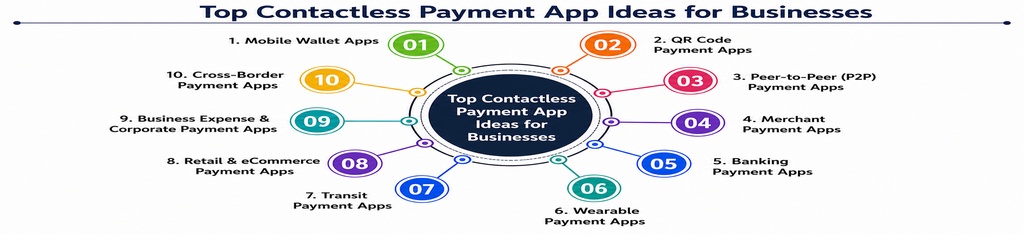
1. Mobile Wallet Apps
Mobile wallet applications enable users to securely store payment cards, bank accounts, loyalty cards, and digital coupons in one place. These apps allow customers to make contactless payments using NFC-enabled smartphones or wearable devices at supported point-of-sale (POS) terminals.
Key Features:
- NFC Tap-to-Pay
- Card & Bank Account Management
- Transaction History
- Biometric Authentication
- Loyalty & Rewards Integration
- Digital Receipts
2. QR Code Payment Apps
QR code payment applications allow users to make payments by scanning a merchant’s QR code or presenting their own QR code for scanning. These apps are widely adopted because they require minimal infrastructure and are cost-effective for businesses.
Key Features:
- Scan & Pay
- Dynamic and Static QR Codes
- Instant Payment Confirmation
- Merchant QR Generation
- Payment History
3. Peer-to-Peer (P2P) Payment Apps
Peer-to-peer payment apps enable users to transfer money instantly to friends, family, or businesses without using cash. These apps simplify everyday transactions and often integrate with bank accounts and digital wallets.
Key Features:
- Instant Money Transfer
- Request Payments
- Contact-Based Transfers
- Split Bills
- Bank Account Integration
4. Merchant Payment Apps
Merchant payment applications are designed specifically for businesses to accept contactless payments from customers. These apps integrate with POS systems and provide tools for managing sales, settlements, and customer transactions.
Key Features:
- Contactless Card Payments
- QR Code Payments
- Sales Dashboard
- Inventory Integration
- Refund Management
- Customer Analytics
5. Banking Payment Apps
Banks and financial institutions develop contactless payment apps to offer customers secure digital banking services alongside payment capabilities. These apps often combine banking, fund transfers, and bill payments into a single platform.
Key Features:
- Account Management
- Fund Transfers
- Bill Payments
- Contactless Card Management
- Mobile Check Deposit
- Digital Wallet Integration
6. Wearable Payment Apps
Wearable payment apps allow users to make secure payments using smartwatches, fitness bands, or other connected wearable devices. They provide a convenient hands-free payment experience for users on the move.
Key Features:
- NFC-Based Payments
- Device Authentication
- Card Synchronization
- Transaction Notifications
- Fitness & Lifestyle Integration
7. Transit Payment Apps
Transit payment applications simplify fare collection for public transportation systems by enabling commuters to pay using smartphones or wearable devices.
Key Features:
- NFC & QR Ticketing
- Digital Transit Passes
- Route Information
- Auto Recharge
- Travel History
8. Retail & eCommerce Payment Apps
Retail payment apps provide businesses with an integrated platform for in-store and online payments, offering customers a seamless omnichannel shopping experience.
Key Features:
- Contactless In-Store Payments
- Online Checkout
- Loyalty Programs
- Coupons & Discounts
- Order Tracking
- Purchase History
9. Business Expense & Corporate Payment Apps
These applications help organizations manage employee expenses, corporate cards, reimbursements, and vendor payments through secure contactless transactions.
Key Features:
- Corporate Wallets
- Expense Tracking
- Approval Workflows
- Digital Receipts
- Spending Limits
- Financial Reporting
10. Cross-Border Payment Apps
Cross-border payment apps enable individuals and businesses to send and receive money internationally with competitive exchange rates and faster settlement times.
Key Features:
- Multi-Currency Wallets
- Currency Conversion
- International Transfers
- Compliance Monitoring
- Real-Time Exchange Rates
Critical Features for Building a Contactless Payment App
A successful contactless payment app should combine speed, security, and convenience to deliver a seamless payment experience. As digital transactions continue to replace traditional payment methods, businesses need applications that not only simplify payments but also protect sensitive financial information and comply with industry regulations. The following are the essential features that every modern contactless payment app should include.
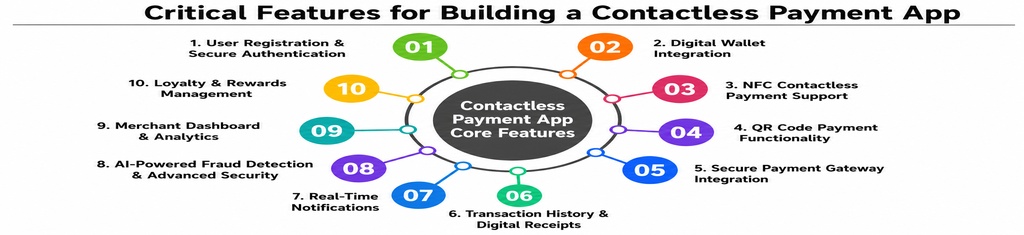
1. User Registration & Secure Authentication
A secure and user-friendly onboarding process is one of the most important features of a contactless payment app. Users should be able to create an account quickly using their email address or mobile number while verifying their identity through OTP authentication. To strengthen security, the app should support biometric authentication such as fingerprint or facial recognition, along with multi-factor authentication (MFA). These measures help prevent unauthorized access and build user confidence by ensuring that only authorized individuals can access payment services.
2. Digital Wallet Integration
Digital wallet functionality enables users to securely store multiple payment methods, including credit cards, debit cards, and bank accounts, within a single application. Instead of entering payment details for every transaction, users can complete purchases with just a tap. Secure tokenization technology replaces sensitive card information with encrypted tokens, ensuring financial data remains protected while providing a faster and more convenient payment experience.
3. NFC Contactless Payment Support
Near Field Communication (NFC) technology is the core of most contactless payment applications. It allows users to make payments by simply tapping their smartphone or wearable device on an NFC-enabled payment terminal. NFC transactions are completed within seconds and use encrypted communication to safeguard payment information. This feature improves checkout speed, enhances customer convenience, and reduces waiting times for both customers and merchants.
4. QR Code Payment Functionality
QR code payments have become increasingly popular because they offer a simple and cost-effective alternative to NFC payments. Users can scan a merchant’s QR code using their smartphone to complete a transaction without requiring specialized hardware. This payment method is especially beneficial for small businesses and developing markets where NFC-enabled terminals may not be widely available. QR code payments also support quick deployment and seamless integration into existing payment systems.
5. Secure Payment Gateway Integration
A reliable payment gateway serves as the bridge between the application, financial institutions, and payment processors. Integrating trusted payment gateways ensures that every transaction is processed securely and efficiently. It also enables support for multiple payment methods while maintaining compliance with global payment standards. A well-integrated payment gateway contributes to a smooth user experience and minimizes transaction failures.
6. Transaction History & Digital Receipts
Providing users with a comprehensive transaction history helps them track spending and manage their finances more effectively. Every completed payment should be recorded with details such as the transaction amount, merchant name, payment status, and date. Digital receipts further improve transparency by allowing users to access or download proof of payment whenever needed, enhancing both convenience and trust.
7. Real-Time Notifications
Real-time notifications keep users informed about every payment-related activity occurring within their account. Instant alerts for successful payments, failed transactions, refunds, and suspicious login attempts improve transparency and strengthen security. Notifications also provide opportunities for businesses to engage users with promotional offers, loyalty rewards, and important service updates.
8. AI-Powered Fraud Detection & Advanced Security
Since payment applications handle sensitive financial information, robust security is essential. Artificial intelligence can monitor user behavior and transaction patterns in real time to detect suspicious activities before fraud occurs. Combined with encryption, tokenization, secure APIs, and device recognition, AI-powered fraud detection significantly reduces financial risks while improving the overall security of the payment platform.
9. Merchant Dashboard & Analytics
A dedicated merchant dashboard enables businesses to manage transactions efficiently while gaining valuable insights into customer behavior and sales performance. Merchants can monitor payment activity, generate sales reports, process refunds, and analyze customer purchasing trends through an intuitive interface. These insights support better business decisions, optimize operations, and enhance customer service.
10. Loyalty & Rewards Management
Integrating loyalty programs into a contactless payment app helps businesses increase customer engagement and encourage repeat purchases. Users can earn reward points, receive cashback offers, redeem coupons, and participate in referral programs directly through the application. These features create a more personalized payment experience while improving customer retention and brand loyalty.
Modern Tech Stack for Secure NFC Payment Applications
Choosing the right technology stack is essential for building a secure, scalable, and high-performing NFC payment application. Since NFC payment apps handle sensitive financial transactions, the technology stack should support seamless payment processing, robust security, real-time data synchronization, and compliance with industry standards such as PCI DSS and EMV. Below is a comprehensive overview of the technologies commonly used in NFC payment app development.
| Technology Layer | Recommended Technologies | Purpose |
| Frontend Development | Flutter, React Native, Swift (iOS), Kotlin (Android) | Develop responsive and user-friendly mobile applications for Android and iOS. |
| Backend Development | Node.js, Java Spring Boot, .NET Core, Python (Django/FastAPI) | Manage business logic, APIs, user authentication, and payment processing. |
| Database | PostgreSQL, MySQL, MongoDB, Firebase Firestore | Store user profiles, transaction records, payment history, and application data securely. |
| Cloud Platform | Amazon Web Services (AWS), Microsoft Azure, Google Cloud Platform (GCP) | Provide scalable infrastructure, cloud storage, monitoring, and backup services. |
| Payment Gateway | Stripe, PayPal, Adyen, Razorpay, Braintree | Process secure online and contactless payments while supporting multiple payment methods. |
| NFC Technology | Android NFC API, Apple Core NFC | Enable tap-to-pay functionality and communication with NFC-enabled payment terminals. |
| Authentication & Identity | OAuth 2.0, Firebase Authentication, Auth0 | Secure user authentication through biometrics, OTPs, and multi-factor authentication. |
Why Choosing the Right Tech Stack Matters
The technology stack you choose has a direct impact on the performance, security, and scalability of your NFC payment application. Modern frameworks such as Flutter and React Native allow businesses to build cross-platform apps with a single codebase, reducing development time and costs. On the backend, technologies like Node.js and Java Spring Boot provide the reliability and scalability needed to handle high volumes of payment transactions.
Cloud platforms such as AWS, Microsoft Azure, and Google Cloud offer flexible infrastructure that supports real-time transaction processing, automatic scaling, and secure data storage. Integrating trusted payment gateways like Stripe, PayPal, or Adyen ensures seamless payment processing while maintaining compliance with global payment standards.
Security is a critical aspect of NFC payment app development. Implementing AES-256 encryption, SSL/TLS protocols, tokenization, and biometric authentication helps protect sensitive financial information and minimizes the risk of fraud. Additionally, AI-powered fraud detection systems can monitor transaction patterns in real time, enabling businesses to identify and prevent suspicious activities before they impact users.
By leveraging a modern and reliable technology stack, businesses can develop secure, feature-rich, and future-ready NFC payment applications that deliver exceptional user experiences while supporting long-term scalability and regulatory compliance.
Technical Challenges in Contactless Payment App Development
Developing a contactless payment app involves much more than creating a user-friendly interface. Since these applications handle sensitive financial data and process real-time transactions, developers must address several technical, security, and regulatory challenges. Overcoming these challenges is essential to building a secure, reliable, and scalable payment solution that delivers a seamless user experience. Below are some of the most common challenges businesses face during contactless payment app development.

1. Ensuring Data Security and Fraud Prevention
Security is the biggest challenge in contactless payment app development. Payment applications process sensitive customer information, including card details, bank account data, and personal information, making them attractive targets for cyber criminals. Developers must implement robust security measures such as end-to-end encryption, tokenization, biometric authentication, and multi-factor authentication to protect user data. Additionally, integrating AI-powered fraud detection systems helps identify suspicious activities in real time and reduces the risk of fraudulent transactions.
2. Meeting Regulatory and Compliance Requirements
Financial applications must comply with various national and international regulations to ensure secure payment processing. Standards such as PCI DSS, EMV, GDPR, PSD2, and local financial regulations require developers to implement strict security controls and data privacy measures. Ensuring compliance throughout the development lifecycle can be complex, especially for businesses operating across multiple countries with different regulatory requirements.
3. Integrating Multiple Payment Gateways
Modern contactless payment apps often support multiple payment gateways to provide users with flexible payment options. Integrating different payment processors, banks, digital wallets, and third-party APIs can be technically challenging due to varying protocols, authentication methods, and transaction workflows. Developers must ensure seamless integration while maintaining high performance, reliability, and transaction security.
4. Delivering a Seamless User Experience
Users expect contactless payments to be fast, intuitive, and error-free. Designing an application that offers smooth navigation, quick payment processing, and minimal transaction steps requires careful UI/UX planning. Poor interface design, slow loading times, or complicated payment flows can lead to user frustration and reduced adoption rates. Maintaining simplicity without compromising functionality is a key development challenge.
5. Supporting Cross-Platform Compatibility
Businesses often need to launch their payment applications on both Android and iOS platforms while ensuring consistent performance across different devices and operating system versions. Developers must also consider compatibility with various NFC-enabled smartphones, smartwatches, and payment terminals. Testing and optimizing the application for multiple devices increases development complexity and project timelines.
6. Maintaining High Performance and Scalability
As the number of users and transactions grows, the application must continue to perform efficiently without delays or downtime. Developers need to build scalable backend infrastructure capable of handling large transaction volumes, real-time data synchronization, and peak traffic periods. Leveraging cloud platforms and load-balancing technologies helps ensure consistent application performance as the business expands.
7. Managing Real-Time Transaction Processing
Contactless payment apps are expected to process transactions instantly. Any delay in payment authorization or synchronization between payment gateways, banks, and merchants can negatively impact the user experience. Developers must optimize APIs, backend services, and database performance to ensure real-time payment processing with minimal latency.
8. Ensuring Reliable NFC and QR Code Functionality
Supporting both NFC and QR code payment methods adds flexibility for users but also increases development complexity. Developers must ensure accurate communication between devices and payment terminals while accounting for differences in hardware capabilities, operating systems, and regional payment infrastructures. Thorough testing is required to deliver reliable performance across various environments.
9. Continuous Maintenance and Security Updates
The payment industry evolves rapidly, with new security threats, operating system updates, and compliance requirements emerging regularly. Businesses must continuously maintain their contactless payment applications by releasing security patches, updating third-party integrations, fixing bugs, and introducing new features. Ongoing maintenance is essential to ensure long-term reliability and user trust.
Conclusion
Contactless payment technology has transformed the way consumers and businesses conduct financial transactions, making payments faster, more secure, and more convenient than ever before. As the demand for cashless and digital payment solutions continues to grow, businesses across industries are investing in innovative contactless payment applications to improve customer experiences, streamline operations, and remain competitive in an increasingly digital marketplace.
Developing a successful contactless payment app requires careful planning, the right technology stack, robust security measures, and compliance with global financial regulations such as PCI DSS and EMV standards. From selecting the most suitable app model and implementing essential features to integrating secure payment gateways and addressing technical challenges, every stage of the development process plays a vital role in delivering a reliable and scalable payment solution.
Emerging technologies such as artificial intelligence, biometric authentication, cloud computing, blockchain, and wearable payments are further reshaping the future of digital payments. Businesses that embrace these innovations can create future-ready payment applications capable of meeting evolving customer expectations while reducing fraud and improving operational efficiency.
Frequently Asked Questions (FAQs)
1. How much does it cost to build a contactless payment app?
The cost of developing a contactless payment app depends on factors such as app complexity, features, supported platforms (Android and iOS), payment gateway integrations, security requirements, and regulatory compliance. A basic application typically starts around $30,000, while an enterprise-grade solution with advanced features like AI-powered fraud detection, NFC payments, and digital wallets can exceed $250,000.
2. What technologies are used in contactless payment app development?
Modern contactless payment apps are built using technologies such as Flutter, React Native, Swift, and Kotlin for mobile development, while Node.js, Java Spring Boot, and Python are commonly used for backend services. Secure payment processing relies on NFC technology, QR codes, trusted payment gateways like Stripe and PayPal, cloud platforms such as AWS and Azure, and security standards including PCI DSS, EMV, and AES-256 encryption.
3. What are the essential features of a contactless payment app?
A robust contactless payment app should include secure user authentication, digital wallet integration, NFC and QR code payment support, payment gateway integration, transaction history, real-time notifications, AI-powered fraud detection, merchant dashboards, loyalty and rewards programs, and advanced encryption to ensure fast, secure, and seamless payment experiences.
4. How long does it take to develop a contactless payment app?
The development timeline depends on the project’s complexity and feature set. A basic contactless payment app generally takes 3–5 months, while a feature-rich solution with custom integrations, compliance implementation, AI-based security, and extensive testing can require 6–12 months or more before launch.
5. Why should businesses invest in contactless payment app development in 2026?
The rapid growth of digital payments, increasing smartphone usage, and consumer preference for fast and secure transactions make contactless payment apps a valuable investment. Businesses can improve customer convenience, reduce checkout times, strengthen payment security, gain actionable transaction insights, and stay competitive in an increasingly cashless economy by adopting modern contactless payment solutions.