Introduction
Customers increasingly expect digital platforms to provide more than a basic online store. They want to compare multiple sellers, view real-time availability, place orders quickly, select convenient delivery slots, track deliveries, make secure payments, and receive reliable support.
These expectations have increased demand for multi-vendor delivery platforms.
A multi-vendor marketplace brings customers, vendors, delivery partners, and platform administrators into one connected digital ecosystem. Unlike a conventional ecommerce website that sells products from one business, a marketplace allows multiple independent vendors to register, create storefronts, list products, process orders, and receive payments.
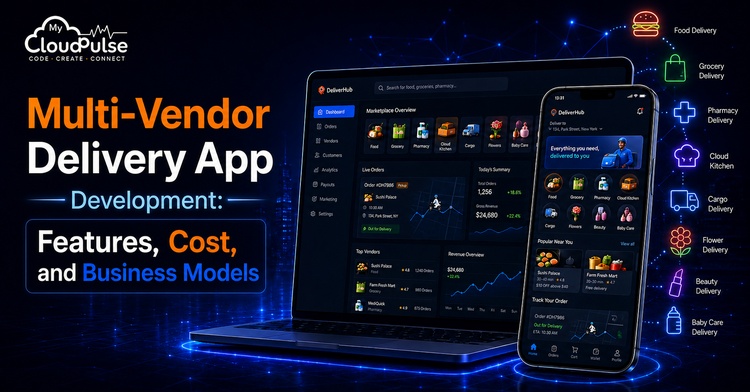
A single marketplace can support restaurants, grocery stores, pharmacies, cloud kitchens, cargo operators, florists, beauty retailers, and baby-care sellers. However, each category has different operational requirements. Food must be delivered quickly and kept at an appropriate temperature. Grocery inventory changes frequently. Pharmacy orders may require prescriptions and professional review. Flowers may need scheduled delivery and personalised messages. Cargo services must calculate distance, package weight, dimensions, and suitable vehicle capacity.
Successful multi vendor delivery app development, therefore, requires more than copying a standard e-commerce platform. The system must provide a shared marketplace foundation while supporting specialised workflows for every vertical.
This guide explains the market opportunity, platform structure, core and advanced features, development process, approximate cost, required team, business models, and major decisions involved in launching a scalable multi-vendor delivery application.
Market Statistics and Growth Potential
Multi-vendor delivery applications operate across several rapidly expanding digital markets. Because research organisations define each category differently, the figures should be examined independently rather than combined into one overall market size.
The global online food delivery market was valued at approximately USD 288.84 billion in 2024. It is estimated to reach USD 355.6 billion in 2026 and approximately USD 505.5 billion by 2030, representing a projected compound annual growth rate of 9.4% from 2025 to 2030.
The online grocery sector is also expanding rapidly. One market forecast estimates that the global online grocery market will increase from USD 655.51 billion in 2025 to USD 794.86 billion in 2026. This represents approximately 21.3% year-over-year growth.
Digital pharmacy is another important opportunity. The global ePharmacy market was valued at USD 150.7 billion in 2025 and is projected to reach USD 177.79 billion in 2026. That is an increase of approximately 18% in one year. The same forecast expects the market to reach USD 733.38 billion by 2034, with a CAGR of 19.38% from 2026 to 2034.
Cargo and logistics marketplace solutions are experiencing a similar digital transformation. The global digital freight-matching market was valued at approximately USD 47.21 billion in 2024 and is expected to reach USD 61.46 billion in 2025. It is projected to grow to approximately USD 247.58 billion by 2030, with a CAGR of 32.1% from 2025 to 2030.
Beauty and personal-care products also have strong e-commerce potential. Industry forecasts indicate that ecommerce sales in this category are expected to grow at a CAGR of approximately 10.3% between 2024 and 2030.
| Market segment | Current estimate | Near-term estimate | Growth indicator |
| Online food delivery | USD 288.84B (2024) | USD 355.6B (2026) | 9.4% CAGR to 2030 |
| Online grocery | USD 655.51B (2025) | USD 794.86B (2026) | 21.3% YoY |
| ePharmacy | USD 150.7B (2025) | USD 177.79B (2026) | 19.38% CAGR to 2034 |
| Digital freight matching | USD 47.21B (2024) | USD 61.46B (2025) | 32.1% CAGR to 2030 |
| Beauty ecommerce channel | Growth segment | — | 10.3% CAGR to 2030 |
What Is a Multi-Vendor Delivery App?
A multi-vendor delivery app is a digital platform through which several vendors sell products or delivery services to customers. The platform owner generally does not need to own every product listed in the application. Instead, the platform provides the technology, customer traffic, payment infrastructure, delivery coordination, vendor tools, and support system required to complete each transaction.
Customer Application
The customer application allows users to find vendors, browse products, place orders, pay, track deliveries, communicate with support, and submit ratings. It may be available as an Android app, iOS app, progressive web application, or responsive website.
Vendor Application or Dashboard
The vendor interface enables restaurants, stores, pharmacies, kitchens, cargo providers, and other sellers to manage marketplace activity. Vendors can update products, stock, preparation times, prices, operating hours, delivery areas, orders, promotions, and financial reports.
Delivery Partner Application
The delivery application allows drivers or couriers to receive delivery requests, navigate to pickup and drop-off locations, communicate with customers, provide proof of delivery, and track earnings.
Administrative Panel
The administrator controls the complete multi-vendor e-commerce platform. Administrative functions include vendor approval, category management, commissions, settlements, disputes, refunds, delivery zones, promotional campaigns, reports, permissions, and platform settings.
How a Multi-Vendor Delivery Platform Works
The process begins when a vendor applies to join the marketplace. The platform verifies its identity, business documents, licences, payment details, service area, and category eligibility.
Modern marketplace-payment systems can create a connected financial account for every vendor, collect identity and business information, process customer payments, deduct platform fees, and schedule seller payouts.
After approval, the vendor creates an online store and adds products or services. The catalogue may include product names, descriptions, images, pricing, variants, taxes, preparation times, stock, minimum order requirements, and delivery availability.
The customer enters a location or allows the app to identify it. The platform then shows eligible vendors according to distance, service zones, availability, delivery capacity, rating, category, and other ranking factors.
When the customer submits an order, the platform performs the following actions:
- Validates products, prices, stock, address, taxes, and delivery charges
- Sends the order to the relevant vendor.
- Allows the vendor to accept, reject, or modify the order according to platform rules.
- Identifies an available delivery partner.
- Track preparation, pickup, transit, and delivery status.
- Completes payment, commission, refund, and settlement calculations.
- Transfers the vendor share according to the payout schedule.
Marketplace payment infrastructure can support split payments, application fees, vendor balances, scheduled payouts, refunds, and dispute management.
Popular Categories for a Multi Vendor Delivery App Development
1. Food and Restaurant Delivery
The food module should support menus, item variants, add-ons, preparation times, restaurant schedules, dietary filters, special instructions, and real-time order status. Restaurants may also require kitchen display systems and printer integrations.
2. Grocery and Quick Commerce
Grocery delivery requires inventory synchronisation, weighted products, product substitutions, expiry tracking, delivery slots, dark-store support, and high-volume catalogue management. Customers should be able to approve or reject substitutions when a selected product becomes unavailable.
3. Pharmacy Delivery
A pharmacy module may require prescription uploads, pharmacist approval, restricted-product controls, medicine substitutions, batch information, expiry dates, dosage information, and tamper-resistant delivery confirmation. Requirements differ by country and region, so legal and compliance review is essential.
4. Cloud Kitchen Marketplace
A cloud-kitchen platform may support several virtual food brands operating from the same kitchen. The system should manage kitchen capacity, cooking queues, ingredient availability, preparation times, brand-specific menus, packaging, and driver handovers.
5. Cargo and Parcel Delivery
Cargo services require pickup and drop-off scheduling, package dimensions, weight, vehicle selection, price calculation, insurance options, shipment documents, driver assignment, and proof of delivery. Route-optimisation systems can assign stops and create routes based on time, cost, vehicle capacity, and operational constraints.
6. Flower and Gift Delivery
Flower delivery requires scheduled orders, date selection, personalised messages, occasion-based categories, custom arrangements, product add-ons, and anonymous or surprise-delivery options. Inventory may depend on season, availability, location, and preparation capacity.
7. Beauty and Personal Care
This module may include product variants, shades, ingredients, skin or hair concerns, beauty consultations, appointment booking, subscriptions, and product recommendations. The platform must distinguish clearly between product delivery and beauty-service booking.
8. Baby-Care Marketplace
Baby-care marketplaces may sell food, clothing, hygiene products, toys, feeding products, and wellness items. Useful capabilities include age-based filters, product-safety information, recurring orders, parent profiles, subscriptions, and personalised recommendations.
Core Features of a Multi-Vendor Delivery App
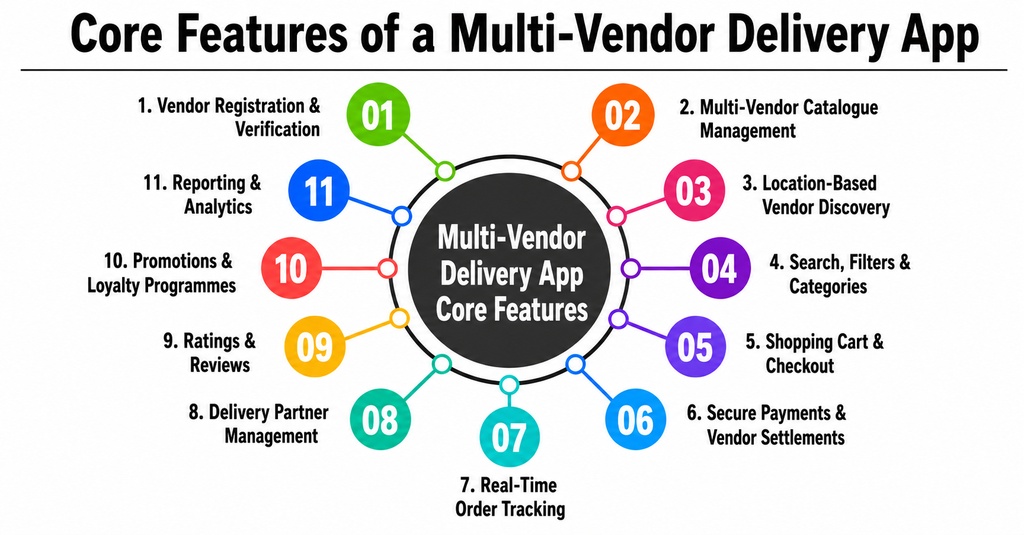
1. Vendor Registration and Verification
Vendors should be able to submit business information, licences, bank details, tax information, delivery locations, and identity documents. Administrators must be able to review applications, request corrections, approve categories, and suspend accounts.
2. Multi-Vendor Catalogue Management
Every vendor needs control over products, variants, descriptions, images, availability, taxes, prices, minimum order values, and promotional offers. The platform must prevent one seller from accessing another seller’s data.
3. Location-Based Vendor Discovery
Customers should see only vendors that can serve their location. Discovery may consider delivery radius, postal code, operating hours, expected delivery time, minimum order, category, service availability, and delivery capacity.
4. Search, Filters, and Categories
A strong search system helps customers discover products across multiple vendors. Filters can include price, rating, delivery time, distance, availability, dietary preference, brand, product type, prescription requirement, or service category.
5. Shopping Cart and Checkout
The cart should calculate item prices, taxes, packaging charges, platform fees, delivery charges, tips, discounts, and final order value. Businesses must decide whether customers can combine products from several vendors in one cart. A multi-vendor cart improves convenience but makes order splitting, payments, delivery, refunds, and tracking more complex.
6. Secure Payments and Vendor Settlements
The platform may support cards, bank transfers, e-wallet applications, cash on delivery, and region-specific payment methods. Settlement tools should calculate commissions, refunds, promotional contributions, taxes, delivery deductions, and vendor earnings.
7. Real-Time Order Tracking
Customers should receive statuses such as order received, vendor, accepted, preparing, ready for pickup, assigned to driver, on the way, and delivered. Push notifications can communicate order updates and re-engagement messages.
8. Delivery Partner Management
The platform should manage driver registration, verification, availability, vehicle details, current location, delivery assignment, earnings, incentives, and performance.
9. Ratings and Reviews
Customers may rate products, vendors, delivery partners, and the complete ordering experience. The platform should support moderation, abuse reporting, vendor responses, and verified-purchase identification.
10. Promotions and Loyalty Programmes
Coupons, referral rewards, wallet credits, category discounts, free delivery, vendor-sponsored offers, and loyalty points can encourage repeat purchasing. Promotion rules must clearly identify whether the platform or vendor funds the discount.
11. Reporting and Analytics
Administrators and vendors require reports for sales, commission, taxes, cancellations, refunds, customer retention, delivery performance, product demand, and settlement status.
Advanced Features of a Multi-Vendor Delivery App
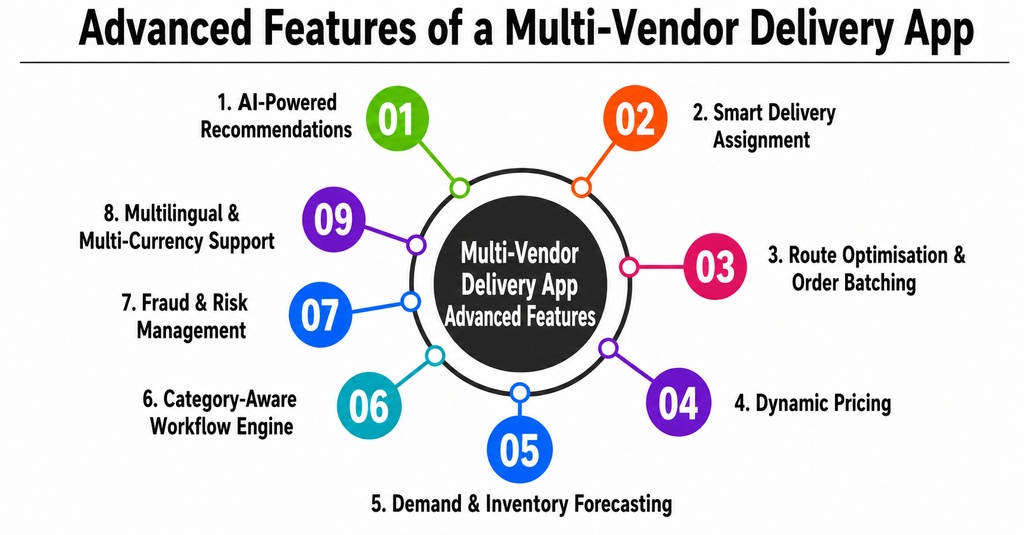
1. AI-Powered Recommendations
AI can recommend products, vendors, bundles, and reorder options based on customer history, location, time, preferences, and cart contents. For instance, the platform may suggest baby wipes with diapers, a vase with flowers, or dessert with a restaurant order. As a result, customers can discover relevant products more easily, while vendors can increase cross-selling opportunities and average order value.
2. Smart Delivery Assignment
Additionally, the system can assign drivers based on pickup distance, vehicle type, current workload, service area, delivery priority, and estimated completion time.
3. Route Optimisation and Order Batching
Order batching allows one driver to complete multiple compatible deliveries during the same trip. The platform must consider vendor preparation time, delivery deadlines, route direction, vehicle capacity, and product compatibility.
4. Dynamic Pricing
Delivery charges may change according to demand, distance, weather, traffic, vendor location, vehicle type, or driver availability. Pricing rules should remain transparent to avoid customer dissatisfaction.
5. Demand and Inventory Forecasting
Historical order data can help vendors predict demand, plan stock, manage ingredients, and reduce waste. This is particularly useful for groceries, cloud kitchens, flowers, food, and perishable baby-care products.
6. Category-Aware Workflow Engine
Instead of forcing every order through the same process, the platform applies rules according to product type. A pharmacy order may pause for prescription approval, a cargo order may require vehicle confirmation, a flower order may wait until a scheduled date, and a food order may immediately enter preparation.
7. Fraud and Risk Management
Fraud controls can examine unusual orders, repeated refunds, promotional abuse, suspicious locations, failed payments, and abnormal vendor behaviour.
8. Multilingual and Multi-Currency Support
Marketplace apps entering multiple regions should support local languages, currencies, taxes, measurements, addresses, and payment methods.
9. Subscription and Membership Plans
Customers may pay a monthly or annual fee for free delivery, exclusive discounts, priority service, or reward benefits. Vendors may subscribe to advanced reports, lower commissions, promotional tools, or additional store locations.
Unique Selling Proposition of a Multi-Vendor Marketplace
The main USP is convenient access to multiple vendors, products, and delivery services through one platform.
Customers benefit from greater choice, price comparison, consolidated accounts, trusted payment methods, loyalty rewards, and centralised support.
Vendors gain an online store, customer reach, delivery infrastructure, payment processing, promotions, and analytics without developing an independent system.
The platform owner benefits from a scalable business model in which revenue can grow through transactions, subscriptions, advertising, delivery, and related services.
A multi-category platform has an additional USP: it can use one customer relationship across several verticals. A customer who orders groceries may later use the same app for medicines, flowers, food, beauty products, or parcel delivery.
Multi Vendor Delivery App Development Process
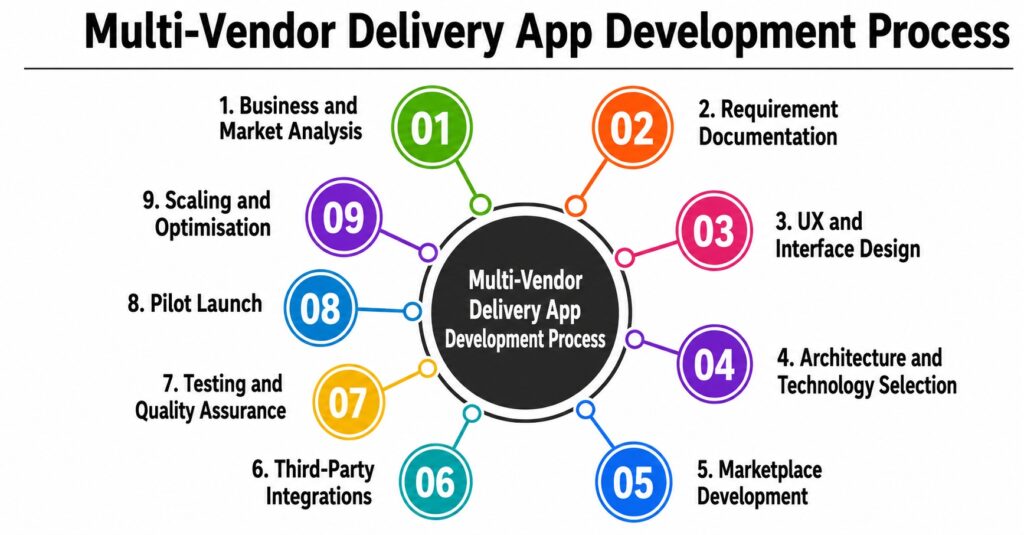
1. Business and Market Analysis
Define the city, target customers, categories, vendor types, fulfilment model, delivery model, competitors, regulations, and revenue strategy. Launching all categories at once may create excessive operational complexity, so many businesses should begin with one anchor category and expand after validating demand and delivery performance.
2. Requirement Documentation
Document features for customers, vendors, drivers, administrators, support agents, finance teams, and operations managers. Requirements should separate essential MVP functions from future enhancements.
3. UX and Interface Design
Create user flows, wireframes, prototypes, design systems, and responsive layouts. Each interface should be optimised for its user. Drivers need simple controls, while vendors need efficient catalogue and order-management screens.
4. Architecture and Technology Selection
Choose mobile frameworks, web technologies, backend architecture, databases, cloud infrastructure, mapping services, communication providers, payment systems, and analytics tools. The architecture should support category-specific modules without creating disconnected systems.
5. Marketplace Development
Develop the customer app, vendor interface, delivery app, administrator panel, backend services, databases, and integrations. Modules should be released gradually and tested continuously.
6. Third-Party Integrations
Common integrations include payment gateways and payouts, maps and route optimisation, SMS and push notifications, identity verification, customer-support software, analytics, accounting, tax tools, and inventory or point-of-sale systems.
7. Testing and Quality Assurance
Testing should cover functionality, security, permissions, performance, payment accuracy, order status, maps, notifications, refunds, settlements, and device compatibility. Furthermore, the team should test category-specific exceptions to ensure that each delivery workflow functions correctly..
8. Pilot Launch
Launch first in a limited area with selected vendors and drivers. Measure order acceptance, delivery time, cancellation rate, complaints, settlement accuracy, and vendor adoption.
9. Scaling and Optimisation
After validating the operating model, add locations, categories, vendors, payment methods, fulfilment centres, and advanced automation. A complex multi-vendor platform may require a phased programme rather than a single release.
Team Structure for Multi Vendor Delivery App Development
A serious marketplace project requires both technology and operational expertise. The exact team size depends on scope, but the core responsibilities normally include:
- Product owner or business strategist
- Project manager
- Business analyst
- UI and UX designers
- Mobile application developers
- Web frontend developers
- Backend developers
- Database or solution architect
- Quality-assurance engineers
- DevOps or cloud engineer
- Security specialist
- Data or AI specialist for advanced features
- Vendor-onboarding manager
- Delivery-operations manager
- Customer-support representatives
- Legal and compliance advisers
When selecting a mobile app development company, businesses should evaluate marketplace experience rather than looking only at the lowest hourly rate. The company should understand payments, vendor isolation, delivery logistics, real-time tracking, security, scalability, and operational exceptions.
Multi Vendor Delivery App Development Cost
The development cost depends on the number of applications, categories, regions, integrations, design complexity, technology stack, security requirements, and delivery model.
Industry project data suggests that many app-development projects fall between USD 10,000 and USD 49,999, while average project values can be substantially higher. A multi-vendor delivery platform is usually more complex than an average standalone application because it requires several user interfaces, a marketplace backend, payments, logistics, and administrative tools.
The following ranges are indicative planning estimates rather than fixed quotations:
| Platform scope | Estimated development cost |
| Prototype or limited proof of concept | USD 15,000–35,000 |
| Basic single-category MVP | USD 35,000–70,000 |
| Multi-category, growth-ready platform | USD 70,000–160,000 |
| Advanced multi-city marketplace | USD 160,000–300,000 |
| Enterprise marketplace ecosystem | USD 300,000–500,000+ |
The final ecommerce website development cost may be lower than the cost of a complete marketplace app because a conventional website normally does not require vendor onboarding, driver applications, delivery assignment, split payments, live tracking, and multi-party settlements.
Businesses should also budget for cloud hosting, map and route APIs, SMS and notification services, payment-processing charges, app-store accounts, monitoring, analytics, customer support, security updates, third-party licences, and ongoing product development.
Maintenance is often estimated at approximately 15% to 20% of the initial development cost per year, although the actual figure depends on usage, integrations, infrastructure, and the frequency of new releases.
Business and Monetization Models
1. Commission on Every Order
The platform deducts a percentage or fixed fee from each completed transaction. Commission may vary by category, vendor plan, product margin, delivery model, or promotional agreement.
2. Delivery Charges
Customers, vendors, or both may contribute to the delivery cost. Charges may be based on distance, order value, weight, urgency, vehicle type, or service level.
3. Vendor Subscription Plans
Vendors can pay monthly or annual fees for premium placement, advanced reports, more product listings, lower commission, or access to multiple locations.
4. Customer Membership
Customers may subscribe to receive free delivery, special discounts, loyalty rewards, or faster support.
5. Sponsored Listings and Advertisements
Vendors can pay to appear in featured positions, category banners, search results, recommendation sections, or promotional notifications. Sponsored content should be labelled clearly.
6. Payment and Settlement Fees
The platform may charge vendors for payment processing, instant payouts, currency conversion, or financial reporting.
7. White-Label Marketplace Solutions
The company can license its technology to other businesses under their own brands. This SaaS model may include setup fees, monthly subscriptions, transaction charges, or custom-development revenue.
8. Cargo and B2B Service Fees
Cargo-focused marketplace apps may earn through shipment commissions, insurance, priority matching, warehousing, fleet subscriptions, or business accounts. These capabilities can also support organisations evaluating B2B ecommerce platforms.
9. Vendor Services
Additional revenue can come from product photography, catalogue creation, advertising, packaging, analytics, training, fulfilment, and managed delivery.
Common Challenges in Building a Multi-Vendor Marketplace
1. Balancing Supply and Demand
A marketplace must have enough customers, vendors, and delivery partners in the same locations. Too few vendors reduce customer choice, while insufficient order volume makes the platform unattractive to vendors and drivers.
2. Delivery Profitability
Fast delivery can be expensive. Businesses must improve order density, route efficiency, batching, vendor preparation, and driver utilisation.
3. Vendor Quality
The platform’s reputation depends on vendors it does not completely control. Clear standards, monitoring, reviews, inspections, and enforcement are essential.
4. Inventory Accuracy
Incorrect stock information causes substitutions, cancellations, refunds, and poor customer experiences.
5. Regulatory Complexity
Food, pharmacy, cargo, tax, consumer protection, privacy, and employment requirements vary among regions.
6. Technology Scalability
High demand during festivals, meal times, sales, and emergencies can create sudden traffic spikes. The ecommerce platform must scale without losing orders, duplicating payments, or delaying notifications.
Conclusion
Multi vendor delivery app development offers businesses an opportunity to create a digital ecosystem connecting customers with restaurants, stores, pharmacies, cloud kitchens, cargo operators, florists, beauty retailers, and baby-care vendors.
The platform’s success depends on more than attractive mobile screens. It requires reliable vendor onboarding, catalogue management, payments, delivery coordination, settlements, customer support, analytics, security, and category-specific workflows.
A business should not attempt to launch every vertical simply because the architecture supports it. The stronger approach is to identify an anchor market, validate its economics, create a reusable marketplace foundation, and gradually add complementary categories.
The most successful multi-vendor marketplace will provide customers with convenience, give vendors practical business value, support delivery partners with efficient tools, and provide administrators with complete operational control.
FAQs
Que 1. How long does it take to develop a multi-vendor delivery app?
Answer: A basic MVP may take approximately four to six months. A multi-category, multi-city platform with advanced logistics, payments, and integrations may require eight to twelve months or a phased development programme.
2. How much does multi-vendor delivery app development cost?
Answer: A limited MVP may cost between USD 35,000 and USD 70,000, while advanced marketplace solutions can cost USD 160,000 to USD 500,000 or more. The final amount depends on features, applications, categories, integrations, location, and team rates.
3. Can one application support food, grocery, pharmacy, and cargo?
Answer: Yes. A shared platform can support several categories, but it should use a modular and category-aware architecture. Each category requires different catalogue fields, fulfilment rules, delivery logic, compliance controls, and customer experiences.
4. What is the best business model for a multi-vendor marketplace?
Answer: Commission-based revenue is the most common starting model. It can be combined with delivery charges, vendor subscriptions, customer memberships, sponsored listings, payment fees, and white-label licensing.
5. Should a business use an existing e-commerce platform or develop a custom solution?
Answer: Existing platforms can work for a simple online store or early validation. Custom development is generally more suitable when the business requires specialised delivery operations, multiple vendor types, category-specific workflows, complex settlements, or long-term scalability.