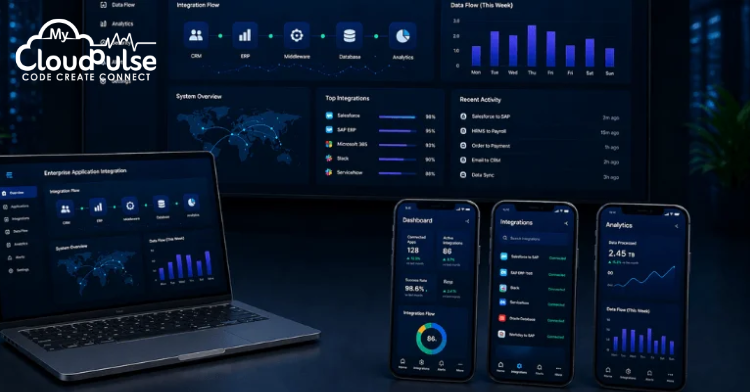
In today’s digital-first business environment, organizations rely on multiple software systems such as ERP, CRM, HRM, and cloud-based applications to manage operations. However, when these systems operate in isolation, they create data silos, inefficiencies, and communication gaps that hinder business performance. This Enterprise Application Integration Guide explores how businesses can overcome these challenges by connecting systems, enabling seamless data flow, and improving overall operational efficiency through effective integration strategies.
Enterprise Application Integration (EAI) is the solution to this challenge. It enables seamless communication between disparate systems, ensuring real-time data exchange, improved workflow automation, and better decision-making. By integrating applications across departments, businesses can achieve a unified digital ecosystem that enhances productivity and scalability.
In 2026, EAI is no longer optional—it is a strategic necessity. With the rise of cloud computing, AI, and automation, organizations are investing heavily in integration platforms to stay competitive. This blog explores the benefits, challenges, solutions, cost, and key features of enterprise application integration, helping businesses understand how to implement it effectively.
Market Stats
The Enterprise Application Integration (EAI) market is experiencing rapid growth as organizations prioritize digital transformation, automation, and data-driven decision-making. With businesses increasingly relying on multiple applications, the need for seamless integration has become more critical than ever.
📊 Global Market Size & Growth
- The global Enterprise Application Integration market is estimated at around $20.39 billion in 2026 and is projected to reach $41.79 billion by 2031, growing at a CAGR of 15.4%
- The iPaaS (Integration Platform as a Service) market is expanding rapidly, expected to grow from $8.5 billion in 2024 to over $21 billion by 2035, with a CAGR of 35%+
👉 Key Insight:
Enterprise integration is becoming a core pillar of digital infrastructure across industries.
📈 Adoption & Usage Trends
- The average enterprise uses approximately 897 applications, but nearly 71% remain unintegrated, leading to inefficiencies and data silos
- Around 62% of organizations are adopting cloud-based integration solutions, reflecting a shift toward scalable and flexible architectures
- By 2026, over 75% of large enterprises are expected to rely on iPaaS platforms as a primary integration strategy
👉 Key Insight:
The growing number of applications is driving strong demand for integration solutions.
💰 ROI & Business Impact
- Companies implementing integration platforms report up to 345% ROI over three years
- Integration can reduce operational and labor costs by 25% to 80%, significantly improving efficiency
- Development cycles can be reduced by up to 30% with modern integration tools
👉 Key Insight:
EAI not only improves efficiency but also delivers substantial financial returns.
🌐 Technology & Future Trends
- The rise of multi-cloud and hybrid environments is accelerating the demand for integration platforms
- AI-powered integration and automation are becoming key drivers of innovation in the industry
- SMEs are emerging as the fastest-growing adopters, driven by cost-effective cloud solutions
👉 Key Insight:
Future growth will be fueled by AI, cloud adoption, and API-driven ecosystems.
🎯 Final Insight
The market statistics clearly show that Enterprise Application Integration is evolving from a technical necessity to a strategic business enabler. As organizations continue to adopt cloud, AI, and automation technologies, the demand for robust integration solutions will only accelerate in the coming years.
Core Features of Enterprise Application Integration Guide
Enterprise Application Integration (EAI) platforms are built on a set of core features that enable seamless communication, efficient data exchange, and streamlined business processes. These features help organizations eliminate silos and create a unified digital ecosystem.
🔗 Application Connectivity
One of the primary features of EAI is the ability to connect multiple applications across the enterprise, including ERP, CRM, HRM, and third-party systems.
Key capabilities:
- Integration across on-premise and cloud applications
- Support for various protocols (REST, SOAP, etc.)
- Seamless communication between systems
👉 This ensures smooth data flow and improves operational efficiency.

🔄 Data Integration & Synchronization
EAI platforms enable real-time data sharing and synchronization across different systems.
Benefits include:
- Elimination of duplicate data
- Consistent and accurate information across platforms
- Real-time updates for better decision-making
👉 This improves data reliability and reduces errors.
⚙️ Workflow Automation
Automation is a key feature that helps streamline repetitive and manual tasks.
Examples:
- Automated order processing
- Invoice generation
- Customer onboarding workflows
👉 Reduces manual effort and increases productivity.
📊 Centralized Monitoring & Management
EAI systems provide centralized dashboards to monitor integrations and workflows.
Features include:
- Real-time performance tracking
- Error detection and alerts
- System health monitoring
👉 Enhances visibility and control over operations.
🔐 Security & Compliance
Security is critical in enterprise integration to protect sensitive data.
Key features:
- Data encryption (in transit and at rest)
- Role-based access control
- Compliance with regulations (GDPR, HIPAA)
👉 Ensures data protection and regulatory compliance.
🔌 API Management
APIs play a crucial role in modern integration systems.
Capabilities:
- API creation and management
- Secure API gateways
- Third-party integrations
👉 Supports scalable and flexible integration architecture.
🎯 Final Insight
Core features such as application connectivity, data synchronization, automation, security, and API management form the foundation of EAI platforms. By leveraging these capabilities, businesses can build efficient, scalable, and secure integration systems that drive productivity and digital transformation.
Advanced Features of Enterprise Application Integration Guide
Modern Enterprise Application Integration (EAI) platforms go beyond basic connectivity by incorporating advanced features that enable intelligent automation, scalability, and real-time responsiveness. These capabilities help organizations adapt quickly to changing business needs and technological advancements.
🤖 AI & Machine Learning Integration
AI-powered integration enhances decision-making and automation across systems.
Key capabilities:
- Predictive analytics for business insights
- Intelligent data mapping and transformation
- Automated anomaly detection
👉 Helps organizations make data-driven and proactive decisions.
🌐 Event-Driven Architecture
Advanced EAI systems support event-driven models where actions are triggered instantly based on system events.
Features include:
- Real-time notifications
- Automated workflows triggered by events
- Faster response to business changes
👉 Improves agility and responsiveness.
📡 Real-Time Data Processing
Real-time processing ensures that data is instantly available across all integrated systems.
Benefits:
- Immediate data updates
- Reduced latency
- Enhanced customer experience
👉 Critical for time-sensitive operations like finance and e-commerce.
☁️ Cloud & Hybrid Integration
Modern platforms support integration across cloud, on-premise, and hybrid environments.
Advantages:
- Scalability and flexibility
- Cost-efficient infrastructure
- Easy deployment across environments
👉 Enables businesses to operate in multi-cloud ecosystems.
🔐 Advanced Security & Governance
As integration complexity increases, advanced security becomes essential.
Features include:
- Multi-factor authentication (MFA)
- Role-based access control (RBAC)
- Data governance and compliance management
👉 Ensures enterprise-grade security and regulatory compliance.
🔌 Advanced API Management
APIs are central to modern integration strategies.
Capabilities:
- API lifecycle management
- Rate limiting and throttling
- Developer portals and documentation
👉 Supports scalable and secure integrations.
🎯 Final Insight
Advanced features such as AI integration, real-time processing, event-driven architecture, and enhanced security elevate EAI platforms from simple connectors to intelligent, scalable ecosystems. These capabilities empower businesses to achieve greater efficiency, innovation, and competitive advantage in a rapidly evolving digital landscape.
Development Process of Enterprise Application Integration Guide
Developing an Enterprise Application Integration (EAI) solution requires a well-structured and strategic approach to ensure seamless connectivity, scalability, and security. Since EAI involves integrating multiple systems across an organization, careful planning and execution are essential.

🔍 Step 1: Requirement Analysis & Planning
The process begins with understanding business objectives and identifying integration needs.
Key activities:
- Analyze existing systems and workflows
- Identify integration points and challenges
- Define clear use cases and goals
👉 This step ensures the solution aligns with business requirements.
🧩 Step 2: Architecture Design
Designing the integration architecture is critical for performance and scalability.
Includes:
- API-first or microservices architecture
- Data flow mapping between systems
- Selection of middleware or iPaaS platforms
👉 A strong architecture forms the backbone of the integration system.
🎨 Step 3: UI/UX & Dashboard Design
User-friendly dashboards are essential for monitoring and managing integrations.
Key elements:
- Visual dashboards for data tracking
- Simple navigation for administrators
- Real-time monitoring interfaces
👉 Improves usability and operational efficiency.
💻Step 4: Enterprise Application Integration Guide
This phase involves building the integration components.
Includes:
- API development and configuration
- Connector development for different systems
- Workflow automation setup
👉 Ensures seamless communication between applications.
🔗 Step 5: Integration & Data Mapping
Applications are connected, and data flows are configured.
Activities:
- Mapping data formats between systems
- Ensuring compatibility and synchronization
- Setting up real-time data exchange
👉 Eliminates data silos and improves consistency.
🧪 Step 6: Testing & Quality Assurance
Testing ensures the system is reliable and secure.
Types of testing:
- Functional testing
- Performance testing
- Security testing
👉 Helps identify and fix issues before deployment.
🚀 Step 7: Deployment & Monitoring
The solution is deployed in the production environment.
Key tasks:
- System deployment
- Performance monitoring
- Issue tracking
👉 Ensures smooth go-live and operation.
📈 Step 8: Maintenance & Optimization
Continuous improvement is essential for long-term success.
Includes:
- Regular updates and upgrades
- Performance optimization
- Scaling as business grows
👉 Keeps the system efficient and future-ready.
🎯 Final Insight
A well-defined development process ensures that EAI solutions are reliable, scalable, and secure, enabling businesses to achieve seamless integration and improved operational efficiency.
Required Team Structure
Successfully implementing an Enterprise Application Integration (EAI) solution requires a cross-functional team with expertise in software development, system architecture, data management, and business processes. Since integration projects often involve multiple systems and stakeholders, collaboration and clear role definition are essential.
👨💼 Product Manager
The Product Manager is responsible for defining the vision, roadmap, and overall strategy of the integration solution.
Responsibilities:
- Set project goals and priorities
- Coordinate between technical and business teams
- Ensure timely delivery and quality
👉 Acts as the driving force behind the project.
📊 Business Analyst
The Business Analyst bridges the gap between business requirements and technical implementation.
Responsibilities:
- Gather and document requirements
- Identify integration use cases
- Analyze workflows and inefficiencies
👉 Ensures the solution meets business needs.
🏗️ Solution Architect
The Solution Architect designs the overall integration architecture.
Responsibilities:
- Define system architecture (API-first, microservices)
- Choose appropriate tools and technologies
- Ensure scalability and performance
👉 Provides the technical blueprint for the project.
💻Integration Developers
These developers build APIs, connectors, and middleware components.
Responsibilities:
- Develop and configure integrations
- Handle data transformation and mapping
- Ensure seamless communication between systems
👉 Core contributors to system functionality.
⚙️ Backend Developers
Backend developers manage server-side logic and data processing.
Responsibilities:
- Develop backend services
- Manage databases and workflows
- Ensure system performance
👉 Supports the integration infrastructure.
🎨 UI/UX Designers
Designers create user-friendly dashboards and interfaces.
Responsibilities:
- Design intuitive dashboards
- Improve user experience
- Ensure easy navigation
👉 Enhances usability and adoption.
🔐 Security Specialist
Security experts ensure data protection and compliance.
Responsibilities:
- Implement encryption and access controls
- Conduct security audits
- Ensure regulatory compliance
👉 Protects sensitive enterprise data.
🧪 QA Engineers
QA engineers ensure the platform is reliable and bug-free.
Responsibilities:
- Perform testing and validation
- Identify and fix issues
- Ensure system stability
👉 Maintains quality and performance.
📣 DevOps & Support Team
This team manages deployment, monitoring, and ongoing support.
Responsibilities:
- Handle CI/CD pipelines
- Monitor system performance
- Provide technical support
👉 Ensures smooth operations post-deployment.
🎯 Final Insight
A well-structured team with clearly defined roles ensures that EAI projects are efficient, scalable, and secure, enabling organizations to achieve seamless integration and long-term success.
Monetization Methods of Enterprise Application Integration Guide
Enterprise Application Integration (EAI) platforms offer multiple monetization opportunities by combining subscription-based models, usage-based pricing, and enterprise-level services. A well-defined monetization strategy not only ensures steady revenue but also supports long-term scalability and customer retention.
💰 Subscription Model (SaaS)
The most common revenue model for EAI platforms is the Software-as-a-Service (SaaS) approach.
Key elements:
- Monthly or annual subscription plans
- Tiered pricing based on features or number of integrations
- Premium plans with advanced analytics and automation
👉 Provides predictable recurring revenue and scalability.
📦 Usage-Based Pricing
In this model, customers are charged based on their usage of the platform.
Examples:
- Cost per API call
- Data volume processed
- Number of workflows executed
👉 Ideal for businesses with variable usage patterns and ensures fair pricing.
🤝 Enterprise Licensing
EAI providers often offer customized solutions for large enterprises.
Includes:
- One-time licensing fees
- Custom integrations and deployments
- Dedicated support and maintenance
👉 Generates high-value contracts and long-term partnerships.
📊 Premium Analytics & Reporting
Advanced data analytics can be offered as a paid feature.
Services include:
- Real-time dashboards and insights
- Predictive analytics
- Performance monitoring tools
👉 Adds value and creates an additional revenue stream.
🌐 API Monetization
APIs can be monetized by charging developers and businesses for access.
Models include:
- Pay-per-use APIs
- Subscription-based API access
- Partner integrations
👉 Encourages ecosystem growth while generating revenue.
💼 Consulting & Implementation Services
Many businesses require assistance with integration setup and customization.
Services include:
- Integration consulting
- System migration and onboarding
- Custom development
👉 Provides additional revenue and strengthens client relationships.
🎯 Final Insight
A combination of subscription, usage-based pricing, enterprise licensing, and value-added services creates a diversified monetization strategy. By aligning pricing with customer needs, EAI providers can build a profitable, scalable, and sustainable business model in a competitive market.
Enterprise Application Integration Guide
The cost of developing an Enterprise Application Integration (EAI) solution can vary widely depending on the number of systems involved, complexity of integrations, and level of customization required. Organizations must evaluate their specific business needs and long-term goals to determine the appropriate investment.
💸 Cost Breakdown
- MVP (Minimum Viable Product): $40,000 – $100,000
A basic integration setup connecting a few core systems (such as CRM and ERP) with limited automation and essential features. - Mid-Level Solution: $100,000 – $250,000
Includes multiple system integrations, advanced workflows, API management, and improved security features. - Enterprise-Level Solution: $250,000 – $700,000+
Fully scalable platforms with AI-driven automation, real-time data processing, advanced analytics, and enterprise-grade security.
⏱️ Development Timeline
- MVP: 3–6 months
- Mid-Level Solution: 6–9 months
- Enterprise Solution: 9–12+ months
📊 Key Cost Factors
Several factors influence the overall development cost:
- Number of Integrations: More systems increase complexity and cost
- Data Volume & Processing Needs: High data loads require robust infrastructure
- Architecture Type: API-first, microservices, or hybrid models impact development effort
- Security & Compliance: Industry-specific regulations (e.g., HIPAA, GDPR) add to costs
- Third-Party Tools & APIs: Licensing and integration fees
💡 Ongoing Costs
In addition to development, businesses should consider recurring expenses:
- Maintenance and updates
- Cloud hosting and infrastructure
- Support and monitoring services
🎯 Final Insight
While the initial investment in EAI may be significant, the long-term benefits—such as improved efficiency, reduced operational costs, and enhanced scalability—make it a valuable and strategic investment for modern enterprises.
Challenges of Enterprise Application Integration Guide
While Enterprise Application Integration (EAI) offers significant benefits, implementing it comes with several challenges. Understanding these obstacles and applying the right solutions is essential for a successful integration strategy.
⚠️ Challenge 1: Integration Complexity
Enterprises often use multiple legacy systems, cloud applications, and third-party tools, making integration highly complex.
Solution:
- Adopt an API-first architecture
- Use iPaaS platforms for simplified integration
- Standardize data formats and protocols
👉 Simplifies connectivity and reduces development effort.
⚠️ Challenge 2: Data Silos & Inconsistency
Disconnected systems lead to fragmented and inconsistent data across departments.
Solution:
- Implement centralized data management
- Enable real-time synchronization
- Use data validation and governance tools
👉 Ensures data accuracy and consistency.
⚠️ Challenge 3: Security & Compliance Risks
Integrating multiple systems increases the risk of data breaches and regulatory violations.
Solution:
- Use end-to-end encryption
- Implement role-based access control (RBAC)
- Conduct regular security audits
👉 Protects sensitive information and ensures compliance.
⚠️ Challenge 4: Legacy System Compatibility
Older systems may not support modern integration methods, creating compatibility issues.
Solution:
- Use middleware and adapters
- Gradually modernize legacy systems
- Leverage API wrappers
👉 Enables seamless integration without full system replacement.
⚠️ Challenge 5: High Implementation Costs
Initial setup and development costs can be significant, especially for large enterprises.
Solution:
- Start with an MVP approach
- Use cloud-based integration platforms
- Scale gradually based on business needs
👉 Optimizes costs while delivering value.
⚠️ Challenge 6: Performance & Scalability Issues
Handling large volumes of data and transactions can impact system performance.
Solution:
- Use scalable cloud infrastructure
- Implement event-driven architecture
- Optimize APIs and workflows
👉 Ensures high performance and reliability.
🎯 Final Insight
Although EAI implementation comes with challenges, the right strategies—such as API-first design, strong security practices, and scalable infrastructure—can effectively overcome these obstacles. By addressing these issues proactively, businesses can build robust, secure, and future-ready integration systems that drive long-term success.
Conclusion
Enterprise Application Integration is transforming how businesses operate by enabling seamless connectivity between systems. It eliminates data silos, improves efficiency, and supports real-time decision-making.
Despite challenges such as complexity and cost, the benefits far outweigh the drawbacks. With advancements in AI, cloud computing, and automation, EAI is becoming a critical component of digital transformation strategies.
Organizations that invest in integration today will be better positioned to achieve scalability, agility, and long-term success in an increasingly competitive market.
FAQs
EAI is the process of connecting different enterprise systems to enable seamless data exchange and workflow automation.
It improves efficiency, reduces costs, and enables real-time decision-making.
Complexity, security risks, legacy systems, and high implementation costs.
It ranges from $40,000 to $700,000+ depending on complexity.
APIs, middleware, iPaaS platforms, cloud computing, and AI.