This Streaming App Development Guide explores how businesses can build scalable, feature-rich video platforms by leveraging modern technologies, advanced features, and proven development strategies to succeed in the competitive OTT landscape.
In 2026, video streaming app development is not just about delivering video content—it’s about creating immersive, personalized, and seamless viewing experiences. With the rise of smartphones, high-speed internet (4G/5G), and smart TVs, users now expect high-quality streaming, zero buffering, and intelligent recommendations.
Businesses across industries—entertainment, education, fitness, and even corporate training—are investing heavily in video streaming platforms to engage audiences and generate revenue.
Market Stats
The video streaming industry is one of the fastest-growing digital markets globally, driven by OTT adoption and mobile-first consumption.
📊 Global Market Size & Growth
- The global video streaming market was valued at USD 811.37 billion in 2025 and is projected to reach USD 3.39 trillion by 2034, growing at a CAGR of 17%.
- Another estimate shows the market reaching USD 416.8 billion by 2030, with a CAGR of 21.5%.
- The market could further expand to USD 611 billion by 2033, driven by OTT growth and mobile consumption.
📈 OTT & Streaming Trends
- OTT streaming is growing at a CAGR of 22.3%, expected to reach USD 187 billion by 2030.
- Over 65% of global users prefer OTT platforms over traditional TV.
- Around 57% of streaming consumption happens via mobile devices, highlighting mobile-first behavior.
🌍 Regional Insights
- North America dominates with ~37% market share.
- Asia-Pacific is the fastest-growing region due to:
- High smartphone penetration
- Affordable internet
- Large population
- India alone has 600+ million OTT users, showing massive adoption.
📊 Revenue Trends
- U.S. streaming revenue reached $77.7 billion in 2025 and is expected to grow to $89 billion in 2026.
- Growth is increasingly driven by subscriptions + ads + price optimization.
🔮 Future Trends
- Rise of short-form and micro-content (31% growth)
- Increased adoption of AI recommendations
- Growth of ad-supported streaming models
- Expansion of live streaming and interactive content
Core Features of Streaming App Development Guide
To build a successful video streaming app, these foundational features are essential:
👤 User Registration & Profiles
Secure login, personalized profiles, watch history.
🎥 Video Streaming Engine
- Adaptive bitrate streaming
- HD/4K support
- Fast buffering
🔍 Search & Discovery
- Smart search filters
- Category-based browsing
❤️ Watchlist & Favorites
Save content for later viewing.
📊 Content Management System (CMS)
Upload, manage, and organize videos.
🔔 Notifications
Alerts for new releases and updates.
💳 Payment Integration
Subscriptions, rentals, pay-per-view.
📺 Multi-Device Support
Mobile, web, smart TV compatibility.
Advanced Features of Streaming App Development Guide
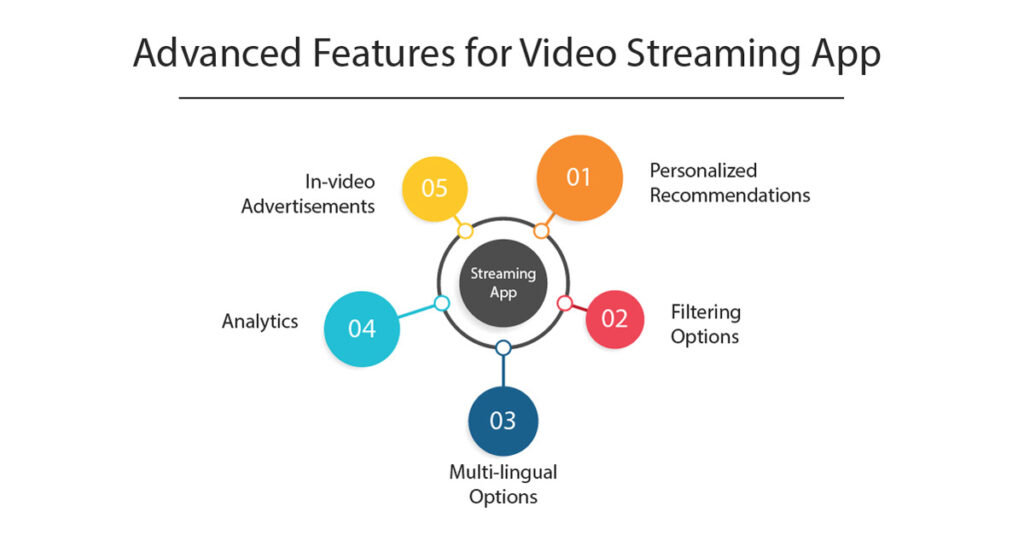
🤖 AI-Based Recommendations
Personalized content suggestions.
🎮 Gamification
User rewards, engagement systems.
📡 Live Streaming
Real-time broadcasting and events.
📥 Offline Viewing
Download and watch later.
🌐 Multi-Language Support
Subtitles, dubbing, localization.
📊 Advanced Analytics
User behavior and engagement tracking.
🔐 DRM Protection
Content security and piracy prevention.
🧠 Voice Search
Hands-free navigation.
Process of Streaming App Development Guide
Developing a video streaming app in 2026 is a complex, multi-layered process that involves careful planning, robust architecture, and seamless integration of advanced technologies like cloud computing, AI, and content delivery networks (CDNs). Unlike traditional apps, streaming platforms must handle high traffic, real-time video delivery, and performance optimization, making the development process more intricate.
Below is a comprehensive breakdown of each stage involved in building a scalable and high-performing video streaming application.
🔍 Phase 1: Market Research & Idea Validation
Every successful streaming platform begins with a strong foundation of research and validation.
Key activities:
- Identify your niche (entertainment, education, sports, fitness, OTT, live streaming)
- Analyze competitors (Netflix, YouTube, Amazon Prime, Hotstar)
- Study user preferences and content consumption trends
- Define your Unique Selling Proposition (USP)
- Validate your idea through surveys, beta testing, or MVP concepts
🧩 Phase 2: Define MVP & Feature Roadmap
Instead of building a full-fledged platform from day one, start with an MVP (Minimum Viable Product).
Why it matters:
This phase ensures you build a product that meets real market demand and stands out in a competitive space.
Key activities:
- Identify core features (video playback, login, search, subscriptions)
- Prioritize features using frameworks like MoSCoW
- Define short-term and long-term product roadmap
- Estimate budget, resources, and timelines
MVP Goal:
Launch quickly, gather user feedback, and iterate based on real-world usage.
🎨 Phase 3: UI/UX Design (User-Centric Experience)
User experience is critical for retention in streaming apps.
Key activities:
- Design wireframes and user flows
- Create interactive prototypes (Figma, Adobe XD)
- Focus on intuitive navigation and content discovery
- Optimize UI for mobile, web, and smart TVs
Best practices:
- Minimal buffering indicators
- Easy browsing categories
- Personalized homepage layout
Why it matters:
A seamless UI directly impacts watch time and user engagement.
⚙️ Phase 4: Technology Stack Selection
Choosing the right technology ensures scalability and performance.
Frontend:
- Flutter / React Native (cross-platform)
- Swift (iOS), Kotlin (Android)
Backend:
- Node.js, Django, Ruby on Rails
Database:
- MongoDB, PostgreSQL
Cloud & Infrastructure:
- AWS, Google Cloud, Azure
Streaming Technologies:
- HLS (HTTP Live Streaming)
- MPEG-DASH
CDN:
- Cloudflare, Akamai, AWS CloudFront
Why it matters:
A strong tech stack ensures fast streaming, low latency, and scalability.
🎥 Phase 5: Streaming App Development Guide
This is the most critical and unique step in streaming app development.
Key components:
- Video ingestion (uploading content)
- Encoding and transcoding (multiple resolutions)
- Storage (cloud-based storage systems)
- Content delivery via CDN
- Adaptive bitrate streaming
Workflow:
- Upload video
- Encode into multiple formats (240p, 480p, 720p, 1080p, 4K)
- Store on cloud servers
- Deliver via CDN for fast streaming
Why it matters:
Ensures smooth playback with minimal buffering across devices and networks.
💻 Phase 6: Frontend & Backend Development
This is where the actual coding happens.
Frontend Development
- Build UI components
- Integrate video players
- Implement search and navigation
- Ensure responsiveness across devices
Backend Development
- Develop APIs (user, content, payments, analytics)
- Manage authentication and authorization
- Handle streaming logic and metadata
- Implement recommendation algorithms
Admin Panel Development
- Content management system (CMS)
- User management
- Analytics dashboard
🔗 Phase 7: Third-Party Integrations
Integrations enhance functionality and reduce development time.
Common integrations:
- Payment gateways (Stripe, PayPal, Razorpay)
- Analytics tools (Google Analytics, Mixpanel)
- Push notifications (Firebase)
- DRM solutions (Widevine, FairPlay)
- Social media sharing
Why it matters:
Speeds up development and adds essential features efficiently.
🧪 Phase 8: Testing & Quality Assurance
Testing is crucial for delivering a high-quality streaming experience.
Types of testing:
- Functional testing (features and workflows)
- Performance testing (load handling, buffering)
- Security testing (data protection, DRM)
- Compatibility testing (devices and OS versions)
Special focus:
- Video playback quality
- Buffering and latency issues
- App responsiveness
Why it matters:
Even minor streaming issues can lead to user drop-offs.
🚀 Phase 9: Deployment & Launch
Once testing is complete, the app is ready for release.
Steps:
- Deploy backend on cloud infrastructure
- Configure CDN for global delivery
- Publish app on App Store and Play Store
- Ensure compliance with platform guidelines
Soft launch strategy:
- Release in a limited region
- Collect feedback and fix issues
📈 Phase 10: Post-Launch Monitoring & Optimization
After launch, continuous improvement is essential.
Key activities:
- Monitor user behavior and engagement
- Track KPIs (watch time, retention, churn rate)
- Optimize streaming performance
- Fix bugs and release updates
Why it matters:
Ensures long-term success and user satisfaction.
Required Team Structure
Building a high-performance video streaming app requires a multidisciplinary team with expertise in mobile development, backend architecture, cloud infrastructure, and content delivery systems. Since streaming apps involve complex components like real-time video processing, scalability, and content security, assembling the right team is critical to success.
The team structure may vary depending on whether you’re building an MVP or a full-scale OTT platform, but a well-balanced team typically includes 8–15 professionals.
👨💼 1. Product Manager (Strategic Lead)
The Product Manager (PM) is responsible for defining the product vision and ensuring that development aligns with business objectives.
Key responsibilities:
- Define product roadmap and feature priorities
- Identify target audience and user needs
- Coordinate between design, development, and stakeholders
- Monitor KPIs such as user engagement and retention
Why it matters:
The PM ensures that the team builds a product that solves real user problems and delivers value.
📊 2. Business Analyst (Requirement Planner)
A Business Analyst helps translate business requirements into technical specifications.
Key responsibilities:
- Conduct market research and competitor analysis
- Create requirement documentation and workflows
- Define user stories and use cases
- Identify risks and improvement opportunities
Why it matters:
Prevents miscommunication and ensures efficient execution.
🎨 3. UI/UX Designer (Experience Creator)
UI/UX designers play a crucial role in ensuring user engagement.
Key responsibilities:
- Design intuitive and visually appealing interfaces
- Create wireframes and prototypes
- Optimize navigation and content discovery
- Ensure responsive and accessible design
Why it matters:
A smooth and engaging UI directly impacts user retention and app success.
💻 4. Frontend Developers (Client-Side Experts)
Frontend developers build the user-facing part of the app.
Key responsibilities:
- Develop mobile and web interfaces
- Integrate APIs with backend systems
- Optimize app performance and responsiveness
- Ensure cross-platform compatibility
Technologies:
- Flutter, React Native, Swift, Kotlin
Why it matters:
They ensure seamless playback, navigation, and user interaction.
⚙️ 5. Backend Developers (Core System Engineers)
Backend developers handle the logic, database, and server-side architecture.
Key responsibilities:
- Build APIs for streaming, users, payments, and analytics
- Manage databases and server operations
- Implement authentication and security
- Handle video processing and streaming logic
Technologies:
- Node.js, Django, Laravel
- MongoDB, PostgreSQL
Why it matters:
A robust backend ensures smooth streaming and scalability.
🎥 6. Video Streaming Engineer (Specialized Role)
This is a critical role unique to streaming apps.
Key responsibilities:
- Implement video encoding and transcoding
- Optimize streaming protocols (HLS, DASH)
- Ensure adaptive bitrate streaming
- Reduce buffering and latency
Why it matters:
Ensures high-quality video playback and a seamless user experience.
☁️ 7. DevOps Engineer (Infrastructure & Scalability Expert)
DevOps manages deployment, scalability, and performance.
Key responsibilities:
- Set up cloud infrastructure (AWS, GCP, Azure)
- Manage CDNs (Content Delivery Networks)
- Implement CI/CD pipelines
- Monitor server uptime and performance
Why it matters:
Ensures the app can handle millions of users without downtime.
🔐 8. Security Engineer (Content Protection Specialist)
Security is critical for protecting premium video content.
Key responsibilities:
- Implement DRM (Digital Rights Management)
- Prevent piracy and unauthorized access
- Secure payment systems and user data
- Monitor vulnerabilities
Why it matters:
Protects intellectual property and maintains user trust.
🧪 9. QA Engineer (Quality Assurance)
QA ensures the app performs flawlessly.
Key responsibilities:
- Test video playback performance
- Identify bugs and UI issues
- Perform load and stress testing
- Ensure cross-device compatibility
Why it matters:
Streaming issues like buffering can lead to immediate user churn.
📊 10. Data Analyst (Insights & Optimization)
Data analysts help optimize performance and user engagement.
Key responsibilities:
- Track user behavior and watch patterns
- Analyze retention and engagement metrics
- Provide insights for content recommendations
- Optimize monetization strategies
Why it matters:
Data-driven decisions improve user experience and revenue.
📣11. Marketing & Growth Team
A strong marketing team is essential for scaling the platform.
Key responsibilities:
- User acquisition campaigns
- App Store Optimization (ASO)
- Social media and influencer marketing
- Retention strategies
Why it matters:
Helps attract and retain users in a competitive market.
🎬 12. Content Management Team
Content is the core of any streaming platform.
Key roles:
- Content managers
- Video editors
- Licensing specialists
Key responsibilities:
- Manage content uploads and scheduling
- Handle licensing and partnerships
- Ensure content quality and compliance
Why it matters:
Without high-quality content, even the best platform cannot succeed.
🎧 13. Customer Support Team
Support ensures a smooth user experience post-launch.
Key responsibilities:
- Resolve playback or payment issues
- Handle user queries
- Provide technical assistance
Why it matters:
Improves customer satisfaction and retention.
👥 Team Structure Based on Project Stage
MVP Team (6–8 Members)
- Product Manager
- UI/UX Designer
- 2 Developers (Frontend + Backend)
- QA Engineer
- DevOps (part-time)
- Basic content support
Growth Stage Team (8–12 Members)
- Product Manager
- Business Analyst
- UI/UX Designer
- 3–4 Developers
- QA Engineer
- DevOps Engineer
- Data Analyst
- Marketing Specialist
Scale Stage Team (12–15+ Members)
- Dedicated streaming engineers
- Security specialists
- Full content and marketing teams
- Advanced analytics and AI experts
📌 Key Traits of a Strong Team
✔ Strong collaboration and communication
✔ Experience in scalable app development
✔ Knowledge of video streaming technologies
✔ Agile development approach
✔ Focus on performance and user experience
🎯Final Insight
A video streaming app is a complex product that requires more than just developers—it needs a well-coordinated team of strategists, engineers, designers, and content experts. Building the right team ensures faster development, better performance, and a scalable platform capable of handling millions of users.
Investing in the right talent is just as important as investing in technology when building a successful streaming app in 2026.
Monetization Methods of Streaming App Development Guide
Monetization is a critical component of any video streaming app, directly impacting its sustainability and profitability. In 2026, successful streaming platforms no longer rely on a single revenue model—instead, they adopt a hybrid monetization strategy that combines subscriptions, ads, and premium offerings to maximize revenue while maintaining a great user experience.
Below are the most effective monetization methods used by modern video streaming platforms.
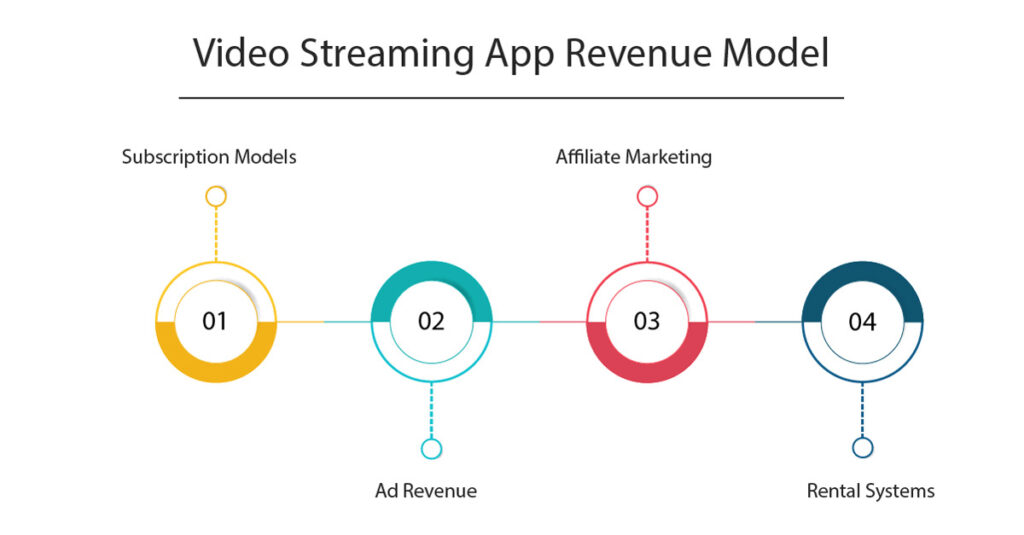
💰 1. Subscription-Based Model (SVOD – Subscription Video on Demand)
This is the most popular and widely used monetization model.
Common pricing tiers:
How it works:
Users pay a recurring fee (monthly or yearly) to access premium content.
- Basic plan (limited features)
- Standard plan (HD streaming, multiple devices)
- Premium plan (4K, multiple screens, offline downloads)
Benefits:
- Predictable recurring revenue
- Strong customer retention
- Higher lifetime value (LTV)
Best for:
Platforms offering exclusive or high-quality content.
📺 2. Ad-Supported Model (AVOD – Advertising Video on Demand)
This model allows users to access content for free while generating revenue through ads.
Ad formats:
- Pre-roll ads (before video starts)
- Mid-roll ads (during playback)
- Banner and display ads
- Native ads within content
Benefits:
- Attracts a large user base
- No entry barrier for users
- High revenue potential with scale
Best for:
Platforms targeting mass audiences or emerging markets.
🎬 3. Transactional Model (TVOD – Pay-Per-View)
Users pay for individual content rather than subscribing.
Examples:
- Renting or buying movies
- Paying for live events (sports, concerts)
Benefits:
- High revenue per transaction
- Ideal for premium or exclusive content
Best for:
New releases, blockbuster movies, and live events.
📦4. Streaming App Development Guide
A combination of free and paid content.
How it works:
- Basic content is free with ads
- Premium content requires subscription
Benefits:
- Easy user onboarding
- Upselling opportunities
- Balanced monetization strategy
Best for:
Apps looking to convert free users into paying customers.
🤝 5. Content Partnerships & Sponsorships
Collaborating with brands and content creators can open new revenue streams.
Examples:
- Sponsored shows or series
- Brand integrations within content
- Co-produced content
Benefits:
- Additional revenue without charging users
- Enhanced brand visibility
- Reduced content production costs
🛍️ 6. In-App Purchases & Add-Ons
Offer additional features or content as paid add-ons.
Examples:
- Early access to episodes
- Premium content bundles
- Ad-free experience upgrades
Benefits:
- Increases average revenue per user (ARPU)
- Flexible monetization
🌍 7. Licensing & Content Distribution
Platforms can license their content to other services.
Examples:
- Selling streaming rights
- Partnering with TV networks
- Distributing content globally
Benefits:
- Large-scale revenue generation
- Expands global reach
📊 8. Data Monetization (Ethical & Compliant)
With user consent, platforms can leverage anonymized data insights.
Use cases:
- Audience analytics for advertisers
- Content performance insights
- Market research reports
Benefits:
- Additional revenue stream
- Valuable business intelligence
📡9. Streaming App Development Guide
Live streaming opens unique monetization opportunities.
Revenue streams:
- Ticketed live events
- Super chats and donations
- Brand sponsorships during live sessions
Benefits:
- Real-time engagement
- High monetization potential
🧾 10. Subscription Bundling
Partner with telecom providers or other platforms.
Examples:
- OTT bundled with mobile plans
- Subscription packages with other apps
Benefits:
- Increased user acquisition
- Reduced churn
📊 Hybrid Monetization Strategy
Most successful platforms combine multiple models:
Example Revenue Mix:
- 50–60% subscriptions
- 20–30% ads
- 10–20% pay-per-view & partnerships
This diversification ensures stable and scalable revenue.
⚖️ Key Considerations for Monetization
✔ Balance user experience with revenue generation
✔ Avoid excessive ads that disrupt viewing
✔ Offer flexible pricing plans
✔ Focus on content quality to justify subscriptions
✔ Use data analytics to optimize pricing and offers
🎯 Final Insight
Monetization in video streaming apps is not just about generating revenue—it’s about creating a sustainable business model that aligns with user expectations. By combining subscription models, advertising, premium content, and strategic partnerships, businesses can maximize profitability while delivering exceptional user experiences.
A well-planned monetization strategy can turn your video streaming app into a high-growth, revenue-generating platform in the competitive OTT market of 2026.
Conclusion
Video streaming app development in 2026 presents a massive opportunity for businesses to tap into a rapidly growing digital market. With billions of users shifting to OTT platforms, the demand for high-quality, on-demand video content continues to rise.
However, success in this competitive landscape requires more than just launching an app. Businesses must focus on:
- Delivering seamless user experiences
- Leveraging AI and personalization
- Ensuring high-performance streaming
- Building scalable and secure infrastructure
The future of video streaming lies in hyper-personalization, immersive experiences, and multi-platform accessibility. Companies that adopt these trends early will gain a competitive edge.
FAQs
It ranges from $25,000 to $150,000+, depending on complexity.
Typically, 3–6 months for MVP.
React Native, Flutter, Node.js, AWS, AI tools.
Video streaming, search, payments, user profiles.
Subscriptions, ads, pay-per-view, partnerships.