Introduction
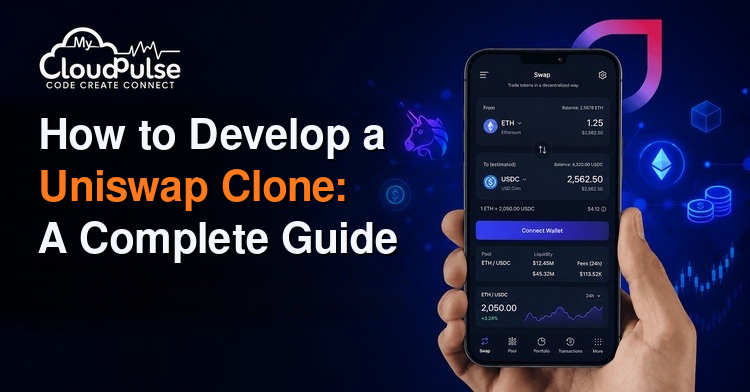
Decentralized exchanges have changed how people trade digital assets. Instead of creating an account on a centralized exchange, depositing funds, completing a lengthy approval process, and relying on a company to match buyers and sellers, users can connect a crypto wallet and swap tokens directly via smart contracts. This is the main idea behind Uniswap, one of the most recognized decentralized exchange protocols in the DeFi ecosystem.
A Uniswap clone development is not simply a copy of Uniswap’s brand or interface. In a practical business sense, it means a decentralized exchange app inspired by Uniswap’s AMM model, liquidity pools, token swapping, and non-custodial trading experience. The goal is to build your own branded DeFi exchange where users can swap tokens, create liquidity pools, provide liquidity, earn trading fees, view analytics, and interact with Web3 infrastructure without giving a central company custody of their assets.
Uniswap itself is a decentralized exchange protocol built on Ethereum. Its official developer documentation describes it as an automated market maker, or AMM, made of smart contracts that let anyone swap tokens, provide liquidity, or create markets directly onchain. It is also designed around decentralization, censorship resistance, and self-custody.
For startups, crypto entrepreneurs, fintech companies, Web3 communities, and blockchain product owners, building a Uniswap-like app can be a powerful opportunity. However, it is also a technically complex product. It requires smart-contract engineering, blockchain integration, liquidity strategy, security audits, token risk management, regulatory awareness, and a user experience simple enough for both crypto-native and new users.
This guide explains the market opportunity, core features, advanced features, development process, team structure, and monetization methods for developing an app like Uniswap.
Market Stats
The DeFi and decentralized exchange market remains one of the most important segments of the crypto industry. As of the current CoinGecko category data, the DeFi token market cap is about $67.1 billion, with around $4.07 billion in 24-hour trading volume and DeFi dominance of about 4.3% versus the global crypto market.
Total value locked is another major indicator of DeFi activity. DefiLlama currently shows around $91.743 billion in total DeFi TVL, which reflects the value of assets deposited across DeFi protocols.
The broader crypto market also provides a strong base for DEX growth. CoinGecko currently reports a global cryptocurrency market capitalization of around $2.17 trillion, while CoinMarketCap reports a global crypto market cap of around $2.09 trillion and a total 24-hour DeFi volume of about $10.22 billion, or 11.91% of total crypto market volume. Differences between trackers are normal because each platform uses its own asset coverage and methodology.
The DEX segment itself is highly active. CoinGecko tracks 915 decentralized crypto exchanges with a total 24-hour trading volume of around $3.72 billion. It also lists Uniswap V4 on Ethereum, PancakeSwap Infinity CLMM on BSC, and Curve on Ethereum among the largest decentralized exchanges by volume at the time of capture.
Market research firms also forecast strong long-term DeFi growth, although their estimates vary. Zion Market Research estimates the global DeFi market was worth $35.02 billion in 2024 and may reach $1,257.38 billion by 2034, growing at a 43.06% CAGR from 2025 to 2034. Next Move Strategy Consulting provides another growth view, estimating the DeFi market at $44.79 billion in 2025 and projecting it to reach $390.47 billion by 2030, at a 54.2% CAGR.
Using Next Move Strategy Consulting’s 2025 base of $44.79 billion and 54.2% CAGR, a simple year-by-year projection would be approximately:
| Year | Estimated DeFi Market Size |
| 2025 | $44.79 billion |
| 2026 | $69.07 billion |
| 2027 | $106.50 billion |
| 2028 | $164.22 billion |
| 2029 | $253.23 billion |
| 2030 | $390.48 billion |
This growth potential is why Uniswap-like DEX products continue to attract founders. The market is not only about token swapping. It includes liquidity provision, AMMs, launchpads, stablecoin swaps, cross-chain swaps, portfolio tools, analytics, onchain identity, institutional DeFi access, and programmable liquidity.
What Is a Uniswap Clone?
A Uniswap clone is a decentralized exchange application that follows the basic Uniswap-style AMM model. Instead of matching buyers and sellers through an order book, it allows users to trade against liquidity pools. Each pool usually contains two tokens, such as ETH/USDC or Token A/Token B. Liquidity providers deposit assets into pools, traders swap through those pools, and the smart contract automatically updates prices based on supply, demand, and pool reserves.
In Uniswap’s official documentation, each pool contains reserves of two ERC-20 tokens, and users trade against those reserves. The protocol uses the constant product formula x * y = k, where x and y represent token reserve balances and k is the invariant that must remain constant or increase after trades. Larger trades relative to available pool depth cause more price movement, commonly known as price impact.
A good Uniswap clone development should include three layers. The first is the smart-contract layer, which manages pools, swaps, fees, liquidity positions, routing, and token approvals. The second is the backend/indexing layer, which collects blockchain data, caches token lists, estimates prices, calculates APY, tracks transactions, and powers charts. The third is the frontend layer, where users connect wallets, swap tokens, add liquidity, manage positions, and review transaction details.
The final product should not feel like a technical blockchain dashboard. It should feel like a clean, fast, trustworthy trading app.
Core Features of a Uniswap Clone Development
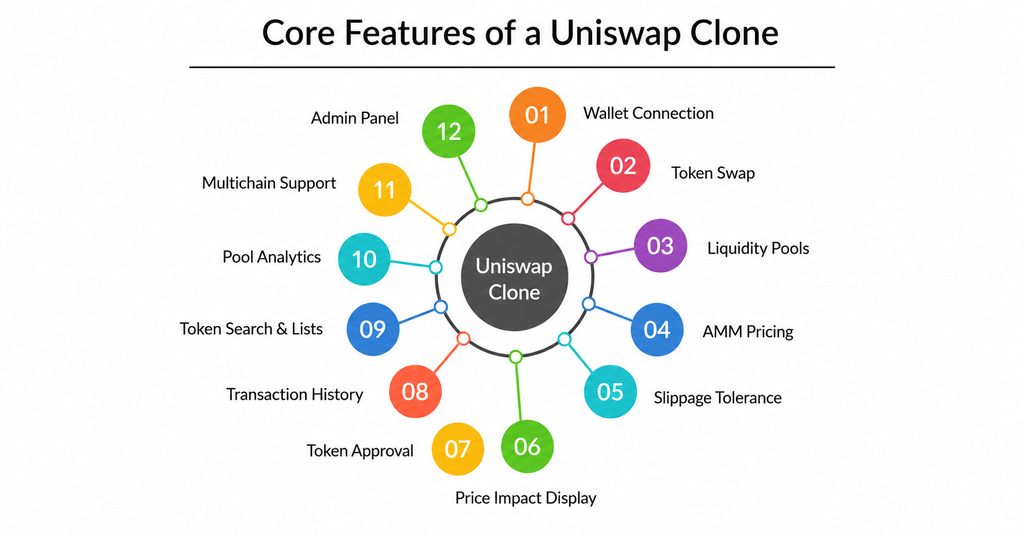
1. Wallet Connection
Wallet connection is the first user action. The app should support MetaMask, WalletConnect, Coinbase Wallet, Trust Wallet, hardware wallets, and mobile deep links. Users should be able to connect, disconnect, switch networks, and view wallet balances easily.
2. Token Swap
The swap module is the heart of the platform. It should allow users to select input and output tokens, enter the amount, view estimated output, review route details, check gas cost, confirm slippage, and submit the transaction.
3. Liquidity Pools
Liquidity pools allow users to deposit two assets and earn a share of swap fees. A strong clone app should support pool discovery, pool creation, adding liquidity, removing liquidity, viewing liquidity share, and claiming fees.
4. AMM Pricing
The AMM automatically prices assets based on pool reserves. This removes the need for a traditional order book. In a basic model, prices shift as the ratio of assets inside the pool changes. Uniswap documentation explains that AMMs replace buy and sell orders with a liquidity pool of two assets priced relative to one another.
5. Slippage Tolerance
Slippage is the difference between the expected swap output and the actual output after execution. Uniswap’s support documentation explains that price impact is caused by the user’s own trade size relative to liquidity, while slippage is the difference between the expected and final swap result. Your app should offer auto slippage, custom slippage, and clear warnings for high-risk settings.
6. Price Impact Display
Price impact helps users understand whether their swap is too large for the available liquidity. If the price impact is high, the app should warn users before confirmation.
7. Token Approval
Before a smart contract can spend a token, users usually approve token access. Your DEX should make approvals clear and safe. Advanced systems can reduce repeated approval friction using Permit2-style signature and allowance patterns. Uniswap’s Permit2 documentation describes signature-based transfers and time-bound allowances for token spending.
8. Transaction History
Users should see pending, completed, and failed swaps. Each transaction should link to the relevant blockchain explorer.
9. Token Search and Token Lists
The app should support verified token lists, custom token import, token contract address search, token logos, token warnings, and scam-token alerts.
10. Pool Analytics
Liquidity providers need data. Add TVL, volume, fees, APY, liquidity depth, pool composition, historical charts, and user position performance.
11. Multichain Support
Modern DeFi users expect support for Ethereum, Layer 2s, and other EVM-compatible chains. Your app can start with one chain and later expand to networks such as Ethereum, Arbitrum, Base, Optimism, Polygon, BNB Chain, Avalanche, or your own custom chain.
12. Admin Panel
The admin dashboard should allow internal teams to manage token lists, featured pools, blocked tokens, fee settings, analytics, announcements, API keys, and risk warnings.
Advanced Features to Make Your Uniswap Clone App More Competitive
1. Concentrated Liquidity
Concentrated liquidity allows liquidity providers to allocate funds within a selected price range instead of spreading liquidity across all possible prices. Uniswap introduced this with v3, and the documentation explains that LPs can concentrate capital into smaller price intervals, which can create deeper liquidity around active prices and improve capital efficiency.
For a Uniswap clone development, concentrated liquidity can attract advanced LPs, market makers, and professional liquidity managers. However, it also increases UX complexity because users must understand ranges, ticks, active liquidity, and impermanent loss.
2. Multiple Fee Tiers and Dynamic Fees
Uniswap v3 supports 1%, 0.3%, 0.05%, and 0.01% fee tiers, while v4 supports unlimited fee tiers according to Uniswap support documentation. A clone can offer different fee tiers for stablecoin pools, volatile token pools, meme tokens, long-tail assets, and premium pools.
3. v4-Style Hooks
Hooks are one of the most important advanced concepts. Uniswap v4 introduced hooks as plugins that customize how pools, swaps, fees, and LP positions interact. Examples include dynamic fees, on-chain limit orders, custom oracles, auto-compounded LP fees, TWAMM-style execution, and internalized MEV distribution.
A DEX clone with hooks can become more than a swap app. It can become a programmable liquidity platform.
4. Singleton Architecture and Flash Accounting
Uniswap v4’s singleton architecture puts all pools inside one smart contract, helping reduce costs for pool creation and multi-pool swaps. Uniswap Labs estimated that v4 could reduce pool creation gas costs by 99%, and flash accounting transfers only net balances instead of moving assets in and out of pools after every swap.
A clone does not have to implement this from day one, but it should consider gas efficiency as a competitive advantage.
5. UniswapX-Style Gasless Swaps
UniswapX is an auction-based swapping protocol where users sign orders and fillers compete to execute them. The official documentation says UniswapX supports competitive pricing, gas-free swapping, MEV protection, and no cost for failed transactions.
For a clone, this can be implemented as an intent-based swap system where professional fillers, solvers, or market makers compete to provide the best execution.
6. Universal Router-Style Execution
Uniswap’s Universal Router composes v2, v3, and v4 swaps with Permit2 approvals in one transaction. It supports split routes, partial fills, ETH wrapping/unwrapping, position manager actions, sub-plan execution, and balance checks. A similar routing engine can help your app deliver better prices across multiple pools and protocol versions.
7. Cross-Chain Swaps
Users do not want to bridge manually, wait, and then swap separately. Uniswap’s 2026 product update highlights cross-chain swaps where users can swap from one chain to another in a single action, with supported routes across networks including Ethereum, Unichain, Arbitrum One, Base, Optimism, World Chain, zkSync, Zora, Linea, Soneium, and MegaETH.
A clone can integrate bridge aggregators, solver networks, or cross-chain messaging protocols to offer similar convenience.
8. Smart Wallet and One-Click Swaps
Smart wallets reduce friction by bundling actions. Uniswap’s smart wallet update explains that one-click swaps combine approvals and swaps into a single tap, while smart wallets can enable features like bundled transactions, gas sponsorship, and paying gas with any token.
This is one of the most important UX upgrades for mainstream users.
9. Portfolio and P&L Tracking
A modern DEX should not stop at swaps. Users want to track holdings, realized profit/loss, unrealized profit/loss, average cost, total return, and multichain balances.
10. Token Risk Engine
Because anyone can create tokens on permissionless markets, scam protection is essential. Add warnings for honeypots, high transfer taxes, proxy contracts, suspicious ownership, low liquidity, blacklists, and tokens with abnormal contract behavior.
How a Uniswap Clone Works
A user connects a wallet and chooses the token they want to sell and the token they want to buy. The app checks balances, token approvals, liquidity pools, swap routes, slippage, price impact, and network gas. The user confirms the transaction. The smart contract receives the input token, calculates the output based on pool reserves and fees, sends the output token to the user, and updates the pool reserves.
Liquidity providers deposit token pairs into pools. In return, they receive liquidity positions or pool tokens representing their share. When traders use the pool, fees are collected and distributed to LPs based on their pool contribution and, in concentrated liquidity models, on whether their liquidity is active within the current price range.
If your app supports concentrated liquidity, LPs choose a price range. When the market price remains inside that range, the liquidity is active and can earn fees. If the price exits the chosen range, the position becomes inactive and stops earning fees until the price re-enters the range. Uniswap’s documentation explains that when the price exits an LP’s interval, the position’s liquidity is no longer active and no longer earns fees.
If your app supports gasless orders, the user may sign an off-chain order instead of submitting a direct transaction. Fillers monitor these signed orders, compete to execute them, and settle the trade on-chain when it becomes profitable. This creates better UX because users may avoid failed transaction costs.
USP of a Uniswap-Like App
The main USP of a Uniswap clone is non-custodial, permissionless token trading. Users do not deposit funds into a centralized account. They connect their wallet and interact directly with smart contracts. This gives them asset control, transparency, and global access.
The second USP is liquidity democratization. Anyone can become a liquidity provider, not just institutions or professional market makers. This creates an open liquidity network.
The third USP is market creation. A new token project can create a pool and enable trading without waiting for centralized exchange listings.
The fourth USP is programmability. With hooks, dynamic fees, routers, cross-chain swaps, and intent-based settlement, a DEX can become a modular DeFi infrastructure layer.
The fifth USP is ecosystem expansion. A Uniswap clone can connect with launchpads, farms, staking, lending, analytics, NFT marketplaces, wallets, bridges, and institutional dashboards.
Step-by-Step Uniswap Clone Development Process
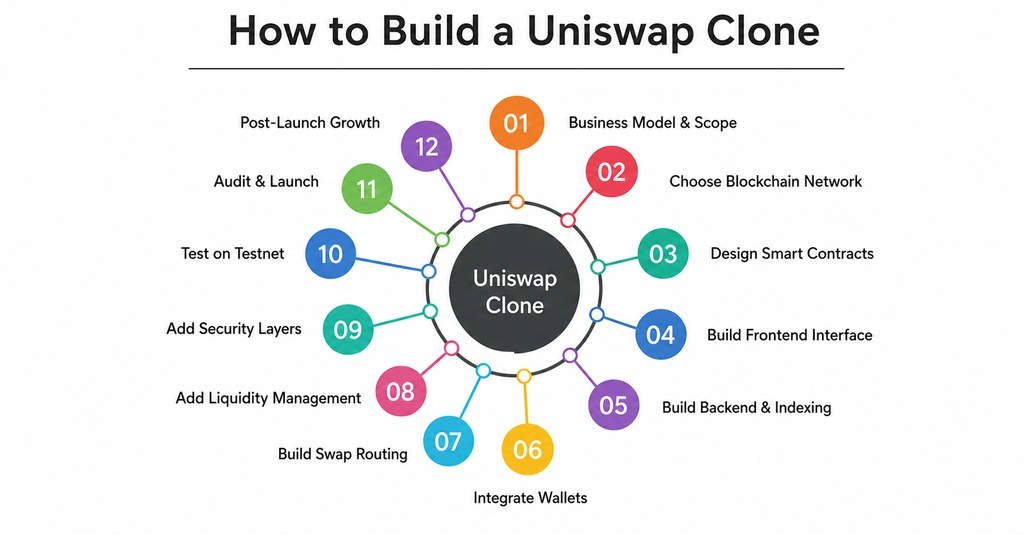
Step 1: Define Business Model and Scope
Start with a clear product scope. Decide whether you want a simple AMM, a v2-style DEX, a v3-style concentrated liquidity DEX, a v4-inspired programmable liquidity platform, or a full multichain DEX aggregator.
Define supported chains, tokens, fee model, target audience, compliance approach, liquidity strategy, and launch geography.
Step 2: Choose Blockchain Network
Most Uniswap-like apps are built on EVM-compatible blockchains because Ethereum tooling is mature. You can choose Ethereum for security and liquidity, or Layer 2 networks for lower fees. You may also build on BNB Chain, Polygon, Arbitrum, Base, Optimism, Avalanche, or a custom appchain.
Step 3: Design Smart Contracts
Smart contracts are the foundation. You need contracts for the factory, pools, router, liquidity positions, fee management, governance, token approvals, and possibly farming or staking.
For a basic AMM, the pool contract manages reserves and swaps. For concentrated liquidity, contracts must support ticks, ranges, position NFTs or accounting tokens, and complex fee distribution.
Step 4: Build Frontend Interface
The frontend should include swap, pool, positions, token import, charts, transaction history, settings, wallet connection, and network switching. The design must be simple because DeFi already feels complex to new users.
Step 5: Build Backend and Indexing
Although swaps happen on-chain, your app still needs backend infrastructure for speed and usability. This includes token metadata, charts, analytics, APY calculation, pool search, transaction indexing, routing quotes, notifications, and admin controls.
Step 6: Integrate Wallets
Integrate MetaMask, WalletConnect, Coinbase Wallet, Trust Wallet, Rabby, and mobile wallets. For advanced UX, add smart wallet support, passkey-based onboarding, or account abstraction.
Step 7: Build Swap Routing
Routing determines the best path for a trade. A swap from Token A to Token C may go directly through A/C or indirectly through A/ETH/C or A/USDC/C. A good router compares routes and chooses the one with the best expected output after price impact and gas.
Step 8: Add Liquidity Management
Liquidity providers need an intuitive dashboard. Show pool share, active/inactive status, earned fees, impermanent loss indicators, APY, deposit ratio, and range status.
Step 9: Add Security Layers
Security is not optional. Add smart-contract audits, formal verification for critical contracts, bug bounty programs, rate monitoring, token risk checks, frontend domain protection, wallet-drain protection, and transaction simulation.
Step 10: Test on Testnet
Before mainnet launch, deploy to testnets and run swap, liquidity, approval, fee, edge-case, and gas tests. Simulate high-volume trading, low-liquidity pools, failed transactions, malicious tokens, and high-slippage trades.
Step 11: Audit and Launch
A professional audit is essential before mainnet deployment. After audit fixes, deploy contracts, verify code on block explorers, prepare documentation, publish risk disclosures, launch liquidity incentives, and monitor the system closely.
Step 12: Post-Launch Growth
After launch, focus on liquidity, integrations, token partnerships, market-making programs, community growth, analytics, API access, and new chain expansion.
Team Structure Required to Develop an App Like Uniswap
A strong Uniswap clone project needs a specialized team:
- Product Manager: Defines product scope, feature priorities, market strategy, and launch roadmap.
- Blockchain Architect: Designs the smart-contract architecture, chain strategy, security assumptions, and protocol logic.
- Smart Contract Developers: Build AMM pools, routers, liquidity logic, fee systems, staking, governance, and upgrade-safe modules.
- Frontend Developers: Build the user-facing Web3 app using frameworks like React, Next.js, Wagmi, Viem, and Ethers.
- Backend Developers: Build indexing services, APIs, caching, analytics, event processing, token metadata systems, and notification infrastructure.
- UI/UX Designer: Creates simple flows for swaps, liquidity, portfolio, slippage, risk warnings, and mobile responsiveness.
- QA Engineers: Test contracts, frontend, backend, wallet behavior, network switching, transaction failures, and edge cases.
- DevOps Engineer: Manages deployment pipelines, nodes, RPC providers, monitoring, hosting, uptime, logs, and security alerts.
- Security Auditor: Reviews smart contracts, frontend risks, wallet flows, backend APIs, and infrastructure vulnerabilities.
- Compliance/Legal Advisor: Reviews jurisdictional risk, token listing policy, user disclosures, privacy rules, and licensing considerations.
- Marketing and Community Team: Handles launch campaigns, liquidity programs, social media, documentation, partnerships, and user education.
Best Monetization Models for Developing an App Like Uniswap
1. Swap Fee Share
You can charge a small interface fee or protocol fee on swaps. This must be transparent and competitive because traders compare total execution cost.
2. Liquidity Provider Fee Model
Liquidity providers earn trading fees. The platform may take a protocol-level fee if built into the smart contracts and disclosed clearly.
3. Token Launchpad Fees
Projects can pay fees to launch pools, run auctions, create token sales, or bootstrap liquidity through your platform.
4. Premium API Access
Offer paid API plans for wallets, trading bots, analytics platforms, institutional dashboards, and aggregators.
5. White-Label DEX Licensing
If your DEX technology is strong, you can license it to other projects, chains, communities, or enterprises.
6. Listing and Verification Services
You can charge for enhanced token verification, but avoid pay-to-list models that damage trust. Use strict risk checks.
7. Staking and Farming Modules
Revenue can come from farming program setup, partner incentives, liquidity mining campaigns, and token reward management.
8. Cross-Chain Swap Fees
If your app integrates bridges or solver networks, you can charge a routing or convenience fee.
9. Institutional Tools
Offer advanced dashboards for funds, market makers, token teams, and liquidity managers.
10. Governance Token Utility
A governance token can support voting, incentives, fee discounts, staking, rewards, and ecosystem participation. However, token design must be handled carefully from a legal and economic perspective.
Key Challenges to Uniswap Clone Development
- Liquidity. A DEX without liquidity cannot offer good prices. You need liquidity incentives, market-maker partnerships, token partnerships, and strong launch campaigns.
- Security. Smart-contract bugs can be extremely costly. Audits, testing, and conservative design are critical.
- UX. Many users still find DeFi difficult. A successful clone should simplify approvals, gas, slippage, token warnings, and cross-chain movement.
- Regulation. DeFi rules are evolving across jurisdictions. You need legal guidance before launching trading, token, or fee features.
- Competition. The market already includes major DEXs, aggregators, wallets, and chain-native exchanges. Your app needs a clear niche, such as lower fees, better UX, a specific chain, advanced LP tools, launchpad features, or community-focused liquidity.
Conclusion
Uniswap clone development can be a strong business opportunity, but it requires more than copying a swap screen. A successful DEX needs secure smart contracts, efficient routing, reliable liquidity, clean UX, multichain support, token risk controls, analytics, and a strong growth strategy.
The market opportunity is significant. DeFi has tens of billions in market capitalization and TVL; DEXs process billions in daily volume, and research firms forecast strong long-term growth. At the same time, the space is competitive and risky. Users expect fast swaps, low fees, safe token warnings, portfolio tools, and cross-chain convenience.
If you are building a Uniswap-like product today, start with a secure MVP: wallet connection, swaps, liquidity pools, slippage control, transaction history, analytics, and admin controls. Then expand into concentrated liquidity, smart wallets, gasless swaps, cross-chain routes, hooks, launchpad tools, and institutional-grade analytics.
The best Uniswap clone will not simply imitate Uniswap. It will take the proven AMM model and improve it for a specific audience, chain, region, asset class, or trading experience.
FAQs
1. What is a Uniswap clone?
A Uniswap clone is a decentralized exchange app inspired by Uniswap’s AMM model. It allows users to connect wallets, swap tokens, create liquidity pools, provide liquidity, and earn trading fees without relying on a centralized exchange.
2. How much does it cost to develop a Uniswap clone?
The cost depends on the scope. A basic AMM DEX may cost less than a v3-style concentrated liquidity platform or a multichain DEX aggregator. Major cost factors include smart-contract complexity, frontend design, backend indexing, chain support, audits, wallet integration, and advanced features like gasless swaps or cross-chain routing.
3. How long does it take to build a Uniswap-like app?
A basic MVP can take a few months, while a secure, audited, production-grade DEX with advanced liquidity, analytics, and multichain support can take much longer. Smart-contract audits and liquidity planning should not be rushed.
4. Is a Uniswap clone safe?
It can be safe if developed with secure smart contracts, professional audits, testing, monitoring, token risk checks, and clear user warnings. However, DeFi always carries risks such as smart-contract bugs, volatile assets, scam tokens, impermanent loss, and regulatory uncertainty.
5. What is the best way to monetize a Uniswap clone?
Common monetization methods include swap fees, protocol fees, launchpad fees, API subscriptions, cross-chain routing fees, premium analytics, white-label licensing, and institutional tools. The best model depends on your target users, liquidity strategy, and legal structure.