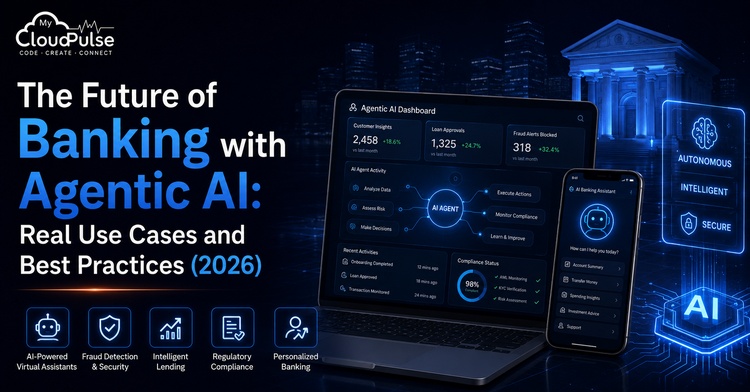
Artificial Intelligence (AI) has already transformed banking through chatbots, fraud detection systems, credit scoring, and personalized recommendations. However, the financial industry is now entering a new era powered by Agentic AI—AI systems capable of independently planning, reasoning, making decisions, and completing complex tasks with minimal human intervention.
Unlike traditional AI models that simply respond to prompts or execute predefined workflows, Agentic AI can understand objectives, create execution plans, interact with multiple systems, learn from outcomes, and continuously optimize decisions. This capability is revolutionizing banking operations by enabling intelligent automation across customer service, lending, compliance, investment management, fraud prevention, and back-office operations.
Banks worldwide are investing heavily in AI-driven automation to reduce operational costs, improve customer satisfaction, enhance regulatory compliance, and deliver highly personalized financial experiences.
Understanding Agentic AI in Banking
Agentic AI in banking refers to the use of autonomous AI agents that can understand objectives, make decisions, plan multi-step workflows, and execute complex banking tasks with minimal human intervention. Unlike traditional AI systems that require predefined rules or constant user prompts, Agentic AI can reason through problems, interact with multiple banking systems, and adapt its actions based on real-time data and business goals.
In simple terms, Agentic AI acts like a digital banking employee rather than just a chatbot or automation tool. It can independently complete tasks such as verifying customer identities, processing loan applications, monitoring suspicious transactions, generating compliance reports, or assisting financial advisors while escalating only high-risk or exceptional cases to human experts.
How Agentic AI Differs from Traditional AI
Traditional AI is designed to perform specific tasks, such as answering customer queries, recommending products, or detecting anomalies based on predefined rules. Agentic AI goes a step further by combining large language models (LLMs), machine learning, reasoning engines, memory, and workflow automation to achieve broader business objectives.
For example:
- Traditional AI: A chatbot answers a customer’s question about their account balance.
- Agentic AI: An AI agent verifies the customer’s identity, checks account details, identifies unusual transactions, blocks a compromised debit card if fraud is detected, initiates a replacement card request, and sends a confirmation—all within a single automated workflow.
Current Market Perspective of Agentic AI in the Banking Sector
Major financial institutions such as JPMorgan Chase, HSBC, Bank of America, Morgan Stanley, Citi, UBS, and BNY are expanding AI from pilot projects into enterprise-scale deployments. Banks are integrating AI agents into customer service, wealth management, treasury operations, trading, and compliance while maintaining human oversight for high-risk decisions.
Industry analysts describe 2026 as the year Agentic AI moves from experimentation to enterprise adoption, with AI becoming a strategic operating layer rather than just another digital tool.
Why Banks Are Rapidly Adopting Agentic AI in 2026
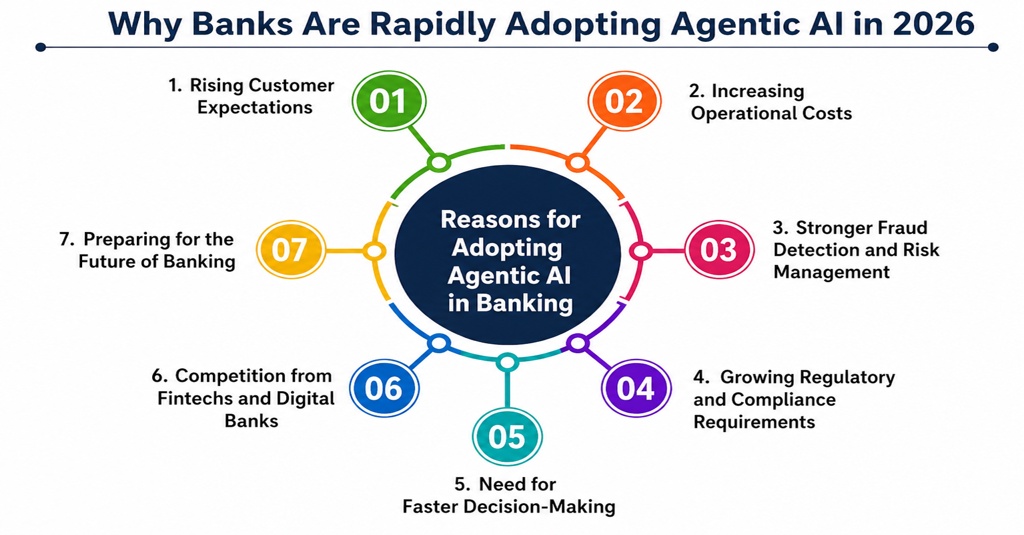
The banking industry is undergoing a major transformation as financial institutions move beyond traditional automation and Generative AI toward Agentic AI intelligent systems capable of planning, reasoning, and executing complex tasks autonomously. In 2026, banks are under increasing pressure to deliver faster services, reduce operational costs, strengthen security, and meet evolving customer expectations. Agentic AI helps address these challenges by enabling end-to-end automation while maintaining human oversight for critical decisions.
1. Rising Customer Expectations
Today’s customers expect banking services to be available 24/7, with instant responses, personalized recommendations, and seamless digital experiences. Whether applying for a loan, opening an account, or resolving a payment issue, customers want quick and frictionless interactions. Agentic AI enables banks to provide intelligent, always-on support by handling complex customer requests, automating service workflows, and delivering personalized financial guidance in real time.
2. Increasing Operational Costs
Banks continue to face growing operational expenses due to manual processes, compliance requirements, and rising service demands. Agentic AI helps reduce these costs by automating repetitive and time-consuming tasks such as document verification, loan processing, customer onboarding, transaction monitoring, and report generation. This allows employees to focus on higher-value activities such as customer relationship management and strategic decision-making.
3. Stronger Fraud Detection and Risk Management
As digital banking and online payments continue to grow, financial fraud has become more sophisticated. Traditional fraud detection systems often rely on predefined rules, making them less effective against emerging threats. Agentic AI continuously monitors customer behavior, transaction patterns, and potential risks in real time. It can investigate suspicious activities, recommend preventive actions, and escalate high-risk cases to fraud analysts, helping banks minimize financial losses and improve security.
4. Growing Regulatory and Compliance Requirements
Banks operate in a highly regulated environment and must comply with requirements related to Anti-Money Laundering (AML), Know Your Customer (KYC), data privacy, and financial reporting. Agentic AI can automate compliance monitoring, analyze regulatory changes, verify customer information, generate audit-ready reports, and identify potential compliance risks. This reduces manual effort while improving accuracy and ensuring regulatory adherence.
5. Need for Faster Decision-Making
Modern banking requires rapid decisions across lending, customer service, and risk management. Agentic AI can analyze large volumes of structured and unstructured data, evaluate multiple scenarios, and recommend the best course of action within seconds. This enables faster loan approvals, quicker dispute resolution, and more informed business decisions without compromising accuracy.
6. Competition from Fintechs and Digital Banks
Digital-first banks and fintech companies are raising the standard for customer experience by offering instant, AI-powered financial services. To remain competitive, traditional banks are investing in Agentic AI to modernize their operations, improve digital services, and deliver highly personalized customer experiences. Autonomous AI agents help banks innovate faster while maintaining the trust and security expected from established financial institutions.
7. Preparing for the Future of Banking
Agentic AI is more than an automation tool, it is becoming a strategic technology that supports intelligent decision-making across the entire banking ecosystem. By integrating autonomous AI agents into customer service, lending, fraud prevention, compliance, and wealth management, banks can improve operational efficiency, enhance customer satisfaction, and build more resilient, future-ready financial services.
Key Statistics Driving Agentic AI Adoption
- More than 80% of global organizations have deployed Generative AI or Agentic AI in at least one business function, demonstrating that AI has moved beyond experimentation into enterprise-wide implementation.
- According to McKinsey’s Global Banking Annual Review 2026, AI adoption is occurring much faster than previous digital technologies. Banks now have an estimated 2–3 years to establish competitive AI capabilities, compared with the 5–10 years organizations previously had to adapt to major technology shifts.
- A Deloitte survey found that 80.5% of finance and accounting professionals believe AI agents will become standard workplace tools within the next five years, while 14.8% expect mainstream adoption within the next 12 months.
- 42.7% of finance professionals identified improved productivity and operational efficiency as the primary benefit of Agentic AI, followed by enhanced analytics and improved decision accuracy.
- Consumer adoption is also increasing rapidly. McKinsey’s banking research found that 23% of consumers already use Generative AI for financial tasks at least once a month, including investment advice, product comparisons, and financial planning. This growing customer familiarity is encouraging banks to develop more advanced AI-powered financial services.
Real-World Applications of Agentic AI Transforming Modern Banking
As banks embrace digital transformation, Agentic AI is evolving from a productivity tool into a strategic business capability. Unlike traditional AI systems that automate isolated tasks, Agentic AI can independently plan, coordinate, and execute complex banking workflows across multiple departments. From customer onboarding to fraud prevention and wealth management, autonomous AI agents are helping financial institutions improve operational efficiency, enhance customer experiences, and make faster, data-driven decisions.
Below are the most impactful real-world applications of Agentic AI in the banking industry.
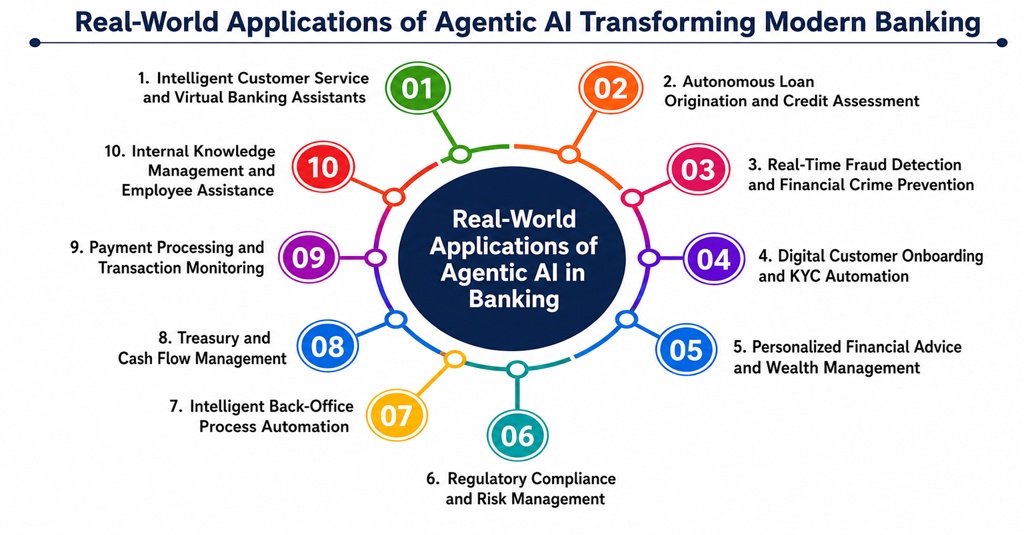
1. Intelligent Customer Service and Virtual Banking Assistants
Customer service has traditionally relied on chatbots that answer predefined questions. Agentic AI significantly enhances this experience by understanding customer intent, maintaining conversation context, and completing end-to-end service requests without requiring multiple interactions.
Key Benefits
- 24/7 personalized customer support
- Faster issue resolution
- Reduced call center workload
- Higher customer satisfaction
- Improved first-contact resolution rates
2. Autonomous Loan Origination and Credit Assessment
Loan processing is one of the most document-intensive banking operations. Agentic AI streamlines the entire lending process by collecting customer information, verifying documents, analyzing credit history, assessing risk, and recommending lending decisions.
Instead of manually reviewing applications, AI agents coordinate with credit bureaus, KYC providers, banking systems, and fraud detection platforms to complete loan evaluations in significantly less time.
AI Can Automate
- Customer onboarding
- Identity verification
- Income validation
- Credit scoring
- Risk analysis
- Loan eligibility assessment
- Document verification
- Loan approval recommendations
Business Impact
- Faster loan approvals
- Lower processing costs
- Reduced human error
- Improved customer experience
3. Real-Time Fraud Detection and Financial Crime Prevention
With digital transactions increasing every year, banks face growing risks from fraud, identity theft, phishing, and money laundering. Traditional fraud detection systems rely heavily on predefined rules, making them less effective against evolving attack patterns.
Agentic AI continuously analyzes customer behavior, transaction history, device information, and spending patterns to detect suspicious activities in real time. It can investigate anomalies, temporarily block suspicious transactions, notify customers, and escalate high-risk cases to fraud analysts.
Common Fraud Detection Applications
- Card fraud monitoring
- Account takeover detection
- Payment fraud prevention
- Identity theft detection
- Suspicious transaction monitoring
- AML investigations
4. Digital Customer Onboarding and KYC Automation
Customer onboarding is often delayed by manual verification processes. Agentic AI automates onboarding by coordinating identity verification, document validation, biometric authentication, sanctions screening, and risk assessment.
Customers can complete the entire onboarding journey digitally while AI agents validate information across multiple systems.
Automated Onboarding Tasks
- OCR document extraction
- Facial recognition
- Identity verification
- Address verification
- AML screening
- Risk scoring
- Account creation
Business Benefits
- Reduced onboarding time
- Improved regulatory compliance
- Better customer experience
- Lower operational costs
5. Personalized Financial Advice and Wealth Management
Agentic AI enables banks to deliver highly personalized financial services by continuously analyzing customer behavior, income, spending patterns, investment goals, and risk tolerance.
Instead of providing generic recommendations, AI agents generate tailored financial strategies and proactively notify customers about opportunities to save, invest, refinance loans, or optimize their portfolios.
Personalized Services Include
- Investment recommendations
- Retirement planning
- Savings strategies
- Portfolio monitoring
- Insurance suggestions
- Budget planning
- Tax optimization insights
6. Regulatory Compliance and Risk Management
Banks operate under strict regulatory frameworks, making compliance one of the most resource-intensive functions. Agentic AI helps automate compliance workflows by monitoring transactions, identifying suspicious activities, generating audit reports, and tracking regulatory changes.
Rather than manually reviewing thousands of transactions, compliance teams receive prioritized alerts and actionable insights generated by AI agents.
Compliance Activities
- AML monitoring
- KYC verification
- Transaction surveillance
- Regulatory reporting
- Audit preparation
- Risk monitoring
- Policy compliance checks
Business Benefits
- Reduced compliance costs
- Improved reporting accuracy
- Faster audits
- Lower regulatory risk
7. Intelligent Back-Office Process Automation
Back-office operations involve repetitive administrative tasks that consume significant employee time. Agentic AI automates these workflows by coordinating information across departments and completing processes without constant supervision.
Examples
- Account reconciliation
- Invoice processing
- Report generation
- Document classification
- Payment verification
- Workflow approvals
- Customer record updates
Business Benefits
- Increased operational efficiency
- Lower administrative costs
- Reduced processing errors
- Higher employee productivity
8. Treasury and Cash Flow Management
Corporate banking divisions increasingly use Agentic AI to optimize liquidity and treasury operations. AI agents continuously monitor cash positions, forecast future cash flows, analyze market conditions, and recommend strategies to improve liquidity management.
Treasury Applications
- Cash flow forecasting
- Liquidity optimization
- Foreign exchange monitoring
- Investment planning
- Treasury reporting
- Working capital management
9. Payment Processing and Transaction Monitoring
Modern payment ecosystems process millions of transactions every day. Agentic AI improves payment efficiency by monitoring transaction status, identifying anomalies, resolving failures, and optimizing routing decisions.
AI Can Manage
- Cross-border payments
- Payment routing
- Settlement monitoring
- Failed payment recovery
- Real-time transaction analysis
- Digital wallet management
10. Internal Knowledge Management and Employee Assistance
Agentic AI also supports banking employees by acting as an intelligent internal assistant. It provides instant access to banking policies, compliance guidelines, product information, and operational procedures. Relationship managers, loan officers, and customer support representatives can receive real-time recommendations while serving customers.
Internal Applications
- Policy search
- Regulatory guidance
- Product recommendations
- Customer insights
- Case summaries
- Workflow assistance
- Automated documentation
Benefits
- Faster employee onboarding
- Improved decision-making
- Consistent customer service
- Reduced training time
Agentic AI in Action: Real-World Banking Use Cases
Banks around the world are rapidly moving beyond traditional AI chatbots and automation tools toward Agentic AI—intelligent AI systems that can reason, plan, and execute complex workflows with minimal human intervention. While many financial institutions are still in the early stages of enterprise deployment, several leading banks have already integrated AI-driven assistants and autonomous workflows into customer service, wealth management, compliance, fraud detection, and operational processes.
Here are some notable real-world examples of how leading banks are leveraging AI technologies that align with the principles of Agentic AI.
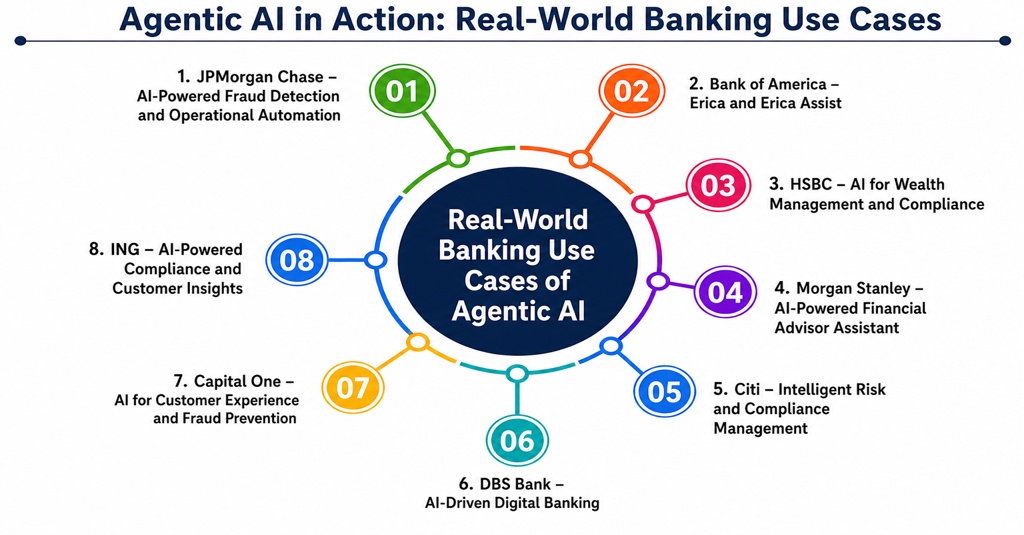
1. JPMorgan Chase – AI-Powered Fraud Detection and Operational Automation
As one of the world’s largest banks, JPMorgan Chase has invested heavily in artificial intelligence to improve fraud detection, automate internal operations, and enhance decision-making.
The bank uses AI to analyze millions of financial transactions in real time, identifying suspicious activities that traditional rule-based systems may overlook. It also applies AI to document processing, contract analysis, and risk management, helping employees complete complex tasks more efficiently.
2. Bank of America – Erica and Erica Assist
Bank of America has developed Erica, one of the most widely used AI-powered virtual financial assistants in the banking industry. Erica helps customers perform banking tasks such as checking account balances, transferring funds, paying bills, tracking spending, and receiving personalized financial insights.
In 2026, the bank expanded its AI capabilities through Erica Assist, an internal AI assistant that supports customer service representatives by retrieving information, summarizing customer interactions, and recommending solutions in real time.
3. HSBC – AI for Wealth Management and Compliance
HSBC is expanding AI across wealth management, digital banking, treasury operations, and compliance. The bank has established dedicated AI teams to develop intelligent solutions that improve customer advisory services and operational efficiency.
AI supports relationship managers by analyzing customer portfolios, identifying investment opportunities, monitoring financial risks, and delivering personalized wealth management recommendations.
4. Morgan Stanley – AI-Powered Financial Advisor Assistant
Morgan Stanley has integrated Generative AI and intelligent assistants into its wealth management division to help financial advisors quickly access research, internal knowledge, and investment insights.
Rather than replacing advisors, AI enhances their productivity by summarizing extensive financial documents, retrieving relevant market information, and supporting more informed client recommendations.
5. Citi – Intelligent Risk and Compliance Management
Citi is investing in AI to strengthen risk management, regulatory compliance, and operational resilience. Intelligent systems assist compliance teams by monitoring transactions, identifying unusual activities, generating reports, and supporting regulatory audits.
The bank also applies AI to automate routine operational processes while improving accuracy and reducing manual effort.
6. DBS Bank – AI-Driven Digital Banking
DBS Bank has become a leader in digital banking by embedding AI into customer service, lending, payment processing, and fraud prevention.
AI analyzes customer behavior to deliver personalized product recommendations, streamline digital onboarding, and improve the overall banking experience.
7. Capital One – AI for Customer Experience and Fraud Prevention
Capital One uses AI to improve customer service, detect fraud, and personalize banking experiences. Intelligent systems monitor customer transactions, identify unusual spending patterns, and provide proactive alerts to protect customer accounts.
The bank also uses AI to enhance digital assistants that help customers manage finances and perform everyday banking tasks.
8. ING – AI-Powered Compliance and Customer Insights
ING leverages AI to automate compliance checks, improve customer analytics, and enhance operational decision-making.
Its AI systems analyze customer data, identify financial risks, and support compliance teams in detecting suspicious activities while improving customer personalization.
Common Agentic AI Adoption Trends Across Leading Banks
Although implementation strategies differ, most leading financial institutions are adopting Agentic AI in similar areas:
| Banking Function | Agentic AI Application |
| Customer Service | AI assistants, automated issue resolution |
| Lending | Intelligent loan processing and credit assessment |
| Fraud Detection | Real-time transaction monitoring and anomaly detection |
| Compliance | AML, KYC, audit reporting, regulatory monitoring |
| Wealth Management | Personalized investment recommendations |
| Operations | Workflow automation and document processing |
| Treasury | Cash flow forecasting and liquidity management |
| Employee Productivity | Internal AI assistants and knowledge management |
Conclusion
Agentic AI is redefining the future of banking by enabling financial institutions to move beyond task-based automation toward intelligent, autonomous decision-making. Unlike traditional AI systems that focus on isolated processes, Agentic AI can understand business objectives, coordinate multiple systems, and execute end-to-end banking workflows with minimal human intervention. From customer onboarding and loan processing to fraud detection, compliance management, and personalized wealth advisory, Agentic AI is helping banks improve efficiency, reduce operational costs, strengthen security, and deliver superior customer experiences.
As highlighted throughout this guide, leading financial institutions such as JPMorgan Chase, Bank of America, HSBC, Morgan Stanley, Citi, DBS Bank, Capital One, and ING are already investing in AI-powered solutions to modernize banking operations. With increasing regulatory requirements, growing competition from digital-first banks, and rising customer expectations for faster and more personalized services, Agentic AI is rapidly becoming a strategic necessity rather than an optional technology.
However, successful adoption requires more than implementing advanced AI models. Banks must establish robust AI governance frameworks, ensure regulatory compliance, maintain data privacy, and keep human oversight for high-risk financial decisions. By combining autonomous AI capabilities with strong security, transparency, and responsible AI practices, financial institutions can build trusted, scalable, and future-ready banking ecosystems.
Looking ahead, Agentic AI is expected to become the foundation of next-generation banking, empowering institutions to operate more intelligently, respond more quickly to market changes, and deliver innovative financial services that meet the evolving needs of customers. Banks that embrace this transformation today will be better positioned to remain competitive and lead the future of digital banking.
Frequently Asked Questions (FAQs)
Que 1: What is Agentic AI in banking?
Answer 1: Agentic AI in banking refers to autonomous AI systems that can independently plan, reason, make decisions, and execute complex banking workflows with minimal human intervention. Unlike traditional AI or chatbots, Agentic AI can coordinate multiple banking systems to automate processes such as loan approvals, fraud detection, compliance monitoring, and customer service.
Que 2: How is Agentic AI different from Generative AI?
Answer 2: Generative AI primarily focuses on creating content, answering questions, or assisting users through conversations. Agentic AI goes a step further by combining reasoning, planning, memory, and workflow automation to independently complete business tasks. In banking, an Agentic AI system can verify customer information, analyze risk, initiate transactions, and complete end-to-end workflows instead of simply responding to prompts.
Que 3: What are the key use cases of Agentic AI in banking?
Answer 3: Some of the most common applications of Agentic AI in banking include:
- Intelligent customer service and virtual banking assistants
- Automated loan origination and credit assessment
- Fraud detection and financial crime prevention
- Digital customer onboarding and KYC verification
- Regulatory compliance and AML monitoring
- Personalized wealth management and financial advisory
- Treasury and cash flow management
- Back-office workflow automation
- Payment processing and transaction monitoring
Que 4: What are the benefits of implementing Agentic AI in banks?
Answer 4: Agentic AI offers several advantages for financial institutions, including:
- Faster customer service and loan approvals
- Reduced operational costs through intelligent automation
- Improved fraud detection and cybersecurity
- Enhanced regulatory compliance and risk management
- Personalized banking experiences
- Higher employee productivity
- Better decision-making using real-time data and analytics
- Scalable operations that support business growth
Que 5: What challenges should banks consider before adopting Agentic AI?
Answer 5: While Agentic AI provides significant business value, banks should address several implementation challenges, including:
- Protecting sensitive customer data and ensuring cybersecurity
- Meeting regulatory and compliance requirements
- Integrating AI with legacy banking systems
- Maintaining transparency and explainability in AI-driven decisions
- Establishing strong AI governance and human oversight
- Managing ethical considerations and reducing AI bias