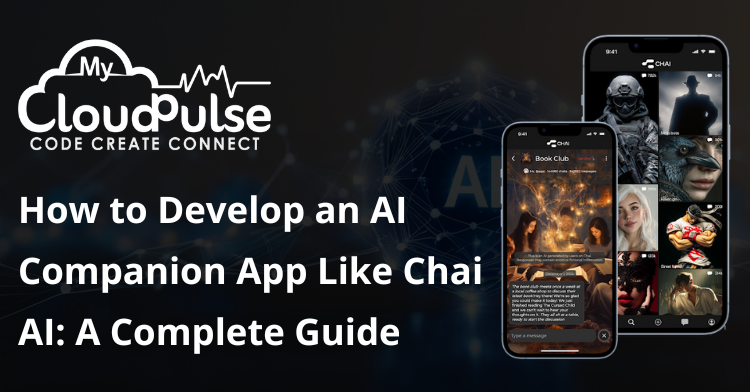
Our ability to interact socially, professionally, and emotionally has all been profoundly altered by AI. One of the most rapidly expanding subsets of these breakthroughs is the use of artificial intelligence in companion apps. New types of virtual companionship have emerged with the rise of platforms like Chai AI, Linky AI, and others that function as AI friends. These platforms provide users with a safe space to communicate, vent, explore fantasies, role-play, or just seek emotional solace whenever and wherever they need it. For encounters that feel genuinely natural and intimate, these apps combine conversational AI, memory systems, emotional intelligence, and persona design. As more creators and businesses aim to develop an app like Chai AI, the focus is shifting toward building immersive, always-available digital companions that understand users deeply and respond with human-like empathy and intelligence.
Integrating a sophisticated model is just the beginning of what is required to Develop an App Like Chai AI. It calls for a methodical strategy for user retention, long-term evolution, safety features, conversation design, backend architecture, and user psychology. If you want to create an AI companion platform from the ground up, this book will show you how to do it in every step: ideation, design, development, launch, and scalability.
Understanding the AI Companion App Landscape
At once chatbot, friend, and emotional outlet—that is the unusual juncture that AI companion apps occupy. They have more than just practical uses. Users aren’t looking for automated processes or fast factual replies. They are seeking a human presence, connection, and empathy.
Emotional intelligence, memory, personality diversity, and constant accessibility are the hallmarks of top companion apps. Instead of one-time encounters, these platforms develop lasting bonds with users by learning their tastes, bringing up previous discussions, and changing as needed. In order to create an engaging companion app, it is crucial to recreate this feeling of continuity.
What Makes Chai AI–style Apps Unique
What gives apps like Chai AI their power and addictiveness is a careful blend of features, design choices, and emotional intelligence. Some of the standout traits you should aim to replicate:
• Emotional awareness and empathy. Unlike standard chatbots that deliver mechanical responses, companion apps respond with warmth, understanding, and emotional nuance. They don’t just answer — they comfort, empathize, joke, console, and adapt.
• Memory-driven personalization. Over time, the AI remembers user details — preferences, stories, moods — to make future conversations more meaningful and personal. This continuity transforms AI from a tool into a companion.
• Diverse personalities & role-playing potential. Users can choose from multiple personas (sweet, serious, playful, romantic, humorous, fantasy-based), or even craft custom characters. This choice and flexibility deepen engagement.
• Voice and human-like communication. Text chats are good — but voice interactions bring another layer of realism. With expressive tone, pacing, and emotional inflection, voice makes the AI feel more alive and present.
• Safety and ethical interaction boundaries. These apps balance emotional depth with responsible safeguards. Content filtering, moderation, and user control ensure interactions remain healthy and respectful.
• Seamless UI/UX and emotional immersion. From warm colors and soft animations to intuitive chat flows and minimal friction, the user interface is crafted to encourage comfort, trust, and a sense of companionship.
Core Pillars to Develop an App Like Chai AI
Develop an App Like Chai AI, you need to develop core pillars technical, emotional, and structural that together create a robust, engaging experience.
Conversational Engine & Language Model Integration
The conversational engine is robust and located at the heart. Customise models for conversation driven by personality traits, or make use of pre-existing Large Language Models (LLMs) like GPT, Claude, or LLaMA. The engine needs to be able to handle natural-sounding dialogue without altering the tone. A common component of well-designed conversational architecture is:
- Custom persona prompts
- Emotional tone control
- Handling open-ended dialogues
- Safe fallback responses
Building such an engine involves prompt engineering, dataset preparation, tuning for empathy, and rigorous evaluation for consistency and safety.
Personality Frameworks & AI Characters
Creating believable AI characters requires more than a simple template. Each persona should have a defined emotional profile, tone, speech style, behavioral tendencies, and even a backstory. This “personality matrix” ensures that the AI remains consistent over long, often complex conversations. Well-designed personalities lead to higher user attachment.
Memory System — Short-Term and Long-Term
Memory transforms AI from stateless chatbot to evolving companion. The memory system can include:
- Short-term memory for the current session
- Long-term memory to remember user preferences, stories, emotional patterns
- Conditional recall logic (fetch memory only when relevant)
Balancing memory with privacy and ethical considerations is crucial. The system must protect user data while enabling personalization.
Emotion Detection & Adaptive Response
The AI needs to be able to detect and react to emotional signals, such as joy, grief, stress, and enthusiasm, in addition to remembering factual information. To better suit the user’s emotional state, an emotionally intelligent system modifies the volume, tempo, empathy level, and content. The companion feels more alive, supportive, and human with this additional layer of emotional intelligence.
Voice Interaction & Audio Emotion Layers
Voice transforms the interaction from reading text to having a real conversation. Integrating speech-to-text (STT) and text-to-speech (TTS) with emotional voice synthesis adds depth — warmth, hesitation, excitement — to the dialogue. Multiple voice options and expressive voice models enhance immersion and help users bond emotionally.
Safety & Moderation Layers
Feeling secure is vital, even more so than having profound feelings. The platform needs robust regulations for content filtering and moderation, limits for romantic relationships, crisis detection for themes like self-harm, and the ability for users to manage their own data and memory. Maintaining user confidence and safety is the goal of ethical design and secure interaction standards.
Building the Architecture Technical Blueprint
A streamlined, extensible architecture is necessary for turning features into a functional product.
Use a microservices architecture for the backend to manage things like user identification, conversation routing, storing of memory, orchestration of AI models, processing of payments, analytics, and content moderation. For scalability and dependability, utilise cloud infrastructure.
If you want your front end to work on both Android and iOS, pick a framework like React Native or Flutter. Create an inviting, easy-to-navigate, and emotionally secure user interface. Create a soothing user experience with minimal design, easy navigation, and fluid animations.
Scalable artificial intelligence companion apps adhere to privacy standards, store data securely, handle media (speech, avatars) seamlessly, and offer quick API calls.
Training, Testing & Refinement to Develop an App Like Chai AI
Just constructing the system is not enough. If you care about quality, safety, and emotional consistency, you must test and refine your product constantly.
Dialogue, emotional reaction, memory stability, and safety stress testing should all be performed several times throughout development to ensure the product is free of dangerous or edge cases. To remedy issues like boundary violations, tone drift, or hallucinations, implement feedback loops, and conduct user testing. Optimise memory recall, fine-tune language models, do A/B testing, and tweak persona prompts.
Continuous improvement, particularly following release, guarantees that the AI adapts to user demands while preserving its authenticity.
Launch Strategy & Onboarding Bringing Users In
A well-planned launch and user onboarding process that swiftly establishes trust are essential for an excellent AI companion app. An individual’s first impression is crucial.
To get a feel for things, try a restricted beta group or soft launch first. A few well-developed AI avatars, an easy-to-understand onboarding process, and transparent privacy and security warnings would be great. Facilitate relaxed and welcoming initial conversations. Instructions on how to communicate, control memory, and personalise a buddy are provided.
Building trust and reducing drop-offs are achieved through a seamless onboarding process. Promote early input and make iterations prior to releasing to the public.
Growth, Monetization & Community Engagement
Both monetization and community strategies are essential for an app’s long-term viability.
The following methods of generating revenue work well together:
- Plans that allow you to speak endlessly and access premium features
- Character packs, voice skins, and memory boosters are all available as in-app purchases.
- Credits for phone calls or premium voice modes to make more money
- Personality marketplace where artists and users can trade and sell one-of-a-kind characters
Encourage referrals, hold themed events, introduce new personalities frequently, and support the sharing of conversation snippets (with user consent) to build community and speed up the virality process.
A combination of daily check-ins, memory reminders, evolving conversations, and fresh content keeps users coming back, which in turn relies on emotional loyalty to retain users over the long run.
Long-Term Maintenance & Evolution Growing with Your Users
A virtual assistant is not a finished good. As its user base expands and expectations change, it will need to change as well.
Make it better and better over time by adding new features like deeper memories, more realistic emotions, faster responses, higher-quality voices, stronger safety filters, updated user interfaces and user experiences, and more character libraries.
The evolution roadmap should be shaped by ongoing community engagement, analytics, and input from users. The platform maintains its relevance, safety, and emotional resonance through constant adaptation.
Final Thoughts
A multi-faceted problem combining technology, empathy, design, psychology, and user experience, building an AI companion app such as Chai AI is no easy feat. When developed with care, this kind of app has the potential to provide users with meaningful and responsible companionship, emotional support, inspiration, and solace.
We are seeing a promising future for AI friendship. Future AI companions will be more intuitive, emotionally intelligent, and personally engaging than ever before as advancements in language models, speech synthesis, memory systems, and emotional AI bring about a new level of human-likeness.
An app may become more than simply software a confidant, a trusted friend, and a source of emotional well-being—for people around the world if it is built with care, respect, and a thorough understanding of user psychology.

An AI companion app is a conversational tool powered by LLMs that interacts like a virtual friend, assistant, or partner with personalized and emotionally aware responses.
A basic version takes around 6–10 weeks, while a full-featured app may take 4–6 months depending on complexity.
Not necessarily. You can use APIs like OpenAI or Anthropic, and later switch to your own model to reduce costs and add customization.
An MVP can cost $10,000–$50,000, while an advanced app ranges between $80,000–$250,000.
Common methods include subscriptions, premium personalities, voice chat minutes, and in-app purchases.