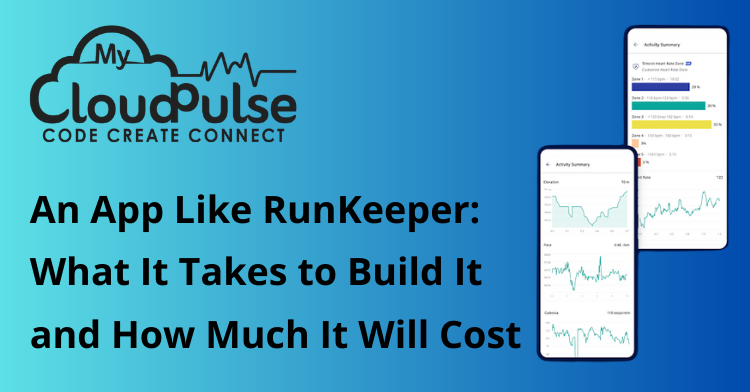
Many people’s perspectives on health, fitness, and wellness have shifted due to the digital fitness revolution. Technologies such as GPS tracking, artificial intelligence (AI), wearable integrations, and cloud computing now power activities that were once recorded manually using notebooks or basic pedometers. At the center of this transformation are fitness tracking applications, with RunKeeper standing out as one of the most established and widely used platforms. As a result, businesses and startups are increasingly looking to develop an app like RunKeeper to meet the growing demand for smart, data-driven fitness and wellness solutions.
A running app is not all that RunKeeper is. It is an all-inclusive fitness companion that provides data-driven insights to help users monitor their activity, evaluate their progress, establish objectives, and maintain motivation. Its success provides a road map for startups and companies looking to get into the fitness tech industry.
This comprehensive guide will go over everything you need to know to build a fitness app similar to RunKeeper, including:
• Potential customers and the reasoning behind the app’s creation
• Main features and advanced functionality
• The app’s architecture and technology stack
• The steps to take during development
• How to break down costs and make money from the app
• What trends will shape the fitness app industry in the future
1. An Overview of Fitness Tracking Apps’ Historical Development
There has been tremendous expansion in the health and fitness market around the world in the last several years. Millions of people are turning to digital fitness solutions due to the growing number of people concerned about lifestyle-related health problems, the widespread availability of smartphones, and the popularity of wearable technology.
Nowadays, fitness apps have more than one function:
• Activity tracking
• tailored exercise advice
• insights supported by data
• social involvement to boost motivation
By providing a simple interface that combined GPS-based activity tracking with real-time feedback and long-term progress analysis, apps like RunKeeper revolutionized fitness tracking.
Fitness applications offer a unique opportunity for businesses to boost engagement, generate recurring revenue, and foster strong brand loyalty. A lifestyle-driven digital ecosystem can be built through the development of an app like RunKeeper, which is more than just a technology undertaking.
2. The Keys to RunKeeper’s Success: A Comprehensive Overview
It is critical to comprehend the reasons behind RunKeeper’s success before developing a comparable app.
Proposition of Essential Value
Users are helped by RunKeeper:
Use GPS and other sensors to
• Keep tabs on your running, walking, and cycling progress
• Evaluate your performance
• Be consistent with your training and your objectives.
• Show how things have changed throughout time
The RunKeeper Process
1. To monitor motion, the app makes use of both GPS and motion sensors.
2. Data is processed in order to determine calories, pace, distance, and speed.
3. In the cloud, the results are safely kept.
4. The benefit of analytics is that they provide insights from raw data.
5. Users are provided with both immediate feedback and reports on their progress over time.
The Reasons RunKeeper Is So Popular Among Users
• Precise Tracking
• Tailored Guidance
• Inspiration from Others in the Community
3. Why Develop an App Like RunKeeper?
3.1 Growing Opportunities in the Market
Rising health consciousness, the rise of remote and hybrid work cultures, and the adoption of smart wearables are driving forces behind the fast expansion of the worldwide fitness app market.
3.2 Strong Customer Engagement and Persistence
Strong user habits and long-term retention are created when fitness apps are used regularly or weekly.
3.3 Models for Revenue Scalability
The scalability of fitness apps is greatly enhanced by their premium features, subscription-based revenue, and corporate partnerships.
3.4 Internet of Things—Wearable Integration
Connectivity to smartwatches and health trackers opens up new possibilities for fitness app data collecting.
3.5 Customization Based on Data
Customer happiness and loyalty are boosted by hyper-personalized experiences made possible by user data.
4. Essential Functions of a RunKeeper-Style App
4.1 Creating an Account and Managing Your Profile
• A user’s contact information (email, phone, social media)
• Their demographic information (age, weight, height)
• Their preferred activities and their fitness objectives
4.2 Activity Tracking Through GPS
The app would not function without this.
• Tracking of speed and elevation
• Distance and pace calculations
• Real-time route charting
Here, precision and saving power are of the utmost importance.
4.3 Real-Time Exercise Dashboard
• Audio cues for milestones
• The ability to pause and resume the game
• Display of statistics in real-time
4.4 Activity Logs and Analytics
• Daily weekly
• monthly reports
• Trend analysis Individual files and achievements
4.5 Plans for Training and Goal Setting
• goals that are based on time or distance structured programs that are based on performance
• adaptive plans that are 5K, 10K, or marathon in length
• Features that foster social interaction and community
4.6 Friends, followers
• activity sharing
• challenges
• leaderboards
4.7 Reminders and Notifications
• Messages to motivate you
• Progress updates on your goals
• Reminders to work out
4.8 Connecting Wearables
• Auto-syncing data
• Fitbit, Garmin
• Apple Watch, Wear OS
4.9 Offline Mode
• Keep records even when you don’t have internet access
• Sync information at a later time
4.10 Dashboard for Administrators
• User administration
• Control of content and training plans
• Reporting and analytics
5. Superior Functions for Distinguishing Yourself from the Competition
5.1 AI-Powered Coaching
• Generating customized training plans
• Predicting how well you will perform
• Suggesting smart ways to relax
5.2 Voice Coaching
• Audible comments in real time
• Phrases to inspire
5.3 Discovering Routes
• Locally popular routes
• Insights into difficulty and elevation
5.4 Nutrition Monitoring
• Calorie recording
• Recommendations for meals
5.5 Gamification
• Badges and prizes
• Achievements and streaks
6. A Tech Stack for Develop an App Like RunKeeper
• Swift for iOS
• Kotlin for Android
• Flutter or React Native for cross-platform development
• Backend development
• Databases with REST or Graph QL APIs
• PostgreSQL or MySQL for structured data
• MongoDB for activity logs
Using a GPS with maps
APIs for health and wearables, scalable storage and computation, Apple HealthKit, Google Fit, Map box, Amazon Web Services (AWS), Microsoft Azure, Google Cloud, or Google Cloud, AI and analytics, Python-based machine learning models, TensorFlow, or pytorch
7. The Steps in Creating an App
7.1 Planning and Research for the Market
• Find out who you’re making it for
• check out what the competition has to offer
•figure out what makes your product stand out.
7.2 User experience and interface design
• Making use of wireframes and prototypes
• Making sure that accessibility is a top priority
7.3 Minimum Viable Product Development
• Essential tracking capabilities
• Foundational analytics
• Robust backend
7.4 Quality Assurance and Testing
• Verifying location and accuracy using GPS
• Evaluating system performance and security
7.5: Implementation and Upkeep
• We will launch in the App Store and the Play Store.
• We will continuously update.
• We will integrate user feedback.
8. RunKeeper-Style App Development Costs
8.1 App Complexity-Related Cost Breakdown
Basic GPS tracking, activity history, and simple statistics are all included of the MVP version.
Price range: $40,000 to $70,000
Mid-Level App
• Enhanced analytics
• Built-in support for wearable devices
• Social media integration
Price Range: $80,000 to $150,000 App with All the Features
Artificial intelligence (AI) coaching, nutrition tracking, gamification, and sync across devices
Price: $180,000 to $300,000 and up
8.2 Elements Platform count
• feature complexity
• team location
• third-party integrations are all factors that might affect costs.
9. Strategies for Monetization
• A freemium approach
• Sponsored challenges
• In-app purchases of training plans
• Corporate wellness initiatives
• Monthly and yearly subscriptions
10. Development Obstacles
• Accuracy and energy consumption of GPS
• Security and privacy of data
• Compatibility with wearables
• Retention of users
11. AI-Powered Customization
• Monitoring of mental well-being and recuperation
• Workouts using augmented reality
• More extensive integration of the internet of things
Conclusion
Constructing an app of RunKeeper’s caliber is a challenging yet gratifying undertaking. Accurate tracking, valuable information, and a frictionless user experience are the pillars upon which success rests. A fitness ecosystem similar to RunKeeper can develop into something far more robust with the correct combination of features, technology, and business model.
With more and more people turning to digital health records, this is a great moment to put money into fitness app development and create tools that motivate people to lead better, more active lives.

FAQs
The cost typically ranges from $60,000 to $200,000+, depending on features, platforms (iOS/Android), and integrations like GPS tracking and analytics.
Core features include GPS activity tracking, workout stats, goal setting, progress analytics, user profiles, and push notifications.
Common technologies include Swift/Kotlin or Flutter, GPS APIs, cloud platforms (AWS/GCP), wearable integrations, and analytics tools.
An MVP can take 3–5 months, while a full-featured app may require 6–9+ months.
They use freemium models, premium subscriptions, personalized coaching plans, and brand partnerships.